How much of a pay rise do you actually keep after tax?
A pay rise is taxed at your marginal rate — the rate that applies to the extra income, not your whole salary. For most UK employees that means you keep 72p of every extra £1: 20% income tax plus 8% National Insurance comes off the top.
| Pay rise (gross) | You keep (basic-rate earner) | Per month |
|---|---|---|
| £1,000 | £720 | £60 |
| £2,000 | £1,440 | £120 |
| £3,000 | £2,160 | £180 |
| £5,000 | £3,600 | £300 |
| £10,000 | £7,200 | £600 |
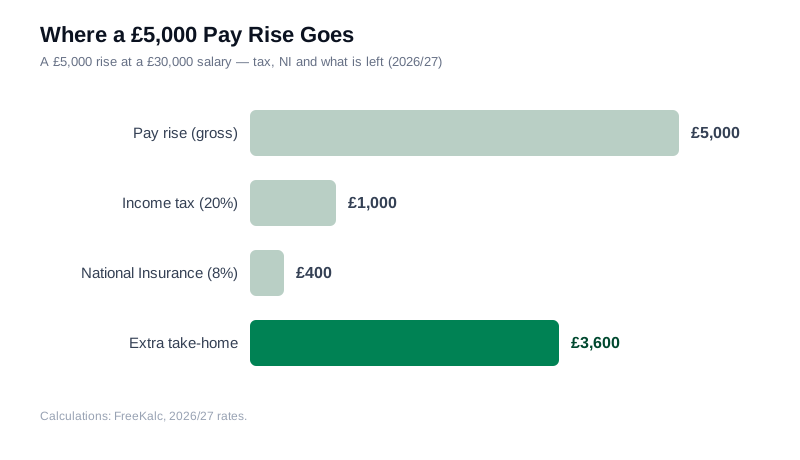
How much of a £5,000 pay rise do you keep at different salaries?
Your current salary decides the bite. The same £5,000 raise is worth very different amounts depending on where you sit in the tax bands:
| Salary | You keep of a £5,000 rise | Per month | Marginal rate |
|---|---|---|---|
| £30,000 → £35,000 | £3,600 | £300.00 | 28% |
| £40,000 → £45,000 | £3,600 | £300.00 | 28% |
| £50,000 → £55,000 | £3,013 | £251.12 | 40% |
| £60,000 → £65,000 | £2,900 | £241.67 | 42% |
| £100,000 → £105,000 | £1,900 | £158.33 | 62% |
The £50,000 row is the surprise: the rise crosses the £50,270 higher-rate threshold, so most of it is taxed at 40% plus 2% NI. And at £100,000 the 60% trap kicks in — every £2 of income above £100,000 cuts your tax-free personal allowance by £1, creating a 62% marginal rate until the allowance is gone.
Does a Plan 2 student loan change the maths?
Yes — significantly. Plan 2 repayments take 9% of everything above £29,385, so they stack on top of tax and NI. On a £5,000 rise at a £30,000 salary, that is another £450 gone: you keep £3,150 instead of £3,600. Every salary page on FreeKalc shows both numbers side by side — for example £40,000 after tax and £50,000 after tax include the Plan 2 line.
Why the marginal rate matters more than the headline rise
When you negotiate, think in take-home terms. A £5,000 rise at £60,000 puts £241 a month in your pocket; at £30,000 it puts £300 a month. That is why our UK salary calculator shows the exact difference for your own figures — including pension contributions, which reduce the taxable rise if you pay into a salary-sacrifice scheme.
Test any before-and-after salary pair in the calculator, or read our UK take-home pay guide for the full band-by-band breakdown.
Frequently asked questions
How much is a £5,000 pay rise after tax in the UK?
It depends on your salary: a £30,000–£45,000 earner keeps £3,600 of it (£300 a month), a £50,000–£55,000 earner keeps about £3,013, and a £60,000 earner keeps £2,900. At £100,000+ you keep only £1,900 because of the 60% personal-allowance taper.
Is a pay rise taxed at 50% in the UK?
No — that is a myth. A pay rise is only taxed at your marginal rate: 28% (20% tax + 8% NI) for basic-rate earners, 42% for higher-rate earners, and up to 62% only for those above £100,000. The extra income is added on top, so your existing salary keeps its lower rates.
Will a pay rise push my whole salary into a higher tax band?
No. UK tax bands are marginal — only the income above each threshold is taxed at the higher rate. If a £5,000 rise takes you from £49,000 to £54,000, only the portion above £50,270 is taxed at 40%; the rest stays at 20%.
How much is a £2,000 pay rise after tax?
At a basic-rate salary (roughly £15,000–£50,000), you keep £1,440 a year — that is £120 a month. With a Plan 2 student loan you keep £1,260, because 9% of the rise goes to loan repayments.