What is the VAT registration threshold in the UK?
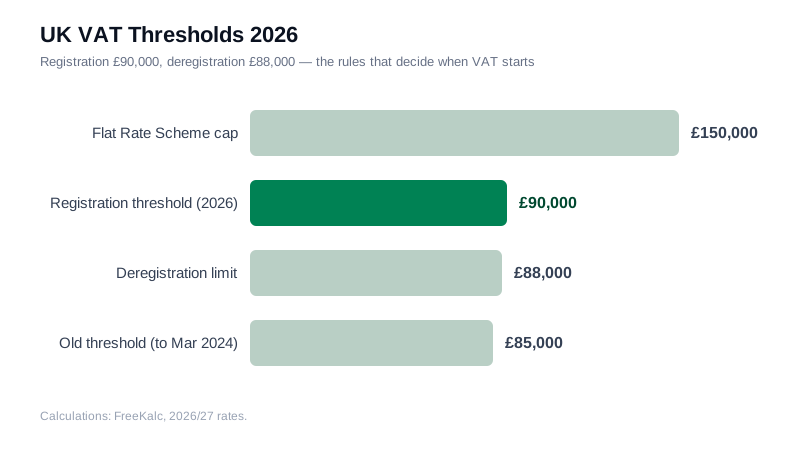
The threshold is £90,000. If your VAT-taxable turnover goes above £90,000 in any rolling 12-month period, registration stops being optional: you must tell HMRC within 30 days and start charging VAT.
| Test | Amount | What it means |
|---|---|---|
| Registration (rolling 12 months) | £90,000 | Must register — 30-day deadline |
| Registration (forward-looking) | £90,000 | Register if you expect to exceed it in the next 30 days alone |
| Deregistration | £88,000 | Turnover below this lets you cancel |
| Old threshold (to 31 March 2024) | £85,000 | Replaced from 1 April 2024 |
How does the rolling 12-month test work?
HMRC looks at the last 12 months ending at each month end, not the calendar year or your company year. Turnover of £8,000 a month is £96,000 on the rolling test even if no single month ever "felt" big. Once any 12-month window breaks £90,000, the clock starts: you have until the end of the following month to notify HMRC, and registration typically begins from the first day of the next month.
What happens if you register late?
Two costs. First, a failure-to-notify penalty calculated as a percentage of the VAT due for the late period. Second — the part that stings — VAT becomes due on your sales from the date you should have registered, but you cannot legally have charged it to customers in the meantime. For a business doing £95,000 a year at 20% VAT, that can be four figures of VAT that comes out of your own margin. Registering on time and charging VAT correctly (with a VAT calculator doing the maths) avoids both.
Is registering early ever the smart move?
Sometimes. Voluntary registration below £90,000 lets you reclaim input VAT on equipment, stock and costs — a real refund if you are B2B and your customers can reclaim what you charge. It also signals a more established business. The cost is admin: Making Tax Digital-compliant software, quarterly returns and charging VAT correctly. The VAT rates guide covers what you would charge once registered.
Frequently asked questions
What is the VAT registration threshold in 2026?
£90,000. You must register for VAT if your taxable turnover exceeds £90,000 in a rolling 12-month period, or if you expect it to exceed £90,000 in the next 30 days alone. The threshold rose from £85,000 on 1 April 2024 and is unchanged for 2026.
When do I have to register for VAT?
Within 30 days of the end of the month in which you exceeded £90,000 on the rolling 12-month test, or within 30 days of knowing you will exceed it. Register late and HMRC charges a VAT-geared penalty plus the VAT you should have charged.
What is the VAT deregistration threshold?
£88,000. If your turnover falls below £88,000 you can ask HMRC to cancel your registration — though staying registered voluntarily lets you keep reclaiming input VAT.
Can I register for VAT before hitting £90,000?
Yes — voluntary registration is allowed at any turnover. It makes sense if your customers are VAT-registered businesses (they reclaim the VAT you charge, and you reclaim the VAT you pay), but it adds admin and MTD-compliant digital record keeping.