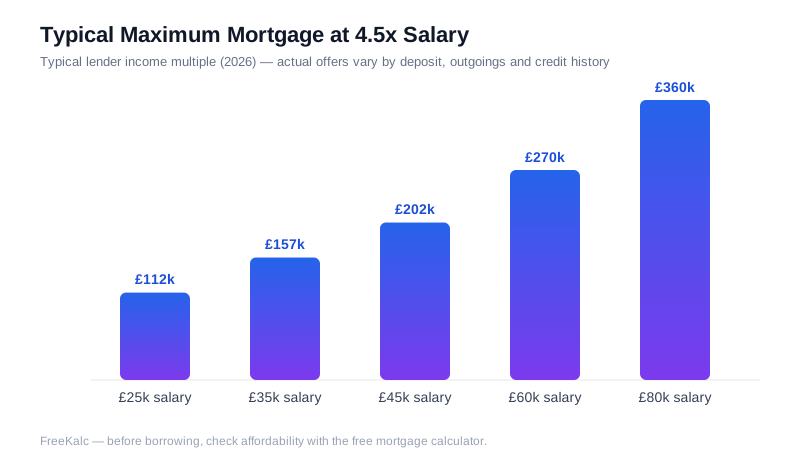
Most UK lenders will offer between 4 and 4.5 times your gross annual income — that single rule of thumb answers most of the question. But deposit size, outgoings and interest rates decide the rest.
The four factors lenders check
- Income multiple — usually 4–4.5x salary; some professions (doctors, solicitors) get 5–5.5x.
- Deposit — 5% is the legal minimum, but below 10% means higher rates; 15%+ unlocks better deals.
- Affordability stress test — lenders check you could still pay if rates rose by ~1 percentage point.
- Outgoings — childcare, debts, commuting and spending habits all reduce the offer.
A worked example
Two people earning £45,000 with a £30,000 deposit could borrow around £202,000 — a £232,000 property. At a 4.3% rate over 30 years that's roughly £1,015 a month. Run the exact number (and test extra payments) in the mortgage calculator.
Joint applications
Couples usually get 3.5–4x combined income, not 4.5x each — so two £40,000 salaries borrow roughly £300,000, not £360,000.
What rate you'll pay
Rates move constantly — that's why our calculator lets you test several rates side by side. A 0.5% difference on a £200,000 mortgage is about £60 a month. Start modelling with the free mortgage calculator, and see how salaries differ by region in our UK salary breakdown.