$60,000 after taxes in Montana at a glance
| Pay period | Take-home pay |
|---|---|
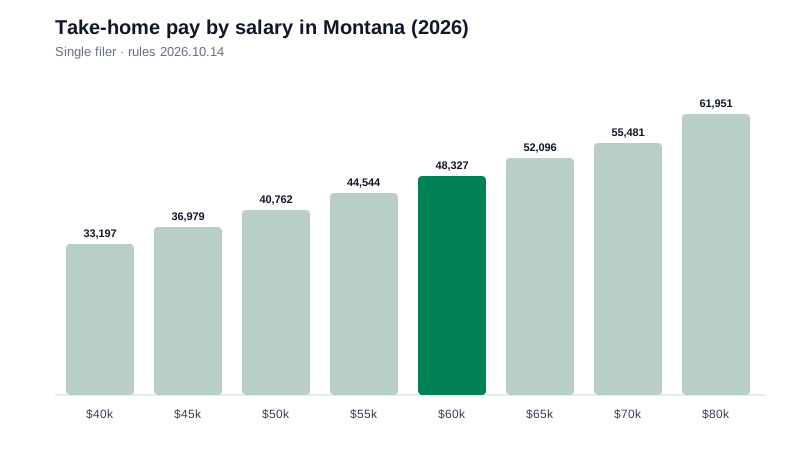
| Per year | 48,327 |
| Per month | 4,027 |
| Per biweekly paycheck | 1,859 |
| Per week | 929.37 |
| Per hour (2,080-hour year) | 23.23 |
Where your $60,000 goes: the 2026 deductions
| Deduction | Amount per year |
|---|---|
| Gross salary | $60,000 |
| Federal income tax (after standard deduction) | −5,020 |
| Social Security (6.2%) | −3,720 |
| Medicare (1.45%) | −870 |
| Montana state income tax | −2,063 |
| Take-home pay | 48,327 |
How Montana income tax works in 2026
The versioned 2026 model uses Montana’s narrow schedule, whose rates run between 4.7% and 5.65%. Local taxes, itemized deductions and person-specific credits are not included. At $60,000, modeled state deductions are about 2,063 (3.4% of gross).
Sixty thousand: the Bozeman benchmark
$60,000 in Montana produces $48,327 of take-home — $4,027 a month, $23.23 an hour — with the state taking $2,063 through its narrow band. This is the salary the Bozeman corridor was built around: remote-eligible professionals discovering what the same job title funds under Big Sky.
The Wyoming comparison, priced honestly
Montana’s southern neighbour levies zero income tax, and the $2,063 state line at this salary is roughly $170 a month — the visible cost of living where Montana’s jobs actually are. The honest offset: Montana’s housing costs and property taxes run well below Jackson-era Wyoming, so the full comparison usually lands closer than the tax column alone suggests.
The deferral lever in a 5.65% state
Montana taxes 401(k) deferrals the way the federal system does, so every pre-tax dollar escapes the 12% federal bracket and the state’s engaged band at once — roughly 18 cents of immediate relief per dollar. A $300-a-month deferral cuts combined withholding by about $53 while the employer match compounds on top, and with no local layer, the payroll election is the whole optimization.
More salaries after tax in Montana
- $40,000 after tax in Montana
- $45,000 after tax in Montana
- $50,000 after tax in Montana
- $55,000 after tax in Montana
- $65,000 after tax in Montana
- $70,000 after tax in Montana
- $80,000 after tax in Montana
- See the full Montana paycheck calculator
$60,000 after tax in other states
- $60,000 after tax in California
- $60,000 after tax in Illinois
- $60,000 after tax in Michigan
- $60,000 after tax in Texas
- $60,000 after tax in Florida
- $60,000 after tax in New York
- $60,000 after tax in Pennsylvania
- $60,000 after tax in North Carolina
Frequently asked questions
What is $60,000 after taxes in Montana?
About 48,327 a year or 4,027 a month for this standard single-filer 2026 estimate.
How much is that per month?
Approximately 4,027 per month, based on annual take-home divided by 12.
How much is that biweekly?
Approximately 1,859 across 26 pay periods.
What is the after-tax hourly rate?
About $23.23 per hour on a 2,080-hour work year.
Does Montana have local income tax?
None. Your paycheck only sees state and federal withholding; Montana cities add nothing extra — the state line is the entire income-tax picture, from Billings to Bozeman.
How does Montana compare to other states at $60,000?
The state tax of 2,063 is the only difference versus most of the country — a zero-tax state such as Texas keeps about 2,063 more of the same salary.