1099 Tax Calculator (2026) — Self-Employed & Freelance
On $50,000 of net freelance income, expect about $9,346 in federal tax — roughly $2,103 per quarter. Run your own numbers below.
1099 tax calculator
Single filer, 2026 federal brackets, standard deduction of $16,100. State tax not included.
| Line | Amount |
|---|
How 1099 taxes work in 2026
If you're paid on a 1099-NEC or 1099-K, no employer withholds for you — you owe both halves of Social Security and Medicare yourself. That "self-employment tax" runs at 15.3%: 12.4% for Social Security, which stops at the $184,500 wage base, plus 2.9% for Medicare with no cap. It applies to 92.35% of your net profit, which mimics the employer half.
Three deductions then soften the blow. You deduct half of your SE tax from gross income, most people qualify for the QBI deduction of 20% of net profit, and everyone gets the $16,100 standard deduction (single, 2026). The calculator chains all three before applying the 2026 brackets, which is why a $50,000 freelancer owes federal income tax of only about $2,281 — the SE tax of $7,065 is the bigger line.
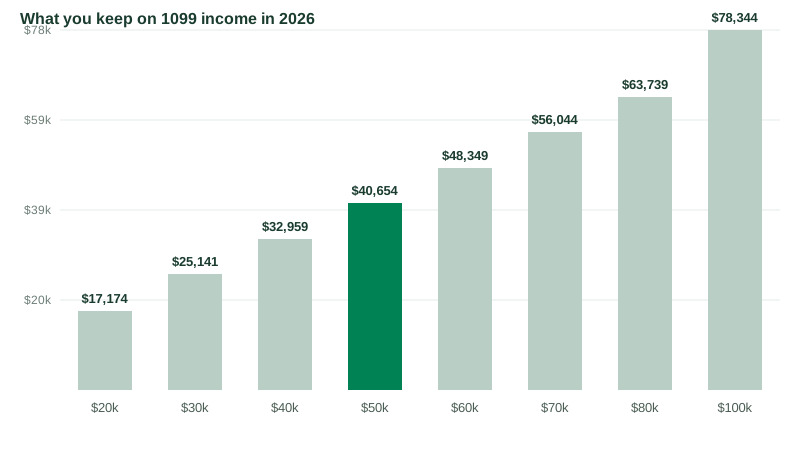
| Net 1099 income | SE tax | Federal income tax | Total tax | Take-home | Effective rate | Per quarter (90%) |
|---|---|---|---|---|---|---|
| $20,000 | $2,826 | $0 | $2,826 | $17,174 | 14.1% | $636 |
| $30,000 | $4,239 | $620 | $4,859 | $25,141 | 16.2% | $1,093 |
| $40,000 | $5,652 | $1,389 | $7,041 | $32,959 | 17.6% | $1,584 |
| $50,000 | $7,065 | $2,281 | $9,346 | $40,654 | 18.7% | $2,103 |
| $60,000 | $8,478 | $3,173 | $11,651 | $48,349 | 19.4% | $2,621 |
| $70,000 | $9,891 | $4,065 | $13,956 | $56,044 | 19.9% | $3,140 |
| $80,000 | $11,304 | $4,957 | $16,261 | $63,739 | 20.3% | $3,659 |
| $100,000 | $14,130 | $7,527 | $21,656 | $78,344 | 21.7% | $4,873 |
Quarterly payments: the 2026 calendar
The IRS expects tax as you earn. If you'll owe more than $1,000 for the year, you pay in four installments: April 15, June 15 and September 15, 2026, then January 15, 2027. The June and September dates don't line up with calendar quarters — set reminders separately.
Miss them and the IRS charges an underpayment penalty (interest-rate based, around 7–8% annualized in recent years) even if you pay everything by April 15. The safe harbors that avoid it: pay 90% of the current year's bill, or 100% of last year's (110% if your AGI topped $150,000).
How much to set aside
Most freelancers should bank 25–30% of every payment. Below roughly $30,000 of net profit the effective federal rate is only 14–16% because the standard deduction and QBI shield most income; above $80,000 it creeps toward 22%. If you also have W-2 wages, withholding can cover your 1099 taxes — many freelancers just bump their day-job withholding instead of filing Form 1040-ES.
Deductions that actually move the number
Expenses come off the top before any tax is computed: software, phone, home office, health insurance premiums (self-employed above the line), and business miles at the IRS standard rate. Reducing net profit cuts both your SE tax and your income tax, so a $1,000 tracked expense at a typical freelancer's margin saves $250–300, not just $120. The W-2 vs 1099 calculator shows how the two pay structures compare once deductions are in play, and the US paycheck calculator covers the employee side.
Frequently asked questions
How much should I set aside for 1099 taxes?
A safe rule of thumb is 25–30% of every payment. This calculator shows your actual number: on $50,000 of net self-employment income the combined federal bill is about $9,346, or roughly 18.7%. Many freelancers save more than needed and treat the surplus as a year-end bonus.
What is the self-employment tax rate in 2026?
15.3% of your net earnings from self-employment: 12.4% for Social Security (which stops at the $184,500 wage base for 2026) and 2.9% for Medicare (no cap). Unlike a W-2 job where your employer pays half, you pay both halves — but half of the total is deductible against your income tax.
When are quarterly estimated taxes due in 2026?
The four deadlines are April 15, June 15 and September 15, 2026, then January 15, 2027 for the final quarter. The June and September dates don't align with calendar quarters, so mark them separately.
What is the safe harbor rule for quarterly payments?
You avoid underpayment penalties if you pay at least 90% of the current year's tax or 100% of last year's tax (110% if your adjusted gross income was over $150,000) through quarterly payments or withholding. This calculator's quarterly figure uses the 90% current-year method.
Can I deduct half of my self-employment tax?
Yes. The employer-equivalent half (about 7.65 points of the 15.3%) is an above-the-line deduction: it lowers your adjusted gross income even if you don't itemize. The calculator applies it automatically.
Does the $600 1099 threshold mean I only owe tax above $600?
No — that's a reporting threshold, not a tax threshold. A payer must issue a 1099-NEC if they paid you $600 or more, but all self-employment income is taxable from the first dollar. If net earnings are under $400 you avoid self-employment tax entirely, but income tax may still apply.
What is the QBI deduction?
The qualified business income deduction lets most self-employed people deduct up to 20% of their net profit (after the half-SE-tax deduction) before applying tax brackets. On $50,000 of net income that's about $9,294 of taxable income shielded. High earners in certain professions (the SSTB limitation) can lose part of it.
Does this calculator include state income tax?
No. It covers federal self-employment tax and federal income tax for a single filer taking the 2026 standard deduction. Most states also tax self-employment income on top, so add your state's rate when budgeting.
Estimates use 2026 federal brackets, the single standard deduction and simplified QBI; they are educational, not tax advice.