Adjust the salary, filing status, 401(k) contribution or state below — every figure on this page comes from the same 2026 rate model.
State estimates currently support single filers only.
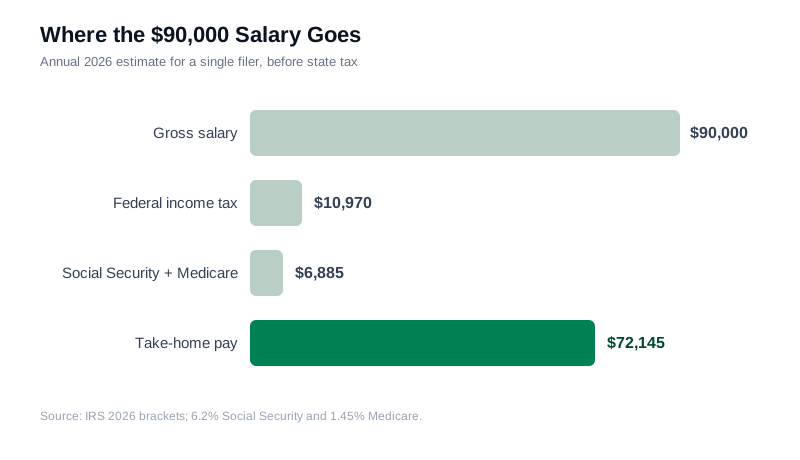
Where does the money go — tax, FICA and take-home?
Deduction
Amount per year
Gross salary
$90,000.00
Federal income tax (after $16,100 standard deduction)
−$10,970.00
Social Security (6.2%)
−$5,580.00
Medicare (1.45%)
−$1,305.00
Take-home pay
$72,145.00
From a $90,000 gross salary, roughly $72,145 a year is take-home pay after federal tax and payroll contributions, before state tax.
Total deductions come to about 19.8% of gross. Federal income tax takes $10,970.00 and FICA payroll taxes take $5,580.00 (Social Security) plus $1,305.00 (Medicare).
Is $90,000 a good salary?
At $90,000 per year, a single filer keeps approximately $72,145 ($6,012.08 per month) after federal income tax and FICA, before state and local taxes. Your actual take-home pay depends on your state, filing status and deductions. Use the paycheck calculator for a personalized estimate.
Where you live changes the answer more than any other factor. A $90,000 salary is taxed under the same federal rules everywhere, but state income tax ranges from $7,301 in Oregon to nothing at all in the no-income-tax states. That is a $7,301-a-year difference — $608 a month — on exactly the same gross pay. The table below runs this salary through the same 2026 model as the calculator on this page (single filer, standard deduction, state rules only — local taxes excluded).
Figures are 2026 estimates for a single filer taking the standard deduction, before any 401(k) or other pre-tax deductions. Open your state’s paycheck calculator from the table for state-specific detail, including pay-period breakdowns.
State income tax: what it does to these figures
The take-home numbers on this page are federal-only — they cover Social Security, Medicare and federal income tax. State income tax is deducted on top of that, ranging from nothing to more than 10%:
Nine states charge no income tax on wages: Florida, Texas, Washington, Nevada, Tennessee, South Dakota, Wyoming, Alaska and New Hampshire — your federal figures are your real figures there.
Flat-tax states (Illinois, Pennsylvania, Indiana, Michigan and others) take a simple 2-5% of your taxable income.
High-tax states — California, New York, Hawaii, Oregon and New Jersey — can take another 6-11% at this income level, cutting your monthly net by roughly $481 (California example).
City taxes can apply too — New York City, Philadelphia, Detroit and St Louis all levy local income taxes of 1-4%.
For exact state-by-state numbers at this salary, see our take-home pay by state breakdown covering all 50 states.
At $90,000 your marginal rate is about 29.6% (federal bracket plus 7.65% FICA, before state tax), so this is what common raises actually add to your bank account:
Pay rise
Federal tax + FICA on the rise
Extra take-home
+$1,000 (to $91,000)
−$296
+$704 net
+$2,500 (to $92,500)
−$741
+$1,759 net
+$5,000 (to $95,000)
−$1,482
+$3,518 net
+$10,000 (to $100,000)
−$2,965
+$7,035 net
A $2,500 raise is worth about 1,759 net — before state income tax takes its share.
Monthly budget on $90,000: the 50/30/20 rule
A common budgeting split for a federal take-home of $6,012.08 a month:
Emergency fund, 401(k) beyond the match, debt overpayments
Frequently asked questions
Is $90,000 a good salary in the US?
It is a high salary — roughly the top quarter of US individual earners. It allows comfortable living in many mid-sized cities and low-cost states.
How much is $90,000 a month after taxes?
About $6,012.08 per month as a single filer with the standard deduction, before state income tax. State and local income taxes can reduce this.
How much is $90,000 an hour after taxes?
$90,000 over a 2,080-hour year works out to $43.27 gross per hour, or roughly $34.69 an hour after federal tax, Social Security and Medicare.
How much is $90,000 a year after taxes in Texas vs California?
In Texas, estimated take-home pay is $72,145.00 with no state income tax. California has state income tax; use a state-specific paycheck calculator to estimate your own net pay.