Michigan Paycheck Calculator — Take-Home Pay After Taxes (2026)
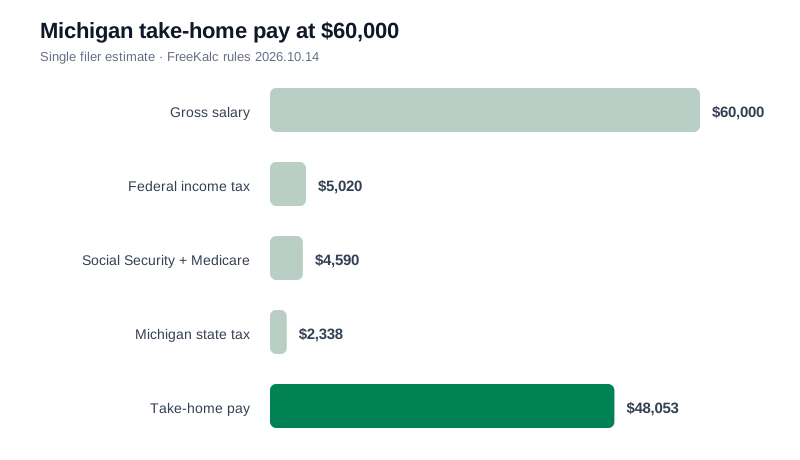
On a $60,000 salary in Michigan, this standard single-filer estimate includes about $2,338 of state income tax, leaving about $48,053 a year ($4,004 a month or $1,848 per biweekly paycheck) after federal tax and FICA. Local taxes and individual credits are excluded. Run your salary through the paycheck calculator or see the breakdown below.
Take-home pay in Michigan at $50k, $60k and $70k
Single filer on the standard deduction, 2026 figures. 401(k) contributions, health premiums and local taxes can shift your actual pay stub a little.
| Gross salary | Federal tax | FICA (SS + Medicare) | Michigan state tax | Take-home / year | Monthly | Biweekly |
|---|---|---|---|---|---|---|
| $50,000 | $3,820 | $3,825 | $1,913 | $40,443 | $3,370 | $1,555 |
| $60,000 | $5,020 | $4,590 | $2,338 | $48,053 | $4,004 | $1,848 |
| $70,000 | $6,570 | $5,355 | $2,763 | $55,313 | $4,609 | $2,127 |
How Michigan income tax works
This standard 2026 single-filer estimate uses flat 4.25%. Local taxes, itemized deductions and person-specific credits are not included.
Some Michigan cities levy a small local income tax (1% residents, 0.5% non-residents) — Detroit's 2.4% resident rate is the big exception.
Does Michigan have local income tax?
None. Michigan cities and counties do not tax wages; only state and federal withholding come off your check.
Biweekly paychecks in Michigan
With 26 pay periods, this $60,000 example averages about $1,848 per biweekly paycheck. For monthly budgeting, annual take-home divided by 12 is about $4,004.
Compare before you relocate or accept an offer
The same headline salary means different money in different states. Compare all states in the take-home pay by state hub, or start from the federal math in $60,000 a year after taxes, $70,000 a year after taxes and $50,000 a year after taxes.
Michigan's flat 4.25%: simple, with a local-tax footnote
Michigan applies one of the country's most straightforward income taxes: a flat 4.25% rate with no brackets, producing about $2,338 of state tax on a $60,000 salary in this 2026 estimate. The flat design means raises cost exactly the same per dollar as your first dollars did — the opposite of a system that punishes overtime at the top of the schedule.
The footnote: city income taxes
Michigan is unusual in allowing cities to levy their own income taxes, and several do. Detroit's resident rate is the best-known example; a handful of other cities charge smaller rates to residents and people who work inside city limits even when they live elsewhere. The table and calculator on this page exclude any local layer, so if your employer's address sits inside a city with its own tax, expect the real take-home to be modestly lower — your payroll department's local withholding line will show it.
Combined marginal rate at $60,000
Stack the pieces: the federal 10%/12% brackets on income after the $16,100 standard deduction, the 7.65% FICA pair on every wage dollar, then Michigan's 4.25%. Each additional dollar keeps roughly three-quarters of itself. Each dollar deferred into a traditional 401(k) escapes federal and Michigan tax now — and unlike high-bracket states, Michigan's flat rate means the retirement-time state tax on withdrawals is a known, fixed quantity you can plan around.
Public pension and retirement note
Michigan exempts most public-pension income and Social Security benefits from state tax, a detail that matters to two-earner households planning a decade ahead: wages are taxed at 4.25% today, but a meaningful slice of retirement income will not be taxed by the state at all.
Michigan paycheck FAQ
How much is $60,000 a year after taxes in Michigan?
For this standard single-filer 2026 estimate, take-home is about $48,053 a year or $4,004 a month after federal income tax, Social Security, Medicare and modeled Michigan state deductions.
What is the Michigan state income tax rate in 2026?
This model uses flat 4.25%. Local taxes and person-specific credits are excluded.
How much is taken out of a paycheck in Michigan?
At $60,000, this model subtracts $5,020 of federal income tax, $4,590 of Social Security and Medicare, and $2,338 of modeled state deductions.
Is $70,000 a good salary in Michigan?
This model leaves about $55,313 a year ($4,609 monthly). Whether that is comfortable depends on housing, household size, benefits and local costs.
How many paychecks do I get in a year?
26 on a biweekly schedule, which is why two months a year pay three times. Semimonthly pay gives exactly 24 checks and weekly pay gives 52.
Does a traditional 401(k) contribution change my take-home?
Yes. Traditional 401(k) contributions come out of your pay before federal income tax and state income tax in most states, so the tax withheld on each check drops and your net pay falls by less than the contribution itself. Roth 401(k) contributions come out after tax. See the 401(k) calculator.
Is take-home pay the same as net pay?
Yes. Take-home pay, net pay and net wages all mean what is left after federal income tax, FICA (Social Security and Medicare) and state withholding. Pre-tax deductions like health premiums reduce it; reimbursements do not.
Tax year 2026 estimates for a single filer claiming the standard deduction. The the paycheck calculator keeps the latest rates.