W2 vs 1099 Calculator (2026)
$50,000 as a W-2 employee keeps $42,355. The same gross on a 1099 keeps $40,654 — a 4% gap, not the 7.65% myth. Compare your own numbers below.
W-2 vs 1099 comparison
Same gross both sides. Single filer, 2026 federal rates, no state tax.
| Line | W-2 employee | 1099 contractor |
|---|
The real gap, line by line
The folk wisdom says contractors pay "double FICA," so they should charge 7.65% more. The math is friendlier than that. Yes, the self-employment tax is 15.3% where FICA is 7.65% — but it applies to only 92.35% of net profit, half of it is itself deductible, and the QBI deduction shields another 20% of profit from income tax. Put together, the same gross leaves a 1099 worker just 1–5% behind the employee across most incomes, and the gap keeps shrinking as income rises.
| Gross | W-2 take-home | 1099 take-home | Gap | Gap % | Break-even 1099 gross |
|---|---|---|---|---|---|
| $30,000 | $26,285 | $25,141 | $1,144 | 4.4% | $31,459 (+4.9%) |
| $50,000 | $42,355 | $40,654 | $1,701 | 4.0% | $52,210 (+4.4%) |
| $70,000 | $58,075 | $56,044 | $2,031 | 3.5% | $72,639 (+3.8%) |
| $100,000 | $79,180 | $78,344 | $836 | 1.1% | $101,203 (+1.2%) |
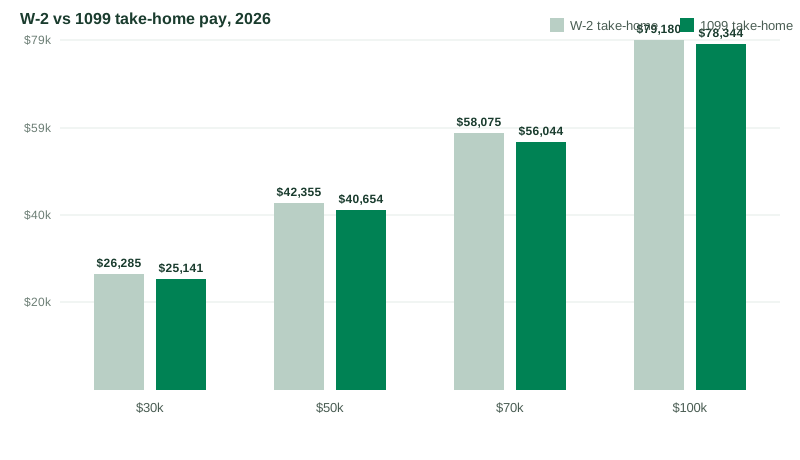
The break-even contractor rate
At $50,000 you need about $52,210 of 1099 gross to match the employee's $42,355 — roughly +4.4%, or about $25.10 an hour instead of $24.04. At $100,000 the premium nearly vanishes (+1.2%). So the tax-only premium is small; the real premium is what employees get for free: health insurance, 401(k) match, paid leave and unemployment coverage. Full-service contractors price those in at 20–30% above W-2.
Expenses flip the result
Everything an employee can't deduct, a contractor can: mileage, home office, software, gear, health premiums. Deducting $8,000 from a $70,000 gross erases about $2,300 of federal tax and closes the W-2 gap entirely. The comparison table above assumes zero expenses on purpose — enter yours in the calculator to see the flip.
What this calculator assumes
2026 federal brackets for a single filer with the $16,100 standard deduction; FICA at 7.65% (Social Security capped at $184,500); SE tax at 15.3% with the half-deduction; the simplified 20% QBI deduction; no state income tax on either side. Married filers and high-income SSTB situations will differ. For contractor-only numbers including quarterly estimates, use the 1099 tax calculator.
Frequently asked questions
How much more should a 1099 contractor charge than a W-2 rate?
Just to match take-home pay, about 1–5% more — not the 7.65% folk wisdom. The QBI deduction and the half-SE-tax deduction eat most of the self-employment tax gap. To also cover benefits you're giving up (health insurance, 401(k) match, paid leave), contractors typically charge 20–30% above the W-2 rate.
Do 1099 workers really pay double FICA?
Not quite. W-2 workers pay 7.65% and their employer pays another 7.65%; 1099 workers pay the combined 15.3% SE tax but only on 92.35% of net profit, and half of it becomes a deduction. On $50,000 the all-in difference is about $1,700 for the year, or 4% of take-home.
Why does the W-2 vs 1099 gap shrink as income rises?
Two reasons. The QBI deduction (20% of net profit) grows with income and only starts phasing out above roughly $197,300 of taxable income for single filers in 2026, and W-2 income hits the 22% bracket quickly while the 1099 side is shielded by QBI. At $100,000 the gap narrows to under 1% before expenses.
Is it better to be W-2 or 1099?
Purely on federal tax, W-2 wins by a few percent — but 1099 income unlocks deductions employees can't touch: mileage, home office, equipment, health premiums, retirement plans with higher limits. A 1099 worker with $8,000 of legitimate expenses at $70,000 gross usually comes out ahead of the employee.
What does the break-even rate in the calculator mean?
It's the gross 1099 income needed to match the W-2 take-home on the same amount. At $50,000, a contractor needs about $52,210 — roughly 4.4% more — to keep the same $42,355. The old 'multiply by 1.0765' rule overstates it because it ignores QBI and the half-SE deduction.
Does this comparison include benefits?
No — it's tax-only. Add the cash value of employer benefits to the W-2 side for a full picture: health insurance (often $6,000–12,000/yr), 401(k) match (3–6% of salary) and paid time off (2–4 weeks). This is why real-world contractor rates need a much bigger premium than the tax math suggests.
Do both W-2 and 1099 income count toward Social Security?
Yes. Both feed the same Social Security earnings record. SE tax pays 12.4% up to the $184,500 wage base in 2026, exactly like the combined employee-employer FICA. Earning $60,000 on W-2 and $30,000 on 1099 credits the same as $90,000 on either alone.
Educational estimates for 2026; not tax, legal or payroll advice.