Alabama Paycheck Calculator — Take-Home Pay After Taxes (2026)
Federal and state tax rates verified · October 2026
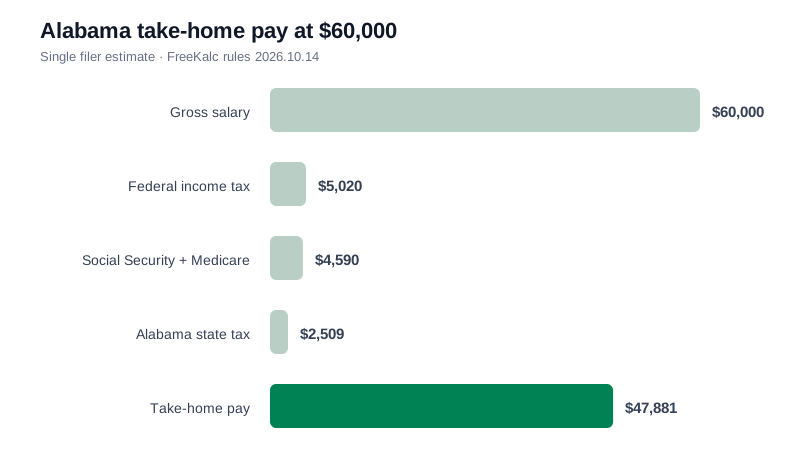
On a $60,000 salary in Alabama, this standard single-filer estimate includes about $2,509 of state income tax, leaving about $47,881 a year ($3,990 a month or $1,842 per biweekly paycheck) after federal tax and FICA. Local taxes and individual credits are excluded. Run your salary through the paycheck calculator or see the breakdown below.
Take-home pay in Alabama at $50k, $60k and $70k
Single filer on the standard deduction, 2026 figures. 401(k) contributions, health premiums and local taxes can shift your actual pay stub a little.
| Gross salary | Federal tax | FICA (SS + Medicare) | Alabama state tax | Take-home / year | Monthly | Biweekly |
|---|---|---|---|---|---|---|
| $50,000 | $3,820 | $3,825 | $2,069 | $40,286 | $3,357 | $1,549 |
| $60,000 | $5,020 | $4,590 | $2,509 | $47,881 | $3,990 | $1,842 |
| $70,000 | $6,570 | $5,355 | $2,932 | $55,143 | $4,595 | $2,121 |
How Alabama income tax works
Alabama uses 2%, 4% and 5% brackets. For this standard single-filer estimate, the 2026 withholding schedule phases the standard deduction to $2,500 at these salaries, allows a $1,500 exemption, and deducts estimated federal income tax. City occupational taxes are not included. Primary 2026 rule source: official source 1.
Does Alabama have local income tax?
Alabama cities levy their own occupational taxes on wages in many places — Birmingham charges about 1%, and several other cities charge between 0.5% and 2.5%. Check your city before budgeting.
Biweekly paychecks in Alabama
With 26 pay periods, this $60,000 example averages about $1,842 per biweekly paycheck. For monthly budgeting, annual take-home divided by 12 is about $3,990.
Compare before you relocate or accept an offer
The same headline salary means different money in different states. Every state is ranked in the take-home pay by state hub; for federal-only figures at common salary points see $60,000 a year after taxes, $70,000 a year after taxes and $50,000 a year after taxes.
Alabama's short bracket ladder: 2%, 4%, 5%
Alabama's income tax runs on one of the shortest schedules in the country — three brackets at 2%, 4% and 5% in this 2026 estimate. On a $60,000 salary the blended result is about $2,509 of state tax, roughly 4.2% of gross, because a salary at that level has climbed past the gentle lower bands and most additional dollars now face the 5% top rate.
The marginal cost of overtime in Alabama
With the 5% band reached, each extra hour worked is taxed at the full state rate plus the federal 12% bracket plus 7.65% FICA — about 25 cents per dollar all-in. That is moderate by national standards, but it makes Alabama's overtime math noticeably flatter than Louisiana's or North Carolina's at the same salary, where large deductions or lower flat rates soften the top slice. If you regularly work overtime in Birmingham or Huntsville, the state tax line on your payslip is the one to watch.
What Alabama taxes that neighbours sometimes don't
Alabama taxes all earned income, but it starts taxing from the first dollar after its standard deduction — a smaller shelter than North Carolina's or Louisiana's — and its top 5% rate arrives at a lower income than most coastal schedules. The state partially compensates through a grocery-tax structure and credits that have changed repeatedly in recent years; the number on your own payslip reflects the current year's version, which is exactly what the calculator above tracks.
Offers across state lines
Against Tennessee's zero or Georgia's flat structure at the same $60,000 salary, Alabama's wedge is a few hundred dollars a year heavier. Against the coasts it remains one of the lighter states in the country, which is why relocation math in the South-east usually turns on housing and wages rather than on the income-tax line alone.
Alabama paycheck FAQ
How much is $60,000 a year after taxes in Alabama?
For this standard single-filer 2026 estimate, take-home is about $47,881 a year or $3,990 a month after federal income tax, Social Security, Medicare and modeled Alabama state deductions.
What is the Alabama state income tax rate in 2026?
This model uses 2%-5% brackets; income-dependent standard deduction, $1,500 exemption, and federal income-tax deduction. Local taxes and person-specific credits are excluded.
How much is taken out of a paycheck in Alabama?
At $60,000, this model subtracts $5,020 of federal income tax, $4,590 of Social Security and Medicare, and $2,509 of modeled state deductions.
Is $70,000 a good salary in Alabama?
This model leaves about $55,143 a year ($4,595 monthly). Whether that is comfortable depends on housing, household size, benefits and local costs.
How many paychecks do I get in a year?
26 on a biweekly schedule, which is why two months a year pay three times. Semimonthly pay gives exactly 24 checks and weekly pay gives 52.
Does a traditional 401(k) contribution change my take-home?
Yes. Traditional 401(k) contributions come out of your pay before federal income tax and state income tax in most states, so the tax withheld on each check drops and your net pay falls by less than the contribution itself. Roth 401(k) contributions come out after tax. See the 401(k) calculator.
Is take-home pay the same as net pay?
Yes. Take-home pay, net pay and net wages all mean what is left after federal income tax, FICA (Social Security and Medicare) and state withholding. Pre-tax deductions like health premiums reduce it; reimbursements do not.
Assumes one filer, standard deduction, tax year 2026. For certainty, run the numbers with the calculator on our site or check with a tax professional.