$70,000 after taxes in Alabama at a glance
| Pay period | Take-home pay |
|---|---|
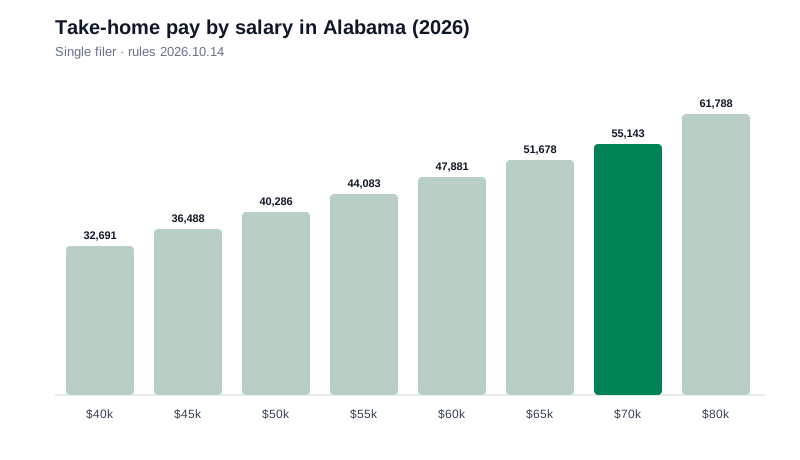
| Per year | 55,143 |
| Per month | 4,595 |
| Per biweekly paycheck | 2,121 |
| Per week | 1,060.46 |
| Per hour (2,080-hour year) | 26.51 |
Where your $70,000 goes: the 2026 deductions
| Deduction | Amount per year |
|---|---|
| Gross salary | $70,000 |
| Federal income tax (after standard deduction) | −6,570 |
| Social Security (6.2%) | −4,340 |
| Medicare (1.45%) | −1,015 |
| Alabama state income tax | −2,932 |
| Take-home pay | 55,143 |
How Alabama income tax works in 2026
The versioned 2026 model uses Alabama’s 2%, 4% and 5% brackets, with the standard deduction phasing to $2,500 at these salaries, a $1,500 personal exemption, and estimated federal income tax deducted from state taxable income. City occupational taxes are not included. At $70,000, modeled state deductions are about 2,932 (4.2% of gross).
Seventy thousand through the 5% bracket
At $70,000, Alabama’s top 5% bracket is fully engaged — the state takes $2,932, leaving $55,143 of take-home ($4,595 a month). The federal-tax deduction and the $2,500 standard deduction keep the effective rate well below the headline: about 4.2% of gross, among the gentler results in the South.
Overtime in the 5% band
With the top bracket reached, additional dollars — overtime, bonuses, raises — all cost 5% to the state plus the federal 12% bracket plus 7.65% FICA: roughly 25 cents per additional dollar all-in. That is moderate by national standards, and the federal-tax deduction keeps Alabama’s slice of it slightly smaller than the raw rate suggests.
The mortgage conversation at 4.5×
Lenders typically offer around 4.5× gross salary — roughly $315,000 at $70,000 — which in Huntsville, Birmingham’s suburbs or the Gulf Coast buys a genuinely good single-family home. The practical Alabama decision at this income is city-versus-suburb: the occupational-tax layer, school districts and commute together move the real annual cost more than the mortgage rate does.
Retirement, the Alabama way
Alabama does not tax Social Security benefits, and its top rate stops at 5% — meaning the state’s slice of retirement income stays fixed and modest. Traditional 401(k) deferrals cut both the current federal bill and the state bill at 5% on the top bracket, and the withdrawal-time state tax is a known, capped quantity.
More salaries after tax in Alabama
- $40,000 after tax in Alabama
- $45,000 after tax in Alabama
- $50,000 after tax in Alabama
- $55,000 after tax in Alabama
- $60,000 after tax in Alabama
- $65,000 after tax in Alabama
- $80,000 after tax in Alabama
- See the full Alabama paycheck calculator
$70,000 after tax in other states
- $70,000 after tax in California
- $70,000 after tax in Illinois
- $70,000 after tax in Michigan
- $70,000 after tax in Texas
- $70,000 after tax in Florida
- $70,000 after tax in New York
- $70,000 after tax in Pennsylvania
- $70,000 after tax in North Carolina
Frequently asked questions
What is $70,000 after taxes in Alabama?
About 55,143 a year or 4,595 a month for this standard single-filer 2026 estimate.
How much is that per month?
Approximately 4,595 per month, based on annual take-home divided by 12.
How much is that biweekly?
Approximately 2,121 across 26 pay periods.
What is the after-tax hourly rate?
About $26.51 per hour on a 2,080-hour work year.
Do Alabama cities add occupational tax?
Yes, in many cities — Birmingham charges about 1% of wages and several other cities charge similar occupational rates. This standard estimate excludes the city layer, so expect slightly lower take-home on a real Birmingham or Montgomery payslip.
How does Alabama compare to other states at $70,000?
The state tax of 2,932 is the only difference versus most of the country — a zero-tax state such as Texas keeps about 2,932 more of the same salary.