Oregon Paycheck Calculator — Take-Home Pay After Taxes (2026)
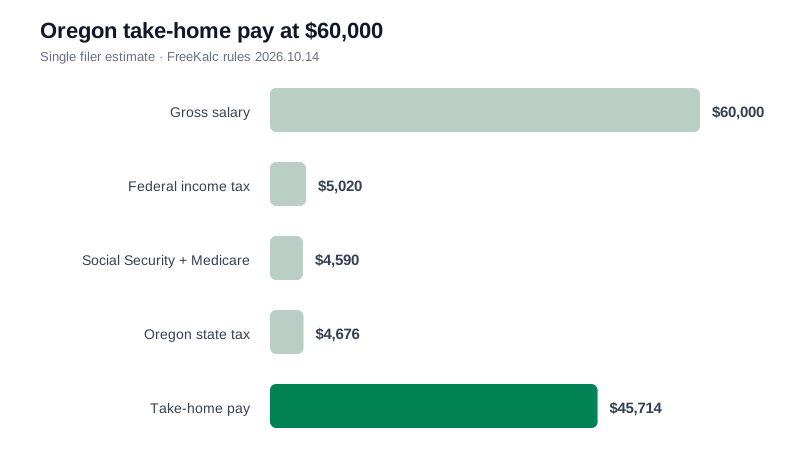
On a $60,000 salary in Oregon, this standard single-filer estimate includes about $4,676 of state income tax, leaving about $45,714 a year ($3,809 a month or $1,758 per biweekly paycheck) after federal tax and FICA. Local taxes and individual credits are excluded. Run your salary through the paycheck calculator or see the breakdown below.
Take-home pay in Oregon at $50k, $60k and $70k
2026 estimates for a single filer using the standard deduction. Your real pay stub may vary slightly with 401(k) deductions, health premiums and local taxes.
| Gross salary | Federal tax | FICA (SS + Medicare) | Oregon state tax | Take-home / year | Monthly | Biweekly |
|---|---|---|---|---|---|---|
| $50,000 | $3,820 | $3,825 | $3,801 | $38,554 | $3,213 | $1,483 |
| $60,000 | $5,020 | $4,590 | $4,676 | $45,714 | $3,809 | $1,758 |
| $70,000 | $6,570 | $5,355 | $5,551 | $52,524 | $4,377 | $2,020 |
How Oregon income tax works
This standard 2026 single-filer estimate uses brackets 4.75%-9.9%. Local taxes, itemized deductions and person-specific credits are not included.
Does Oregon have local income tax?
No city income tax, but the Portland metro area charges an extra 1% on income above $125,000 for single filers. At $50k–$70k that does not apply.
Biweekly paychecks in Oregon
With 26 pay periods, this $60,000 example averages about $1,758 per biweekly paycheck. For monthly budgeting, annual take-home divided by 12 is about $3,809.
Compare before you relocate or accept an offer
Where you live changes what an offer is actually worth. Our take-home pay by state hub lists take-home across all fifty states, while $60,000 a year after taxes, $70,000 a year after taxes and $50,000 a year after taxes work through the federal numbers.
Oregon's two-sided tax personality: high income tax, no sales tax
Oregon runs the highest income tax in this state series — a graduated schedule reaching 9.9% — which is why a $60,000 salary hands over about $4,676 to Salem, noticeably more than the same salary pays in Michigan, Pennsylvania or the South. The trade-off arrives at every cash register: Oregon levies no state or local sales tax, one of only a handful of states to make that choice. Whether the combination favours you depends on your saving rate — spenders come out roughly even, while savers pay income tax on money that sales-tax states would only tax when spent.
What the 9.9% schedule means at ordinary salaries
The top rate sounds intimidating but applies only to taxable income far above the $50k–$70k samples in the table. At $60,000 your Oregon marginal band is in the mid-single digits; the larger wedge is still the federal 10%/12% brackets plus the 7.65% FICA pair. Where Oregon bites harder than neighbours is at every additional dollar, because the schedule climbs quickly — a reason Oregon-based earners lean harder on traditional 401(k) and HSA contributions, which reduce Oregon taxable income alongside federal.
The relocation comparison people actually run
Offers between Portland and Vancouver, Washington cross a famous border: Washington has no income tax, Oregon no sales tax. The standard calculation favours living in Washington and working remotely, but Oregon taxes income earned from work physically performed in the state, and Washington's high-stakes property and business taxes fill part of the gap. For most salaried employees the honest answer is that housing costs decide the comparison long before tax rates do.
Oregon paycheck FAQ
How much is $60,000 a year after taxes in Oregon?
For this standard single-filer 2026 estimate, take-home is about $45,714 a year or $3,809 a month after federal income tax, Social Security, Medicare and modeled Oregon state deductions.
What is the Oregon state income tax rate in 2026?
This model uses brackets 4.75%-9.9%. Local taxes and person-specific credits are excluded.
How much is taken out of a paycheck in Oregon?
At $60,000, this model subtracts $5,020 of federal income tax, $4,590 of Social Security and Medicare, and $4,676 of modeled state deductions.
Is $70,000 a good salary in Oregon?
This model leaves about $52,524 a year ($4,377 monthly). Whether that is comfortable depends on housing, household size, benefits and local costs.
How many paychecks do I get in a year?
26 on a biweekly schedule, which is why two months a year pay three times. Semimonthly pay gives exactly 24 checks and weekly pay gives 52.
Does a traditional 401(k) contribution change my take-home?
Yes. Traditional 401(k) contributions come out of your pay before federal income tax and state income tax in most states, so the tax withheld on each check drops and your net pay falls by less than the contribution itself. Roth 401(k) contributions come out after tax. See the 401(k) calculator.
Is take-home pay the same as net pay?
Yes. Take-home pay, net pay and net wages all mean what is left after federal income tax, FICA (Social Security and Medicare) and state withholding. Pre-tax deductions like health premiums reduce it; reimbursements do not.
Assumes one filer, standard deduction, tax year 2026. For certainty, run the numbers with the full paycheck calculator or check with a tax professional.