Home › Spain Salary Calculator › Beckham Law Spain
Beckham Law Spain: The 24% Flat Tax
Spain's most famous tax break for newcomers: qualifying expatriates and digital nomads pay a flat 24% on Spanish employment income instead of progressive rates up to 45%. It sounds unbeatable — but for most salaries it actually costs you money. Here is who should elect it, and who should not.
Spain salary calculatorCompare ordinary IRPF with Beckham on your salary
What the Beckham regime actually is
The regime (Real Decreto 1003/2023, the modern version of the rule David Beckham popularised) lets workers who relocate to Spain for qualifying reasons be taxed like non-residents: a single 24% rate on Spanish-source employment income up to €600,000 (47% above that), for the year of the move plus the following five. No progressive brackets, no regional scales, no savings-income complexity on most foreign income.
Who qualifies in 2026
You must become a Spanish tax resident because of the move, not have been tax resident in Spain during the previous five years, and start one of the qualifying situations: a Spanish employment contract, an international teleworking arrangement (the digital nomad route opened by the Startup Law 28/2022), a highly-skilled or research role, or certain artistic and sporting activities. The election is made in the first tax return filed after the move.
The honest comparison: flat 24% vs ordinary IRPF
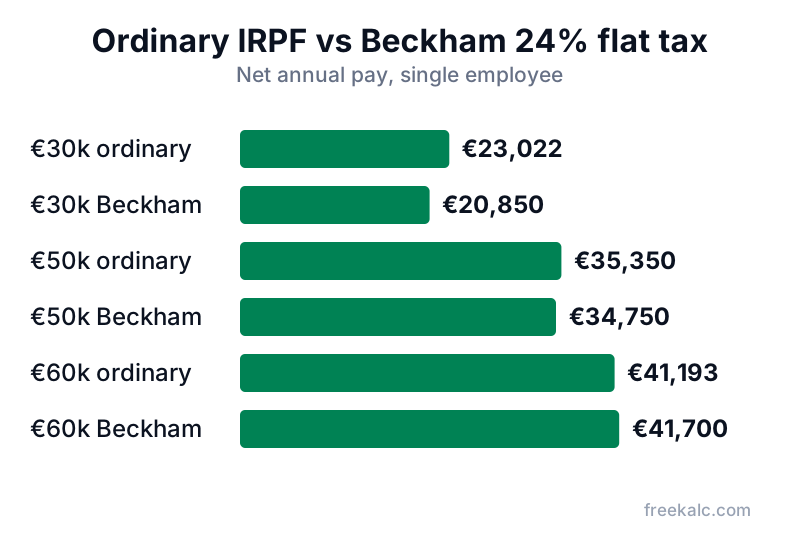
Spain's ordinary brackets start at 19% and only reach 24.5% around €20,200 of taxable income — so a flat 24% is worse than the ordinary system for most single salaries. The crossover for a single employee with only Spanish employment income sits near €55,000. Real figures, single filer, no children, typical region:
| Gross salary | Ordinary regime net | Beckham net | Difference |
|---|---|---|---|
| €30,000 | €23,022 | €20,850 | -€2,172 |
| €50,000 | €35,350 | €34,750 | -€600 |
| €60,000 | €41,193 | €41,700 | +€507 |
The flat rate only starts to win around €55,000-€60,000 of Spanish income. Its real power is elsewhere: foreign-source income such as dividends, interest and capital gains outside Spain is generally not taxed in Spain at all during the regime, and you avoid wealth tax exposure on those assets. Someone with €40,000 of Spanish salary and €20,000 of foreign investment income can still come out far ahead despite the flat rate.
Six years, no renewal
The regime covers the year you move plus five more tax years. There is no extension, no renewal and no re-election after it expires — at that point you become an ordinary progressive-scale resident automatically. Plan the exit before year five, because capital gains accumulated in the meantime can become taxable in Spain once the regime ends.
Digital nomads: visa plus regime
The digital nomad visa and the Beckham regime are separate tools that pair well. The visa (Law 28/2022) gives residence to remote workers with foreign clients or employers; the Beckham regime is the tax treatment many of them elect. Note the Social Security nuance: the 24% replaces income tax only — a Spanish contract still carries the 6.50% employee Social Security contribution, while posted remote workers may stay in their home system for a transitional period.
Frequently asked questions
What is the Beckham Law in Spain?
Spain's special expatriate tax regime (Ley Beckham): qualifying workers who relocate to Spain can opt to be taxed at a flat 24% on Spanish-source employment income up to €600,000 for up to six years, instead of progressive IRPF of up to 45% plus regional scales. It is regulated by Royal Decree 1003/2023.
Who qualifies for the Beckham regime?
Workers who become Spanish tax residents as a consequence of a qualifying move: employees starting a Spanish employment relationship, digital nomads working remotely for foreign employers, researchers, highly skilled professionals and certain artists and sportspeople. You must not have been a Spanish tax resident in the previous five years.
Is 24% flat always better than normal IRPF?
No. A flat 24% only beats Spain's progressive brackets once your Spanish income is above roughly €55,000 for a single filer. At €30,000, the ordinary system leaves you €23,022 versus €20,850 under Beckham. The regime pays off at higher salaries and especially when it shields foreign income from Spanish tax.
How long does the Beckham regime last?
The year of the move plus the five following years — six years in total, with no renewal or extension. When it ends you automatically become an ordinary Spanish tax resident.
Do Beckham-regime workers pay Spanish Social Security?
Yes. The flat 24% replaces income tax only; Social Security (6.50% employee share) still applies if you are on a Spanish contract, or you stay in your home country's social security system for a while as a posted remote worker.
Is the digital nomad visa the same as the Beckham Law?
They are separate things that often pair together. The digital nomad visa (Ley de Startups, Law 28/2022) is a residence permit for remote workers; the Beckham regime is a tax treatment. Nomads on the visa commonly qualify to elect the 24% regime too.
Does the Beckham regime tax my foreign income?
Under the regime you are taxed as a non-resident: Spanish-source employment income at 24%, and most foreign-source income (like dividends or capital gains abroad) is not taxed in Spain at all — which is the biggest hidden benefit for people with investments outside Spain.
Can I switch out of the Beckham regime early?
Yes, you can waive it, but you cannot elect it again in a later year. Choose carefully the first April following your move — the election is made in the special section of the Spanish income tax return.
Related pages
Spain Salary Calculator
Take-home for €25k to €60k
€30,000 After Tax Spain
Take-home pay on a €30k salary
€60,000 After Tax Spain
Take-home pay on a €60k salary
Spain VAT Calculator
21%, 10% and 4% IVA rates
Sources: Beckham regime regulation: Royal Decree 1003/2023 (BOE). IRPF brackets and withholding: Agencia Tributaria (AEAT). Social Security rates: Seguridad Social.