How much tax do you pay on a bonus in the UK?
A bonus is not taxed at a special rate. It is PAYE income, added on top of your salary and taxed at your marginal rate — exactly like a pay rise. What you keep depends on where your salary sits in the tax bands.
| £5,000 bonus | You keep | What comes off |
|---|---|---|
| Salary £30,000 | £3,600 | £1,000 tax (20%) + £400 NI (8%) |
| Salary £50,000 | £2,900 | £2,000 tax (40%) + £100 NI (2%) |
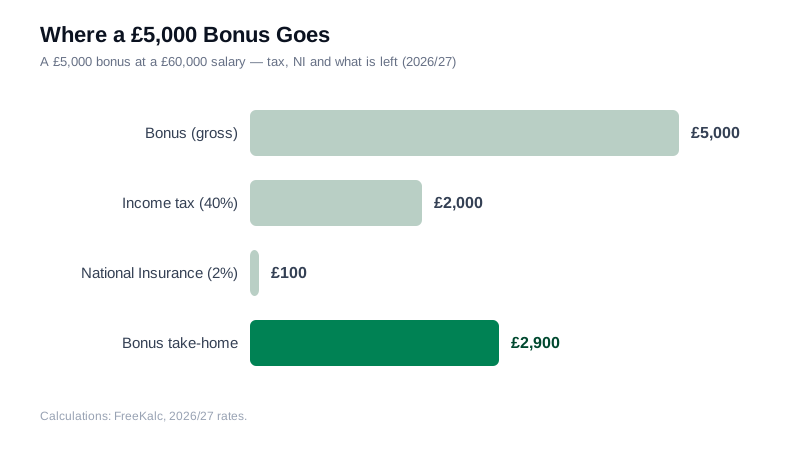
| Salary £60,000 | £2,900 | £2,000 tax (40%) + £100 NI (2%) |
| Salary £100,000 | £1,900 | £3,000 tax (60% taper) + £100 NI |
Why does my bonus month look over-taxed?
Payroll withholds monthly as if that month repeats all year. A £5,000 bonus on a £5,000 monthly salary makes the system see £10,000 that month and withhold at a higher rate. This is withholding, not your real tax bill — HMRC trues it up over the year, and most people get the difference back through their tax code. If your bonus is large and your code does not adjust, check your tax code after the payment (our tax codes guide explains how).
How do bonuses and pay rises compare?
A bonus and a same-size pay rise cost the same in tax in the year they are paid. The difference is the future: a pay rise raises your baseline and its tax every year, while a bonus is one-off. Both are taxed at your marginal rate — see our pay rise after tax guide for the full breakdown at each salary level.
Bonuses, Scotland and the pension trick
Scottish taxpayers have different band boundaries (the top of the Scottish 20% band is £26,993 rather than £50,270), so a bonus that is basic-rate in England may be intermediate-rate in Scotland. The cleanest legal way to keep more of a bonus is paying it into your workplace pension — it leaves taxable pay entirely. Run your own numbers on the UK salary calculator.
Frequently asked questions
How much tax will I pay on a £5,000 bonus in the UK?
At a basic-rate salary you keep £3,600 — 20% income tax and 8% National Insurance come off. A £60,000 earner keeps £2,900 (40% + 2%), and a £100,000+ earner keeps just £1,900 because of the personal-allowance taper.
Are bonuses taxed at 50% in the UK?
No — that is a myth. A bonus is extra income taxed at your marginal rate, the same as a pay rise. The myth comes from month-of-payment withholding: if a bonus is large, the payroll system may withhold at a higher rate that month, but it evens out over the tax year and any overpayment is refunded.
Is a bonus taxed differently from salary?
No. Bonuses are PAYE income and are added to your salary for the year. They can feel different because a big bonus can push part of that month into a higher withholding band, but the annual maths is identical to a pay rise of the same size.
How can I reduce the tax on my bonus?
The legal route is pension contributions: paying bonus into a workplace pension (especially via salary sacrifice) removes it from taxable pay. Charitable Gift Aid and salary-sacrifice benefits also reduce the hit. Anything else risks falling under HMRC anti-avoidance rules.