$28 an hour after taxes at a glance
| Pay period | Gross pay | Take-home pay |
|---|---|---|
| Per year (2,080 hours) | $58,240 | $48,976 |
| Per month | $4,853 | $4,081 |
| Per biweekly paycheck | $2,240 | $1,884 |
| Per week | $1,120 | $942 |
| Per hour | $28 | $24 |
Where your $58,240 goes: the 2026 deductions
| Deduction | Amount per year |
|---|---|
| Gross annual pay ($28 × 2,080 hours) | $58,240 |
| Federal income tax (after standard deduction) | −$4,809 |
| Social Security (6.2%) | −$3,611 |
| Medicare (1.45%) | −$844 |
| Take-home pay | $48,976 |
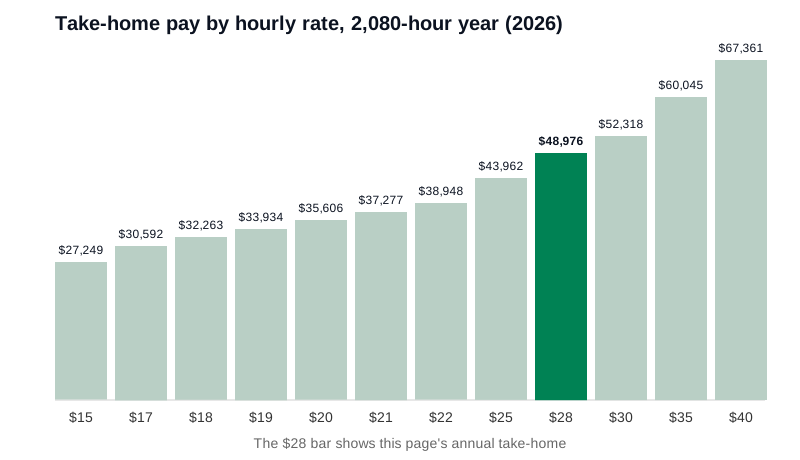
The week, the month and the year at $28 an hour
The budgeting view: $4,081 per month, $1,884 per biweekly check, $942 per week. The annual figure behind those is $48,976 — and the weekly-to-monthly conversion hides a detail worth knowing: monthly figures spread the two extra biweekly checks evenly, so real cash-flow months run slightly above and below that average.
Overtime at $28 an hour, priced
An overtime hour at $28 earns $42.00 gross, of which about $33.75 survives the combined marginal of federal income tax, Social Security and Medicare — close to eighty cents on the dollar. Double-time hours at $56.00 gross keep roughly $45.00.
Twenty-eight an hour: the rate the searches ask about
$28 an hour is among the most-searched rates in this series — the level where healthcare, skilled trades and experienced support roles overlap. The full-time conversion: $58,240 gross, $48,976 after federal tax and FICA, $4,081 a month.
Its position in the federal schedule is the reason the rate keeps climbing in demand: still inside the 12% bracket with the standard deduction long since absorbed, the marginal stack holds at roughly 80 cents kept per additional dollar. Overtime priced below uses that same stack — which is why experienced $28-an-hour workers often treat time-and-a-half as the real wage and the base rate as the floor.
More hourly rates after tax
- $15 an hour after tax
- $17 an hour after tax
- $18 an hour after tax
- $19 an hour after tax
- $20 an hour after tax
- $21 an hour after tax
- $22 an hour after tax
- $25 an hour after tax
- $30 an hour after tax
- $35 an hour after tax
- $40 an hour after tax
Related pages
Frequently asked questions
$28 an hour is how much a year after taxes?
At $28 an hour, a full 2,080-hour year is $58,240 gross and about $48,976 after taxes. That is $4,809 of federal income tax and $4,455 of Social Security and Medicare.
How much is $28 an hour a month after tax?
$4,081 per month. $28 an hour works out to $48,976 a year after federal income tax, Social Security and Medicare.
How much is $28 an hour a week after tax?
About $942 per week after tax ($1,884 on a biweekly paycheck). These figures assume a standard 40-hour week and the 2026 standard deduction.
What is $28 an hour per year before taxes?
$58,240 gross per year at $28 an hour, based on 2,080 hours (40 hours a week for 52 weeks). After taxes, take-home is about $48,976.
Is $28 an hour good pay in 2026?
$28 an hour is roughly the equivalent of a $58,240 annual salary — $48,976 take-home. Whether it is good depends on your state and cost of living; compare your take-home across states with the free paycheck calculator.
How much is $28 an hour annually after tax per paycheck?
About $1,884 per biweekly paycheck (26 pay periods) or $2,041 semimonthly. Per hour worked, that is $24 after tax.
Do these figures include state income tax?
No — this is a federal-only estimate covering federal income tax, Social Security and Medicare. Most states levy their own income tax on top, which reduces the figures above; the state paycheck calculators cover the full picture.
How much is $28 an hour overtime after tax?
Time-and-a-half hours at $28 pay $42.00 gross. After the marginal federal tax and FICA stack, roughly $33.75 of that survives — about 80 cents per overtime dollar.