$30 an hour after taxes at a glance
| Pay period | Gross pay | Take-home pay |
|---|---|---|
| Per year (2,080 hours) | $62,400 | $52,318 |
| Per month | $5,200 | $4,360 |
| Per biweekly paycheck | $2,400 | $2,012 |
| Per week | $1,200 | $1,006 |
| Per hour | $30 | $25 |
Where your $62,400 goes: the 2026 deductions
| Deduction | Amount per year |
|---|---|
| Gross annual pay ($30 × 2,080 hours) | $62,400 |
| Federal income tax (after standard deduction) | −$5,308 |
| Social Security (6.2%) | −$3,869 |
| Medicare (1.45%) | −$905 |
| Take-home pay | $52,318 |
The week, the month and the year at $30 an hour
$4,359 a month is the number to budget from: rent or mortgage, then utilities, then everything else. Across a full year that is $52,318, and it lands in the account as roughly $2,012 on each of 26 paychecks. A weekly-paid worker sees $1,006; a biweekly worker plans around the two months each year that carry three checks.
Overtime at $30 an hour, priced
An overtime hour at $30 earns $45.00 gross, of which about $36.16 survives the combined marginal of federal income tax, Social Security and Medicare — close to eighty cents on the dollar. Double-time hours at $60.00 gross keep roughly $48.21.
Thirty an hour: the milestone rate
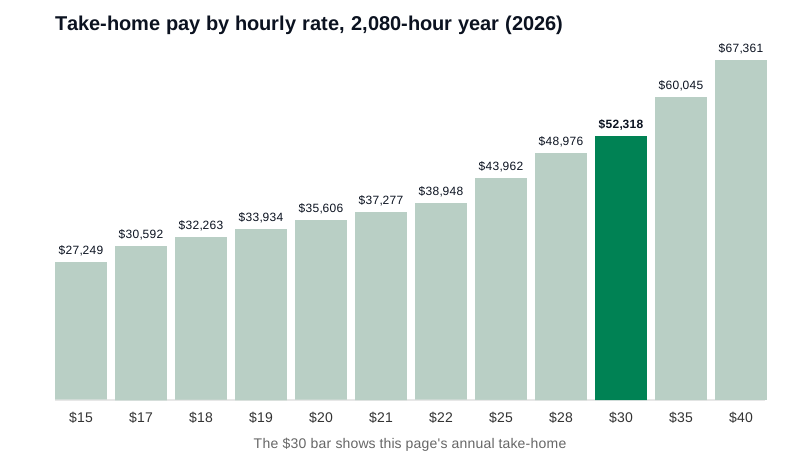
$30 an hour is the number the labor market quotes as “good pay” — and the model above shows why: $52,318 after federal tax and FICA on a $62,400 full-time year, $4,359 a month. It clears the average American salary while still priced at the 12% federal bracket for every additional hour.
The milestone deserves one piece of precision: the 22% bracket begins near $32 an hour of full-time hours, so this is the second-to-last rate in the series where overtime keeps the full ~80 cents per dollar. Workers who can shift overtime into this year rather than next are, in effect, banking hours at the cheaper marginal.
More hourly rates after tax
- $15 an hour after tax
- $17 an hour after tax
- $18 an hour after tax
- $19 an hour after tax
- $20 an hour after tax
- $21 an hour after tax
- $22 an hour after tax
- $25 an hour after tax
- $28 an hour after tax
- $35 an hour after tax
- $40 an hour after tax
Related pages
Frequently asked questions
$30 an hour is how much a year after taxes?
At $30 an hour, a full 2,080-hour year is $62,400 gross and about $52,318 after taxes. That is $5,308 of federal income tax and $4,774 of Social Security and Medicare.
How much is $30 an hour a month after tax?
$4,360 per month. $30 an hour works out to $52,318 a year after federal income tax, Social Security and Medicare.
How much is $30 an hour a week after tax?
About $1,006 per week after tax ($2,012 on a biweekly paycheck). These figures assume a standard 40-hour week and the 2026 standard deduction.
What is $30 an hour per year before taxes?
$62,400 gross per year at $30 an hour, based on 2,080 hours (40 hours a week for 52 weeks). After taxes, take-home is about $52,318.
Is $30 an hour good pay in 2026?
$30 an hour is roughly the equivalent of a $62,400 annual salary — $52,318 take-home. Whether it is good depends on your state and cost of living; compare your take-home across states with the free paycheck calculator.
How much is $30 an hour annually after tax per paycheck?
About $2,012 per biweekly paycheck (26 pay periods) or $2,180 semimonthly. Per hour worked, that is $25 after tax.
Do these figures include state income tax?
No — this is a federal-only estimate covering federal income tax, Social Security and Medicare. Most states levy their own income tax on top, which reduces the figures above; the state paycheck calculators cover the full picture.
How much is $30 an hour overtime after tax?
Time-and-a-half hours at $30 pay $45.00 gross. After the marginal federal tax and FICA stack, roughly $36.16 of that survives — about 80 cents per overtime dollar.