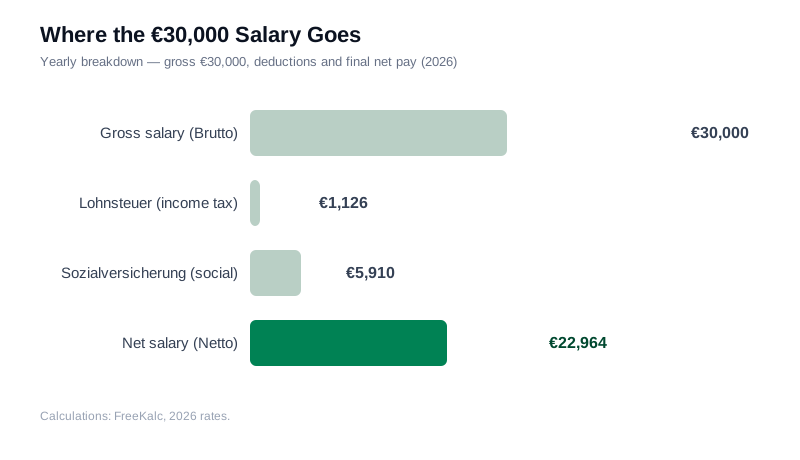
From a €30,000 brutto salary, roughly €23,091 a year is netto after tax and social contributions.
Total deductions are about 33.0% of gross — typical for a single employee in tax class I without church tax.
Understanding the German deductions
Germany combines a progressive income tax (with a €12,348 tax-free Grundfreibetrag) with high flat-rate social contributions. Health and care insurance run on a cap-free basis for most salaries, while pension contributions cap at €96,600 of gross (2026) — at €30,000 you are comfortably under it.
Your Steuerklasse matters: married couples can split income using classes IV/V or the factor method, and members of a church pay 8–9% of income tax as Kirchensteuer. Model all of these in the brutto-netto calculator, or compare with gross vs net salaries across Europe.
€30,000 brutto in netto — the month, the week, the hour
Brutto-netto conversions usually arrive as questions about the month: €1,924.25 net is what the calendar budget is built on. The year behind it is €23,091 — the figure job contracts quote, gross of everything. Per week that averages €444.06, and on a 40-hour schedule the net hourly equivalent is €11.10.
€30,000 brutto: the entry-level read
At €30,000 brutto, the deductions total €6,909 — a 23.03% share of gross, the lightest of this series. Two reasons: the €12,348 Grundfreibetrag (tax-free allowance) still shields a large slice of the income from Lohnsteuer, and the social contributions are flat percentages that hit every level identically.
€1,924.25 a month netto places this salary at the entry tier of full-time German work — apprenticeship graduates, first-office roles, and the lower band of service employment. The planning note that matters: from here, raises are taxed gently at first. The progressive schedule only reaches its full marginal rates well above this level, so the climb from €30,000 to €40,000 keeps a larger share of each raise than the climb from €50,000 upward.
Frequently asked questions
Was bleibt von 30.000 € Brutto netto?
Etwa €23,091 netto pro Jahr (rund €1,924 pro Monat) in Steuerklasse I.
Is €30,000 a good salary in Germany?
No — it is below the German full-time median of about €43,000. It covers a modest single lifestyle in most cities, but is tight in Munich, Frankfurt and Hamburg.
How much is €30,000 brutto per hour in Germany?
About €14.42 gross per hour on a 40-hour week, roughly €11.10 net.
Which deductions come off a German salary?
Lohnsteuer plus health (7.3%), care (1.8%) and pension/unemployment (10.6%) contributions. Church tax only for church members.
Which deductions come off my German salary?
Income tax (Lohnsteuer) after the €12,348 tax-free allowance, plus employee social security: 7.3% statutory health insurance, 1.8% care insurance and 10.6% pension and unemployment insurance. Church tax (8–9% of income tax) applies only to church members.
Is church tax (Kirchensteuer) included in this estimate?
No. Church tax of 8–9% of the Lohnsteuer amount is excluded, as the note above states. Members of a recognised church pay it on top — at this salary that means roughly a two-figure-to-low-three-figure euro amount per month depending on the federal state.
How much is €30,000 brutto in netto per month?
About €1,924.25 per month netto in tax class I, based on €23,091 per year after income tax and social contributions.
Estimates are for guidance only and are based on published 2026 rates for a single employee with no pension or other deductions. Always confirm with a qualified professional for financial decisions.