$40,000 after taxes in North Carolina at a glance
| Pay period | Take-home pay |
|---|---|
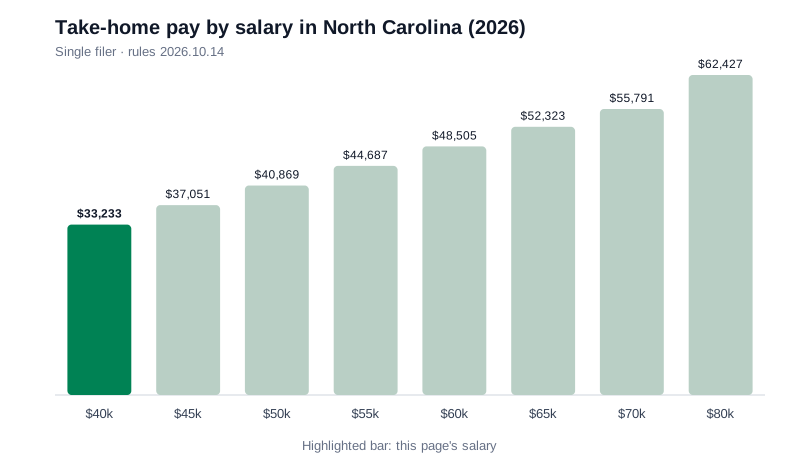
| Per year | $33,233 |
| Per month | $2,769 |
| Per biweekly paycheck | $1,278 |
| Per week | $639.09 |
| Per hour (2,080-hour year) | $15.98 |
Where your $40,000 goes: the 2026 deductions
| Deduction | Amount per year |
|---|---|
| Gross salary | $40,000 |
| Federal income tax (after standard deduction) | −$2,620 |
| Social Security (6.2%) | −$2,480 |
| Medicare (1.45%) | −$580 |
| North Carolina state income tax | −$1,087 |
| Take-home pay | $33,233 |
How North Carolina income tax works in 2026
The versioned 2026 model uses flat 3.99% after a $12,750 standard deduction. At $40,000, modeled state deductions are about $1,087 (2.7% of gross). Local taxes and individual credits are excluded.
More salaries after tax in North Carolina
- $45,000 after tax in North Carolina
- $50,000 after tax in North Carolina
- $55,000 after tax in North Carolina
- $60,000 after tax in North Carolina
- $65,000 after tax in North Carolina
- $70,000 after tax in North Carolina
- $80,000 after tax in North Carolina
$40,000 after tax in other states
- $40,000 after tax in California
- $40,000 after tax in Illinois
- $40,000 after tax in New York
- $40,000 after tax in Pennsylvania
- $40,000 after tax in Louisiana
- $40,000 after tax in Maine
- $40,000 after tax in Michigan
- $40,000 after tax in Oregon
- $40,000 after tax in Oklahoma
- $40,000 after tax in Texas
- $40,000 after tax in Florida
- $40,000 after tax in Washington
- $40,000 after tax in Georgia
Frequently asked questions
What is $40,000 after taxes in North Carolina?
About $33,233 a year or $2,769 a month for this standard single-filer 2026 estimate.
How much is that per month?
Approximately $2,769 per month, based on annual take-home divided by 12.
How much is that biweekly?
Approximately $1,278 across 26 pay periods.
What is the after-tax hourly rate?
About $15.98 per hour on a 2,080-hour work year.
How much North Carolina state tax is included?
$1,087 in modeled state deductions. Local taxes, person-specific credits and benefit deductions are not included.
Is $40,000 a good salary in North Carolina?
After modeled taxes it leaves about $2,769 a month. Affordability depends on housing, household size, insurance, debt and local living costs.