$50,000 after taxes in Delaware at a glance
| Pay period | Take-home pay |
|---|---|
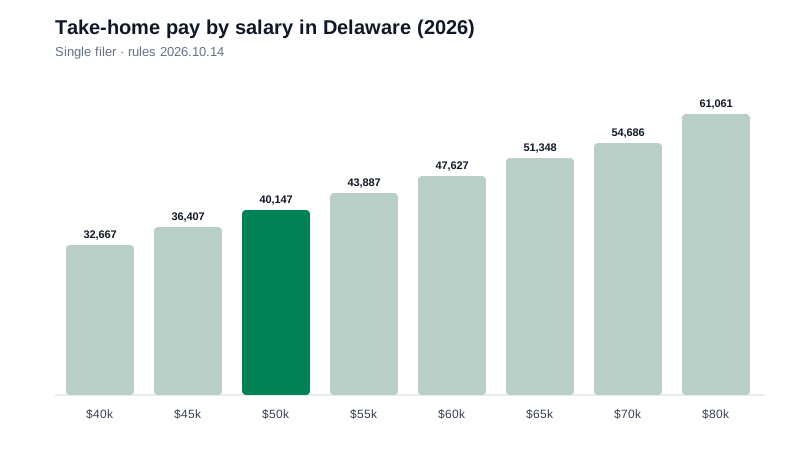
| Per year | 40,147 |
| Per month | 3,346 |
| Per biweekly paycheck | 1,544 |
| Per week | 772.06 |
| Per hour (2,080-hour year) | 19.30 |
Where your $50,000 goes: the 2026 deductions
| Deduction | Amount per year |
|---|---|
| Gross salary | $50,000 |
| Federal income tax (after standard deduction) | −3,820 |
| Social Security (6.2%) | −3,100 |
| Medicare (1.45%) | −725 |
| Delaware state income tax | −2,208 |
| Take-home pay | 40,147 |
How Delaware income tax works in 2026
The versioned 2026 model uses Delaware’s progressive schedule, which starts at a 0% bracket and climbs to 6.6% at higher incomes. Delaware does not allow local income taxes, so the state line is the whole story. At $50,000, modeled state deductions are about 2,208 (4.4% of gross).
The schedule that starts at zero: $50,000 in Delaware
Delaware’s income-tax schedule begins with a genuine 0% bracket and climbs to 6.6% at the top — and at $50,000, the blended result is $2,208 of state tax on a $40,147 take-home ($3,346 a month). Delaware law does not allow local income taxes, so unlike Pennsylvania or Michigan, no city or county adds a layer to the payslip.
What a 0% first bracket actually buys
Most states tax your first dollars at their lowest rate; Delaware exempts a slice of income entirely before the schedule begins. For earners at this salary the effect is modest but structural: the effective rate stays below the headline brackets, and lower salaries get proportionally more protection — Delaware’s schedule is one of the friendlier ones in the corridor between New York and Washington.
Where $3,346 a month lands
Wilmington and Newark sit within commuting range of both Philadelphia and Baltimore — which is the real Delaware decision at this salary. The same pay goes further in Delaware’s smaller towns and beach towns seasonal rates notwithstanding, and with no local income tax and no sales tax on most purchases, the state’s silent deductions are among the smallest on the East Coast.
More salaries after tax in Delaware
- $40,000 after tax in Delaware
- $45,000 after tax in Delaware
- $55,000 after tax in Delaware
- $60,000 after tax in Delaware
- $65,000 after tax in Delaware
- $70,000 after tax in Delaware
- $80,000 after tax in Delaware
- See the full Delaware paycheck calculator
$50,000 after tax in other states
- $50,000 after tax in California
- $50,000 after tax in Illinois
- $50,000 after tax in Michigan
- $50,000 after tax in Texas
- $50,000 after tax in Florida
- $50,000 after tax in New York
- $50,000 after tax in Pennsylvania
- $50,000 after tax in North Carolina
Frequently asked questions
What is $50,000 after taxes in Delaware?
About 40,147 a year or 3,346 a month for this standard single-filer 2026 estimate.
How much is that per month?
Approximately 3,346 per month, based on annual take-home divided by 12.
How much is that biweekly?
Approximately 1,544 across 26 pay periods.
What is the after-tax hourly rate?
About $19.30 per hour on a 2,080-hour work year.
Does Delaware have local income tax?
No — Delaware law does not allow local income taxes, so no city or county adds a layer to your paycheck. The state line on your payslip is the only income tax you pay.
How does Delaware compare to other states at $50,000?
The state tax of 2,208 is the only difference versus most of the country — a zero-tax state such as Texas keeps about 2,208 more of the same salary.