$80,000 after taxes in Delaware at a glance
| Pay period | Take-home pay |
|---|---|
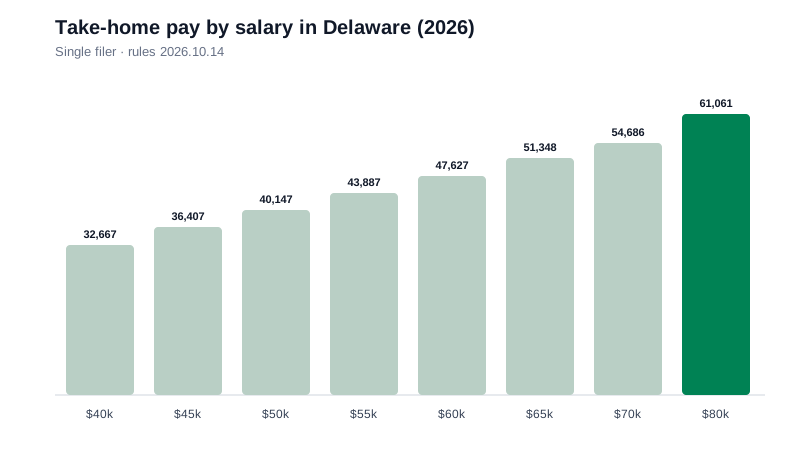
| Per year | 61,061 |
| Per month | 5,088 |
| Per biweekly paycheck | 2,348 |
| Per week | 1,174.25 |
| Per hour (2,080-hour year) | 29.36 |
Where your $80,000 goes: the 2026 deductions
| Deduction | Amount per year |
|---|---|
| Gross salary | $80,000 |
| Federal income tax (after standard deduction) | −8,770 |
| Social Security (6.2%) | −4,960 |
| Medicare (1.45%) | −1,160 |
| Delaware state income tax | −4,049 |
| Take-home pay | 61,061 |
How Delaware income tax works in 2026
The versioned 2026 model uses Delaware’s progressive schedule, which starts at a 0% bracket and climbs to 6.6% at higher incomes. Delaware does not allow local income taxes, so the state line is the whole story. At $80,000, modeled state deductions are about 4,049 (5.1% of gross).
$80,000: the salary where both schedules top out
Delaware at $80,000 is the rare page in this series where both schedules change at once: the federal 22% bracket begins (roughly $8,770 of federal tax), and Delaware’s 6.6% top band engages as taxable income crosses $60,000. The state line is $4,049; the take-home is $61,061 — $5,088 a month.
The double jump, priced
Below roughly $66,500 of gross, additional dollars cost 12% federal plus 5.55% state plus 7.65% FICA — about 75 cents kept. Above it, the top slice pays 22% federal plus 6.6% state: roughly 64 cents kept. It is the largest marginal jump in this state’s series, and it arrives as a pair — which makes the deferral levers strongest exactly here.
The lever, at full depth
A traditional 401(k) or HSA deferral at $80,000 reduces income taxed at 22% + 6.6% — nearly 29 cents of immediate relief per dollar, the deepest combined rate in this series. A $400-a-month deferral cuts withholding by roughly $110 while the employer match compounds, and Delaware’s no-local-tax structure keeps the entire calculation on two lines: federal, and the state.
More salaries after tax in Delaware
- $40,000 after tax in Delaware
- $45,000 after tax in Delaware
- $50,000 after tax in Delaware
- $55,000 after tax in Delaware
- $60,000 after tax in Delaware
- $65,000 after tax in Delaware
- $70,000 after tax in Delaware
- See the full Delaware paycheck calculator
$80,000 after tax in other states
- $80,000 after tax in California
- $80,000 after tax in Illinois
- $80,000 after tax in Michigan
- $80,000 after tax in Texas
- $80,000 after tax in Florida
- $80,000 after tax in New York
- $80,000 after tax in Pennsylvania
- $80,000 after tax in North Carolina
Frequently asked questions
What is $80,000 after taxes in Delaware?
About 61,061 a year or 5,088 a month for this standard single-filer 2026 estimate.
How much is that per month?
Approximately 5,088 per month, based on annual take-home divided by 12.
How much is that biweekly?
Approximately 2,348 across 26 pay periods.
What is the after-tax hourly rate?
About $29.36 per hour on a 2,080-hour work year.
Does $80,000 push me into a higher tax bracket?
Federally, yes: the top dollars of an $80,000 salary enter the 22% federal bracket (roughly $8,770 total federal tax). The Delaware state treatment is described above and applies at every salary level.
How does Delaware compare to other states at $80,000?
The state tax of 4,049 is the only difference versus most of the country — a zero-tax state such as Texas keeps about 4,049 more of the same salary.