Home › Spain Salary Calculator › €55,000 after tax
€55,000 After Tax in Spain
€55,000 a year after tax in Spain is about €38,271 take-home pay — €3,189 per month over 12 payments, or €2,734 over 14 pagas. Here is the exact 2026 breakdown of IRPF and Social Security.
Try the Spain salary calculatorTry your own salary
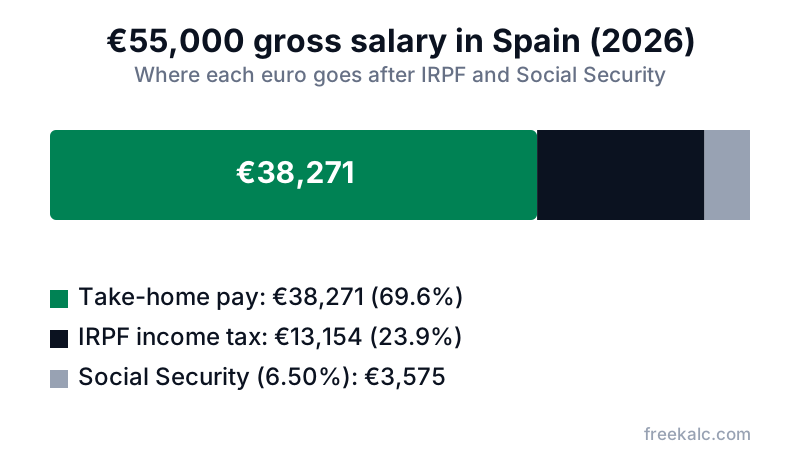
If your gross salary is €55,000 a year and you work in Spain, the number that actually lands in your bank account is smaller than the one on your contract. Here is the honest, line-by-line breakdown for 2026.
How much is €55,000 a year after tax in Spain?
| Pay period | Take-home pay |
|---|---|
| Per year | €38,271 |
| Per month (12 pagas) | €3,189 |
| Per month (14 pagas) | €2,734 |
| Per week | €736 |
| Per working day (260) | €147 |
Rates checked October 2026. Estimates assume a single employee on an indefinite contract, no children, a typical region and no pension contributions. Use the Spain salary calculator for your exact case.
Where does the money go — IRPF and Seguridad Social?
Spanish employers withhold IRPF directly from your payslip, so the figure you negotiate is never the figure you receive. Here is where your €55,000 goes.
| Deduction | Amount per year |
|---|---|
| IRPF income tax (23.9% of gross) | €13,154 |
| Seguridad Social (6.50% employee) | €3,575 |
| Total deductions | €16,677 |
| Take-home pay | €38,271 |
IRPF is Spain's progressive income tax. The state scale runs 19% on the first €12,450, 24% to €20,200, 30% to €35,200, 37% to €60,000 and 45% above, with most regions adding a similar regional scale on top (we model a typical combined 19.5/24.5/30.5/37.5/45.5%). Two reliefs matter for employees: a €5,550 personal minimum and €2,000 of deductible work expenses. On top of your gross, your employer pays roughly 30% in employer-side Social Security - about €16,500 that never shows on your payslip.
Is €55,000 a good salary in Spain?
Context matters more than the raw number. The average gross salary in Spain is around €28,627 a year (INE data), so €55,000 sits well above the national average.
For comparison, see our Spain salary calculator and the Beckham Law guide.
What a pay rise actually pays you
Spanish brackets bite harder as you climb, so a rise never pays what it promises. Here is what each extra euro actually delivers.
| Salary | Net per year | Net gain | Share of the raise kept |
|---|---|---|---|
| €55,000 (now) | €38,271 | — | — |
| €56,000 | €38,856 | +€584 | 58% of the raise |
| €57,000 | €39,440 | +€1,169 | 58% of the raise |
| €60,000 | €41,193 | +€2,922 | 58% of the raise |
Expat? The Beckham regime changes the maths
If you moved to Spain recently for work, you may qualify for the special expatriate regime (the so-called Beckham Law): a flat 24% on Spanish employment income instead of progressive IRPF. At this salary the comparison matters.
At €55,000 the Beckham regime would leave you €38,225 — that is €46 less than the ordinary system. At this level the flat rate is competitive, and it becomes clearly better if you also have foreign income it shields from Spanish tax.
Regional differences
IRPF is half national, half regional. Madrid, Andalusia and the Balearics run lower regional scales; Catalonia and Navarra run higher ones. The same €55,000 salary can move your net by about €300-400 a year depending on your postcode. Our headline figures assume a typical region; check with your payroll provider for your community's exact scale.
Frequently asked questions
How much is €55,000 a year after tax in Spain?
About €38,271 a year. That is roughly €3,189 a month over 12 payments, or €2,734 a month if your company spreads the salary over 14 pagas.
How much is €55,000 a month net?
€3,189 a month on 12 pagas, or €2,734 on 14 pagas. Many Spanish contracts split the annual salary into 12 months plus two extra summer and Christmas payments.
What IRPF rate will I pay on €55,000?
Your effective IRPF rate is about 24.0% of gross, because the first slices are taxed at lower rates and you get a personal allowance. Your top (marginal) slice is taxed at 37.5%.
Is Social Security 6.50% in Spain?
Yes, employees on an indefinite contract contribute 6.50% of gross (4.70% common contingencies, 1.55% unemployment, 0.10% training, 0.15% MEI). Your employer pays roughly 30% on top of your gross salary on its own side.
Does my region change how much tax I pay?
Yes, slightly. Each autonomous community sets part of the IRPF scale, so the same salary can differ by roughly €300-400 a year - Madrid is at the low end, Catalonia and Navarra at the high end. Our figures assume a typical region.
Is the Beckham regime better at this salary?
At €55,000 the Beckham regime would leave you €38,225 — that is €46 less than the ordinary system. At this level the flat rate is competitive, and it becomes clearly better if you also have foreign income it shields from Spanish tax.
Is €55,000 above the average salary in Spain?
The average gross salary in Spain is about €28,627 a year (INE), so €55,000 is well above average. Keep in mind the cost of living gap between Madrid or Barcelona and cities like Valencia or Seville.
Do the 14 pagas change my annual net?
No. The annual take-home is the same; only the monthly instalment changes. Twelve payschecks are simply larger than fourteen.
Related pages
Spain Salary Calculator
All salaries from €25k to €60k
Beckham Law Spain
The 24% expat flat tax compared
Spain VAT Calculator
21%, 10% and 4% IVA rates
€45,000 After Tax Spain
Take-home pay on a €45k salary
€50,000 After Tax Spain
Take-home pay on a €50k salary
€60,000 After Tax Spain
Take-home pay on a €60k salary
Sources: Social Security contribution rates and bases: Seguridad Social - bases y tipos de cotización. Income tax brackets and withholding: Agencia Tributaria (AEAT). Average salary: Instituto Nacional de Estadística. Beckham regime: Royal Decree 1003/2023 (BOE).