$65,000 after taxes in California at a glance
| Pay period | Take-home pay |
|---|---|
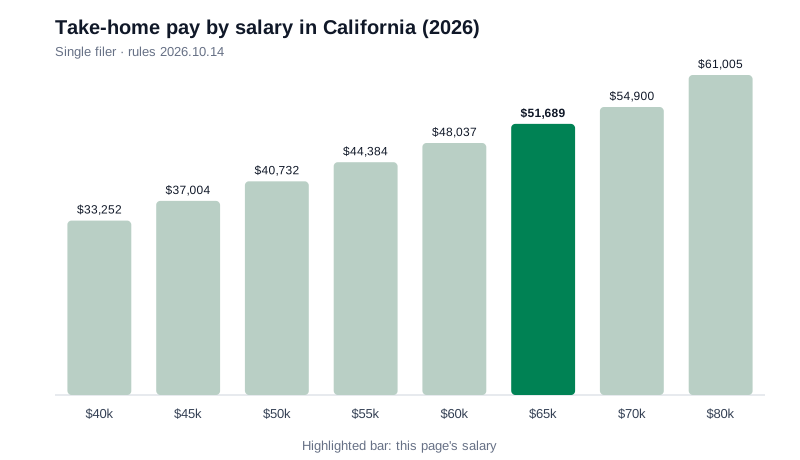
| Per year | $51,689 |
| Per month | $4,307 |
| Per biweekly paycheck | $1,988 |
| Per week | $994.03 |
| Per hour (2,080-hour year) | $24.85 |
Try it: what would you take home on $65,000 in California?
The calculator is pre-set to California — adjust the salary, filing status or 401(k) contribution below. Every figure uses the same 2026 rate model as this page.
State estimates currently support single filers only.
Where your $65,000 goes: the 2026 deductions
| Deduction | Amount per year |
|---|---|
| Gross salary | $65,000 |
| Federal income tax (after standard deduction) | −$5,620 |
| Social Security (6.2%) | −$4,030 |
| Medicare (1.45%) | −$943 |
| California state income tax | −$1,873 |
| State Disability Insurance (SDI 1.3%) | −$845 |
| Take-home pay | $51,689 |
How California income tax works in 2026
The versioned 2026 model uses official 2026 Schedule X brackets, $5,900 deduction, $158 personal credit, plus 1.3% SDI. At $65,000, modeled state deductions are about $2,718 (4.2% of gross). Local taxes and individual credits are excluded. Primary 2026 rule sources: official source 1; official source 2.
Why $65,000 in California keeps less than in most states
California is the highest-tax state in this series, and the deduction table above shows exactly where the money goes. Unlike states with flat rates, California runs a long progressive schedule whose brackets are narrow at ordinary salaries — by $65,000 of gross pay your income is already several bands deep, and each additional dollar is taxed at a higher state rate than the average dollar before it. The result: about $13,311 of the $65,000 sample never reaches your bank account.
The two structural reasons take-home is squeezed
First, California's standard deduction for a single filer is small compared with most states — around $5,706 — so a far larger share of a $65,000 salary is exposed to tax than in North Carolina or Louisiana, whose deductions shelter two to three times as much income. Second, the schedule's upper brackets arrive early: by this salary your California marginal band is already well into single digits, and it climbs from here. A raise in California genuinely costs more per dollar than the same raise in Texas, Florida or Washington.
Your marginal stack on the next dollar
- Federal: the 12% bracket still covers this salary after the $16,100 standard deduction.
- FICA: 7.65% on every wage dollar, unchanged by state.
- California: a mid-schedule marginal band on income after the small state deduction — the largest state-tax slice in this state series.
Add the layers and each additional dollar keeps roughly seventy cents; each dollar routed into a traditional 401(k), HSA or commuter-benefit account escapes both the federal and the California band immediately. At no salary level in America is the deferral argument stronger than in California's bracket range.
The relocation math people run on this page
The comparison Californians most often make is against Texas, Nevada or Washington, where the state column is $0. At $65,000 the difference approaches $4,000–$5,000 a year once the bracket depth is accounted for. The honest version of that math includes the wage premium California salaries often carry: many occupations pay 10–20% more in California precisely because employers price part of the tax burden in. Run both sides of that equation in the calculator above before assuming the zero-tax state wins.
More salaries after tax in California
- $40,000 after tax in California
- $45,000 after tax in California
- $50,000 after tax in California
- $55,000 after tax in California
- $60,000 after tax in California
- $70,000 after tax in California
- $80,000 after tax in California
$65,000 after tax in other states
- $65,000 after tax in Illinois
- $65,000 after tax in North Carolina
- $65,000 after tax in New York
- $65,000 after tax in Pennsylvania
- $65,000 after tax in Louisiana
- $65,000 after tax in Maine
- $65,000 after tax in Michigan
- $65,000 after tax in Oregon
- $65,000 after tax in Oklahoma
- $65,000 after tax in Texas
- $65,000 after tax in Florida
- $65,000 after tax in Washington
- $65,000 after tax in Georgia
Frequently asked questions
What is $65,000 after taxes in California?
About $51,689 a year or $4,307 a month for this standard single-filer 2026 estimate.
How much is that per month?
Approximately $4,307 per month, based on annual take-home divided by 12.
How much is that biweekly?
Approximately $1,988 across 26 pay periods.
What is the after-tax hourly rate?
About $24.85 per hour on a 2,080-hour work year.
How much California state tax is included?
$2,718 in modeled state deductions. Local taxes, person-specific credits and benefit deductions are not included.
Is $65,000 a good salary in California?
After modeled taxes it leaves about $4,307 a month. Affordability depends on housing, household size, insurance, debt and local living costs.