First-Time Buyer Stamp Duty Relief 2026
Rates verified against HMRC SDLT tables · October 2026
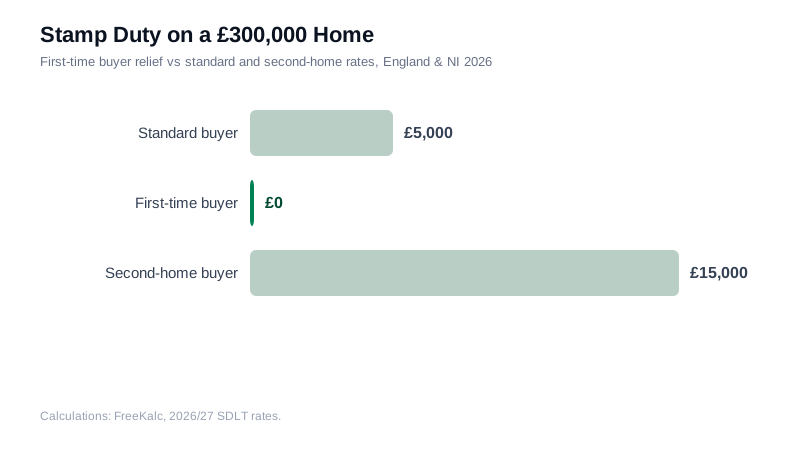
First-time buyers pay zero stamp duty on the first £300,000 of a home in England or Northern Ireland — a £300,000 first home costs £0 in SDLT.
Open the stamp duty calculatorFirst-time buyer stamp duty rates 2026
| Price slice | First-time buyer rate | Standard rate |
|---|---|---|
| £0 – £300,000 | 0% | 0% to £125,000, then 2% |
| £300,000 – £500,000 | 5% | 5% |
| Over £500,000 | Standard rates (relief lost) | 5% to £925,000, then 10%/12% |
What a first home costs in stamp duty
| Property price | First-time buyer | Standard buyer |
|---|---|---|
| £250,000 | £0 | £2,500 |
| £300,000 | £0 | £5,000 |
| £350,000 | £2,500 | £7,500 |
| £400,000 | £5,000 | £10,000 |
| £500,000 | £10,000 | £15,000 |
| £600,000 | £20,000 | £20,000 |
Who qualifies as a first-time buyer?
You have never owned a residential property anywhere in the world — including a share of one, or an inherited property. For joint purchases, every buyer must meet this test; one previous homeowner on the deed cancels the relief for the whole purchase.
Worked example: a £450,000 first home
Relief changes both the rates and the 0% band. For a £450,000 first home:
| Buyer | Calculation | SDLT paid |
|---|---|---|
| First-time buyer | 0% to £300,000 + 5% on £150,000 | £7,500 |
| Standard buyer | 0% + 2% + 5% bands | £12,500 |
| Relief saves | — | £5,000 |
At £450,000 the relief is worth £5,000, and below £300,000 it removes the bill entirely. The relief rules are published by HMRC on gov.uk. For all other prices see the full stamp duty rate tables or work out your exact bill with the stamp duty calculator.
Frequently asked questionsDo first-time buyers pay stamp duty?
In England and Northern Ireland, first-time buyers pay nothing on the first £300,000 and 5% on the portion between £300,000 and £500,000. Above £500,000 the relief disappears and standard rates apply.
Who counts as a first-time buyer for stamp duty?
Someone who has never owned a freehold or leasehold property anywhere in the world, including inherited property. For joint buyers, every person on the mortgage must qualify.
How much stamp duty does a first-time buyer pay on £350,000?
£2,500 — 5% on the £50,000 between the £300,000 relief threshold and the purchase price.
Does first-time buyer relief apply to buy-to-let?
No. The relief only applies to a home you intend to live in as your main residence. A buy-to-let purchase pays the additional-property surcharge instead.
Can a first-time buyer claim relief on a £600,000 home?
No. The relief ends completely above £500,000, so a £600,000 purchase pays the standard £20,000.
Do first-time buyers pay stamp duty on a £600,000 house?
Yes — the full standard amount. Above £500,000 the relief is lost entirely: a £600,000 first home pays £20,000, the same as a standard buyer.
Does first-time buyer relief exist in Scotland and Wales?
This page covers England and Northern Ireland SDLT. Scotland (LBTT) and Wales (LTT) run their own systems with their own reliefs — check the local rules before assuming the £300,000 zero-rate applies.
The £500,000 cliff — and the £600,000 trap
Relief does not taper as the price rises; it switches off. Above £500,000 the first-time buyer bands vanish and standard rates apply to the whole price — which is why a £600,000 first home pays the full £20,000, exactly the same as any other buyer. The numbers reward buying just inside the boundary: at £500,000 the relief is worth £5,000 against the standard £15,000 bill; at £505,000 it is worth nothing and the bill jumps. Negotiating £10,000 off a £510,000 asking price is worth more than £10,000 in tax to a first-time buyer — the purchase price carries the £5,000 relief with it across the line. Buyers close to the ceiling should price the cliff into every offer before exchange.
Related pages
- Stamp Duty Calculator — check any price instantly
- Second Home Stamp Duty 2026
- Stamp Duty Rates 2026: full band tables
- Mortgage Payment Calculator
Sources: gov.uk SDLT rates and HMRC. Rates last verified October 2026. Estimates only — see our editorial policy.