Home › UK Salary Calculator › Tax code 1257L
Tax Code 1257L Explained (UK 2026)
1257L is the UK's default tax code for 2026/27. The numbers mean: 12,570 = your tax-free personal allowance, and L = you get the standard tax-free allowance. Roughly 27 million people are on 1257L or an equivalent emergency code. Here is what it means for your pay.
Try the UK salary calculator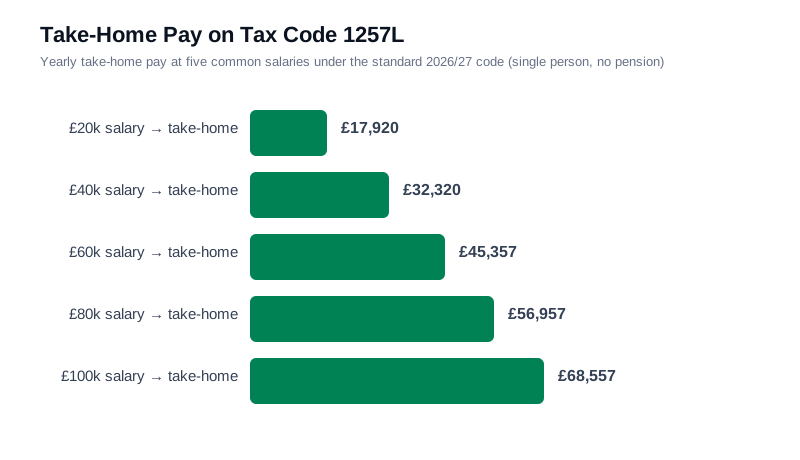
What does tax code 1257L mean?
The code tells your employer to ignore the first £12,570 of your annual salary when calculating income tax. Everything above that is taxed at 20% up to £50,270, then 40% up to £125,140, then 45%. National Insurance is separate and does not depend on your tax code.
Take-home pay on tax code 1257L by salary
| Gross salary | Take-home (year) | Take-home (month) | Total tax + NI | Effective rate |
|---|---|---|---|---|
| £20,000 | £17,920 | £1,493 | £2,080 | 10% |
| £30,000 | £25,120 | £2,093 | £4,880 | 16% |
| £40,000 | £32,320 | £2,693 | £7,680 | 19% |
| £50,000 | £39,520 | £3,293 | £10,480 | 21% |
| £60,000 | £45,357 | £3,780 | £14,643 | 24% |
| £80,000 | £56,957 | £4,746 | £23,043 | 29% |
| £100,000 | £68,557 | £5,713 | £31,443 | 31% |
Rates checked October 2026. Based on standard allowances and no pension or student loan. Model your exact figures in the UK salary calculator.
Why is my tax code not 1257L?
Common variations: 1257L W1/M1/X (emergency, week-by-month basis after a job change), K codes (deductions like a company car exceed your allowance), BR/0T/D0/D1 (second jobs taxed at flat rates), and Scotland-specific S-codes with different bands. If your income passes £100,000 your effective allowance reduces but the code often stays 1257L while HMRC collects the shortfall through self-assessment.
Common UK tax codes and what they mean
| Code | What it means |
|---|---|
| 1257L | The standard code: tax-free pay of £12,570, with L meaning you get the basic personal allowance. |
| BR | Basic Rate: all pay is taxed at 20% with no allowance. Typically a second job or pension. |
| D0 | All pay taxed at 40% — usually a second income when your main job already uses the allowance and basic band. |
| D1 | All pay taxed at 45% — second incomes for higher earners. |
| 0T | No tax-free allowance: taxed at normal bands on every pound. Happens when your allowance is used up elsewhere or HMRC lacks your details. |
| NT | No tax collected from this income at all. |
| K codes (e.g. K497L) | Untaxed benefits (a company car, or a state pension) exceed your allowance, so the excess is added to your taxable pay. |
| W1 / M1 / X | Emergency codes: each week or month is taxed in isolation, ignoring year-to-date pay — often after a job change. |
| S1257L | The Scottish version — same allowance, Scottish bands. See the Scottish income tax calculator. |
| C1257L | The Welsh version — same allowance, Welsh rates (currently aligned with the UK bands). |
Wrong code? HMRC adjusts it automatically once your employer reports pay, but a quick check at the start of each tax year avoids overpaying.
When to check your tax code
Check after changing jobs, getting a pay rise across the £100,000 threshold, starting pension contributions, or receiving an HMRC adjustment letter. You can see your code on your payslip, in your personal tax account on gov.uk, or via the HMRC app. Wrong codes are most common in the first months after a job change — HMRC repays over-collected tax automatically once corrected.
Frequently asked questions
Is 1257L the correct tax code for most people?
Yes — 1257L is the standard code for 2026/27 for anyone with one job and no untaxed income, benefits or underpaid tax from earlier years.
What is the difference between 1257L and 1257L W1?
W1/M1 (week-one/month-one) is an emergency version that ignores your year-to-date earnings and pays no cumulative refund. It usually appears right after a job change and corrects itself once HMRC updates your record.
How much more take-home does 1257L give than the old codes?
The numbers change each tax year with the personal allowance. For 2026/27 the allowance is £12,570 — the code itself simply tells your employer this figure.
Does National Insurance use the 1257L tax code?
No. NI is calculated from gross earnings above £12,570 at 8% up to £50,270, then 2% above that, regardless of your tax code.