How much is £120,000 a year after tax in the UK?
| Pay period | Take-home pay |
|---|---|
| Per year | £76,157.40 |
| Per month | £6,346.45 |
| Every 4 weeks | £5,858.26 |
| Per week | £1,464.57 |
| Per day (260 working days) | £292.91 |
| Per hour (37.5-hour week) | £39.06 |
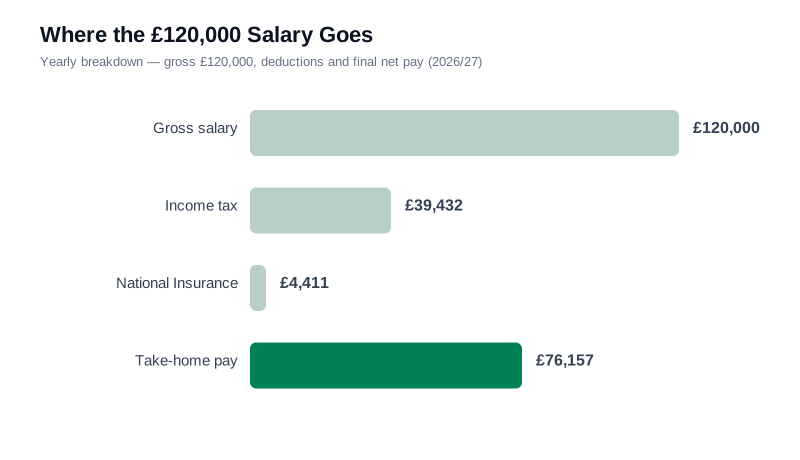
From £120,000 gross, you keep £76,157.40 — about 63% of everything you earn. The rest goes to income tax (£39,432) and National Insurance (£4,411).
Where does the money go — tax, NI and take-home?
| Deduction | Amount per year |
|---|---|
| Gross salary | £120,000.00 |
| Personal allowance | £2,570.00 tax-free (tapered above £100,000) |
| Income tax (20%/40% bands, reduced allowance) | −£39,432.00 |
| National Insurance (8% to £50,270, then 2%) | −£4,410.60 |
| Take-home pay | £76,157.40 |
Your pay sits in the taper zone: for every pound earned between £100,000 and £125,140 you lose 50p of personal allowance, so the effective marginal rate reaches about 62% (40% tax + 20% taper + 2% NI).
Student loan deductions on 120k: all five plans
Student loan deductions are taken after income tax and NI, so they sit on top of the deductions above. Here is what each plan does to your monthly pay at this salary level:
| Plan | Repayment threshold | Rate | Annual deduction |
|---|---|---|---|
| Plan 1 | £26,900.00 | 9% | £8,379.00 |
| Plan 2 | £29,385.00 | 9% | £8,155.35 |
| Plan 4 | £33,795.00 | 9% | £7,758.45 |
| Plan 5 | £25,000.00 | 9% | £8,550.00 |
| Postgraduate | £21,000.00 | 6% | £5,940.00 |
The earliest repayments start on Plan 5 (£25,000 threshold) and postgraduate loans (£21,000). Plan 4, the Scottish scheme, uses a £33,795 threshold. If you hold both Plan 1 and Plan 2 loans, you repay each once your income clears the Plan 1 bar.
What a pay rise actually pays you
The table shows the exact net gain for typical rises at this salary — computed with the 2026/27 bands, allowance taper and both NI rates:
| Pay rise | Tax + NI on the rise | Extra take-home |
|---|---|---|
| +£1,000 (to £121,000) | −£620.00 | +£380.00 net |
| +£2,500 (to £122,500) | −£1,550.00 | +£950.00 net |
| +£5,000 (to £125,000) | −£3,100.00 | +£1,900.00 net |
| +£10,000 (to £130,000) | −£5,471.00 | +£4,529.00 net |
A £2,500 pay rise works out at roughly £79.17 more a month — the marginal rate on your next pound is 62%.
Monthly budget on 120k: the 50/30/20 rule
A common budgeting split for a take-home of £6,346.45 a month:
| Category | Share | Monthly amount | Typical use |
|---|---|---|---|
| Needs | 50% | £3,173.22 | Rent, utilities, food, transport, minimum debt payments |
| Wants | 30% | £1,903.93 | Dining out, streaming, gym, hobbies, travel |
| Savings & debt payoff | 20% | £1,269.29 | Emergency fund, pension top-ups, overpaying debt |
Mortgage lenders typically cap borrowing near 4.5× gross salary, so a 120k income supports roughly a £540,000 mortgage — enough for a first flat in most regional cities with a 10% deposit.
What about Scotland?
Scottish income tax uses different bands — a 19% starter rate, then 20%, then a 21% intermediate rate, with higher rates of 42% and 45% (48% on income above £75,000). At this salary level the practical difference is small: expect your take-home to be within about £5 a week of the figures on this page. National Insurance is the same UK-wide.
Does a pension change this?
The figures above assume no pension contributions. Auto-enrolment takes a minimum 5% of your salary pre-tax, but because contributions reduce taxable pay the hit to take-home is only about £360.00 a month at the 5% minimum — and your employer adds at least 3% on top. Above £100,000, salary-sacrifice contributions also reduce adjusted net income and can restore tapered personal allowance — often the single best financial move at this salary.
Is 120k a good salary in the UK?
£120,000 puts you in the top 3% of UK full-time earners — near the top of the personal allowance taper zone, with only a sliver of tax-free allowance left.
£6,346 a month is top-3% money — executive-level buying power in every UK city. You are near the top of the taper zone, so pay rises from here are taxed at 62% until your allowance is fully gone, then 47%.
Frequently asked questions
Is £120,000 a year a good salary in the UK in 2026?
£120,000 puts you in the top 3% of UK full-time earners — near the top of the personal allowance taper zone, with only a sliver of tax-free allowance left. Against a median of about £37,430, this is well above the typical UK wage.
How much is £120,000 a year per month after tax?
Take-home pay is £76,157.40 a year, which is £6,346.45 per month after income tax and National Insurance. With a student loan the figure is lower — see the student loan table above.
How much is £120,000 a year per hour after tax?
On a standard 37.5-hour week (1,950 paid hours a year), £120,000 gross is £61.54 an hour, and your take-home works out at about £39.06 an hour.
How much National Insurance do I pay on £120,000?
Yes — 8% on earnings between £12,570 and £50,270, then 2% on everything above that. On £120,000 that comes to £4,411 a year. Employer NI (15%) is paid on top by your employer, not you.
How much student loan comes out of a £120,000 salary?
It depends on your plan. On Plan 1 (threshold £26,900) you repay 9% of earnings above it; on Plan 2 (threshold £29,385) the same rate applies above a higher bar. The table above shows the exact deduction for all five plans, including the 6% postgraduate rate.
Is £120,000 after tax different in Scotland?
Yes — Scottish bands (19/20/21/42/45/48%) bite at lower thresholds than the UK-wide 20/40/45% rates, and the gap widens with income. At this salary expect a few pounds a week less in Scotland. NI is the same everywhere in the UK.
What happens to my take-home if I get a pay rise from £120,000?
Your pay sits in the taper zone: for every pound earned between £100,000 and £125,140 you lose 50p of personal allowance, so the effective marginal rate reaches about 62% (40% tax + 20% taper + 2% NI). Check the pay-rise table above for exact net gains at £1,000, £2,500, £5,000 and £10,000.
Does a workplace pension change these figures?
Yes — and above £100,000 it matters twice over. Contributions come out of pre-tax pay, and salary-sacrifice pension contributions also reduce your adjusted net income, which can restore some of the tapered personal allowance. Many higher earners deliberately pension-salary-sacrifice down toward £100,000 for exactly this reason. Use the UK salary calculator to model your exact contribution.
Calculations follow HMRC's 2026/27 rules: £12,570 personal allowance (tapered above £100,000), the 20/40/45% income tax bands, and NI at 8% on income up to £50,270 and 2% above it. Student loan deductions use the 2026/27 thresholds. Treat these as estimates and speak to a qualified professional before acting.
Related pages
UK salary calculator · £110,000 After Tax UK · £150,000 After Tax UK · Student loan repayments · US take-home pay by state · Average salary Ireland