Home › Ireland Salary Calculator › Average salary in Ireland
Average Salary in Ireland (2026)
The latest CSO figures put average weekly earnings in Ireland at €1,075.58 in Q1 2026 — up 4.4% year on year, and equivalent to about €55,900 a year before deductions. Median full-time earnings are lower, around €48,900, because the average is pulled up by high earners.
Try the Ireland salary calculator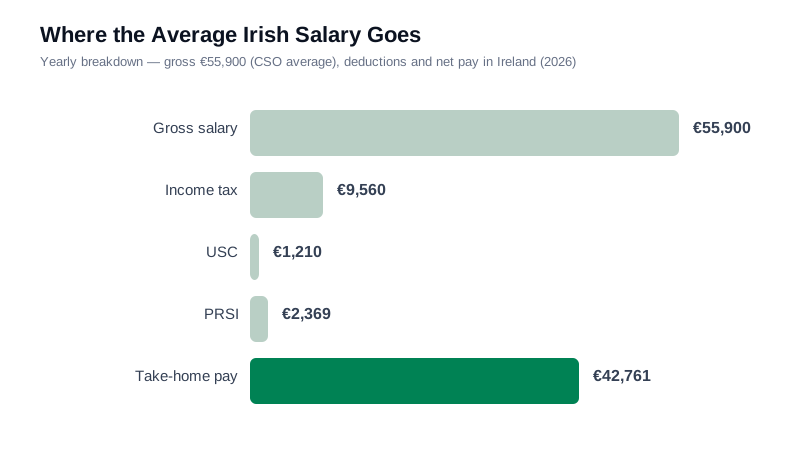
Average salary in Ireland 2026 — the headline numbers
| Measure | Value | Source |
|---|---|---|
| Average weekly earnings (Q1 2026) | €1,075.58 | CSO Earnings and Labour Costs |
| Average annual earnings (52 weeks) | ≈ €55,900 | CSO |
| Median full-time annual earnings | ≈ €48,900 | derived from CSO distribution data |
| Average hourly earnings | €33.13 | CSO Q1 2026 |
How much is the average salary after tax?
A worker on the average €55,900 keeps roughly €42,761 a year after income tax, USC and PRSI — about €3,570 a month. See the full breakdown on our €50,000 after tax and €60,000 after tax pages.
Salaries by sector (CSO, 2025-2026)
The highest average earnings are in information and communication (ICT), financial services and professional sectors, often well above €1,200 per week. Accommodation and food services sit at the bottom, below €600 per week on average. Dublin pays roughly 15-20% above the national average, offset by higher living costs.
Rates checked October 2026. Sources: CSO Earnings and Labour Costs Q1 2026, Revenue.ie. See also our Ireland salary calculator and the Irish income tax guide.
Average vs median: which figure describes your offer
The two numbers answer different questions. The average (€55,900) is the arithmetic mean of everyone’s earnings, pulled upward by the top of the distribution — a small number of very high salaries lifts it well above what the typical worker earns. The median (€48,900) is the middle worker: half of full-time earners make less, half make more. When a job offer is described as “around average”, the median is usually the honest benchmark; when a headline quotes the average, it is quoting a figure most earners sit below.
Practically: an offer of €55,900 beats roughly two-thirds of Irish full-time salaries, while an offer of €48,900 sits at the exact middle. Both are healthy salaries — but negotiating against the average when the role is median-shaped leaves money on the table.
The Dublin premium, priced honestly
Dublin salaries run roughly 15–20% above the national average — on €55,900 that is about €8,400–€11,200 of additional gross pay. The offsetting cost is concentrated almost entirely in housing: Dublin rents price so far above the national figure that the premium rarely survives the lease. The standard calculation most Dublin workers run: the extra salary minus the extra rent, and — outside the specialist sectors — it frequently nets close to zero.
The premium does survive in two cases: roles that exist mainly in Dublin (HQ, tech, finance) with no lower-cost alternative, and households where the second income benefits from the deeper Dublin labour market. For everyone else, the remote-era question — Dublin salary, non-Dublin rent — is the highest-value arbitrage available.
Budgeting the average: €3,570 a month
The average net of €42,761 arrives as roughly €3,570 a month. On the standard 50/30/20 split that is about €1,785 for needs (rent, transport, food, utilities), €1,071 for wants, and €714 for savings and debt paydown. The needs line is where Irish budgets strain: outside Dublin the 50% needs budget is comfortable, inside Dublin the rent alone can consume most of it — which is why the city decision, not the salary, dominates most household outcomes at this income.
The average hourly figure: €33.13 in context
CSO average hourly earnings of €33.13 convert to roughly €64,830 across 1,960 annual hours — well above the €55,900 average annual figure, because hourly averages weight part-time and full-time work differently than annual averages do. The two numbers describe the same market from different angles, and the annual figure remains the better one for comparing offers.
Frequently asked questions
What is a good salary in Ireland in 2026?
Anything above €60,000 puts a single earner comfortably in the upper half of earners. The average is about €55,900; median full-time pay is around €48,900.
Is €40,000 a good salary in Ireland?
It is slightly below the national average but livable outside Dublin. See our €40,000 after tax breakdown for the take-home figures.
How does Dublin compare?
Dublin salaries average roughly 15-20% higher than the national figure, but rents are dramatically higher — net living standards depend heavily on rent.
Is €55,900 a good salary in Ireland?
Yes — it is above the median full-time salary of about €48,900, meaning it beats roughly two-thirds of full-time earners. Net of tax, USC and PRSI it leaves about €3,570 a month.
Is the average salary rising?
Yes — CSO figures show average weekly earnings up 4.4% year on year in Q1 2026, a pace above inflation, which means real average purchasing power is growing.
Popular Ireland salary breakdowns
Exact 2026 take-home pay for every common salary:
- €30,000 after tax in Ireland
- €35,000 after tax in Ireland
- €36,000 after tax in Ireland
- €37,000 after tax in Ireland
- €38,000 after tax in Ireland
- €39,000 after tax in Ireland
- €40,000 after tax in Ireland
- €41,000 after tax in Ireland
- €42,000 after tax in Ireland
- €43,000 after tax in Ireland
- €44,000 after tax in Ireland
- €45,000 after tax in Ireland
- €50,000 after tax in Ireland
- €60,000 after tax in Ireland
- €70,000 after tax in Ireland
- €80,000 after tax in Ireland
Related pages
Ireland Salary Calculator
Full take-home model with USC and PRSI
Irish Income Tax Guide
Bands, credits, USC and PRSI explained
€60,000 After Tax Ireland
Take-home pay on a €60k salary
€30,000 After Tax Ireland
Take-home pay on a €30k salary
€40,000 After Tax Ireland
Take-home pay on a €40k salary
€42,000 After Tax Ireland
Take-home pay on a €42kk salary
€45,000 After Tax Ireland
Take-home pay on a €45kk salary
€70,000 After Tax Ireland
Take-home pay on a €70k salary
€80,000 After Tax Ireland
Take-home pay on a €80k salary