Home › Ireland Salary Calculator › €35,000 after tax
€35,000 After Tax in Ireland
A €35,000 salary in Ireland lands you a whisker from the €30,000 take-home milestone — about €29,980 a year — and every euro of it still sits inside the 20% tax band in 2026. Irish take-home pay is made up of three deductions — income tax, USC (Universal Social Charge) and PRSI — and on a €35,000 salary here is exactly what you keep in 2026. Ireland's average weekly earnings were €1,075.58 in Q1 2026 (CSO) — about €55,900 a year.
Try the Ireland salary calculator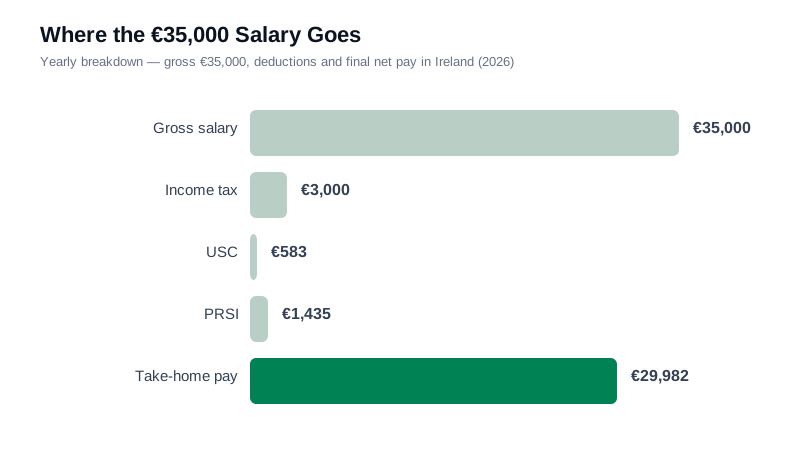
How much is €35,000 a year after tax in Ireland?
| Pay period | Take-home pay |
|---|---|
| Per year | €29,934 |
| Per month | €2,495 |
| Per week | €576 |
| Per hour (37.5-hour week) | €15.38 |
Rates checked October 2026. Estimates assume a single person with standard tax credits, no pension (PRSA) contributions and no tax-saver benefits. Use the Ireland salary calculator for your exact case.
Where does the money go — income tax, USC and PRSI?
| Deduction | Amount per year |
|---|---|
| Income tax (20% up to €44,000 band, 40% above) | €3,000 |
| USC (0.5%, 2%, 3% bands) | €583 |
| PRSI (4.24% employee, 2026 blend) | €1,483 |
| Total deductions | €5,018 |
| Take-home pay | €29,934 |
Your income tax is reduced by €4,000 in annual tax credits (€2,000 personal + €2,000 PAYE employee credit). The USC bands for 2026 are 0.5% on the first €12,012, 2% up to €28,700 and 3% up to €70,044. Employee PRSI is 4.2% on all earnings, rising to 4.35% from 1 October 2026. A €35,000 salary stays fully inside the €44,000 standard-rate band, so income tax is a flat 20% after your €4,000 in credits — the 40% rate is nowhere in sight.
Is €35k a good salary in Ireland?
A €35,000 salary sits below Ireland's average full-time earnings of roughly €55,900 a year (CSO, Q1 2026) but above most starting salaries and the Living Wage benchmark for a single person. Outside Dublin it funds a comfortable lifestyle; in Dublin it works with a flat-share or a commute.
For context, see our average salary in Ireland data page and the Irish income tax guide.
€35,000 a year: hourly, daily, weekly and monthly pay
On a standard 37.5-hour week, a €35,000 gross salary works out at €17.95 an hour before tax and about €15.38 an hour after tax. Spread across the pay periods, the gross and net figures look like this:
| Pay period | Gross pay | Take-home pay |
|---|---|---|
| Per hour (37.5-hour week) | €17.95 | €15.38 |
| Per day (5-day week) | €135 | €115 |
| Per week | €673 | €576 |
| Per month | €2,917 | €2,495 |
| Per year | €35,000 | €29,934 |
The next step crosses the €30,000 net milestone: see €36,000 after tax in Ireland for the breakdown.
€35k compared to the Irish average salary
CSO earnings data for Q1 2026 puts average weekly earnings at about €1,075 (roughly €56,000 a year across the whole workforce), with the median full-time salary nearer €49,000. A €35,000 salary therefore sits below the median but well within the middle of the Irish earnings distribution — for the full picture by sector and county, see our average salary in Ireland 2026 breakdown.
How far does €35k go: Dublin vs outside Dublin
Where you live changes the answer more than the tax code does. Renting a one-bedroom flat in Dublin city typically costs roughly €1,800–€2,200 a month in 2026, which would take a large slice of your €2,495 monthly take-home pay. The same flat in towns across the midlands, the west or Donegal is usually in the €900–€1,300 range, leaving a very different quality of life on the identical salary. Commuter towns in Meath, Kildare and Wicklow sit between the two, once commuting costs are weighed up.
Outside rent, a single person on €35k generally covers groceries, utilities, transport and some savings without strain outside Dublin — and in Dublin it is workable with a flat-share or a longer commute.
What a pay rise actually pays you
Pay rises in Ireland are taxed at your marginal rate. While you stay under €44,000 that rate is 20% income tax + 3% USC + 4.24% PRSI = 27.2% — you keep roughly 73c of each extra euro.
| Pay rise | Tax + USC + PRSI on the rise | Extra take-home |
|---|---|---|
| +€1,000 (to €36,000) | −€272 | +€728 net |
| +€2,500 (to €37,500) | −€681 | +€1,819 net |
| +€5,000 (to €40,000) | −€1,362 | +€3,638 net |
| +€10,000 (to €45,000) | −€2,924 | +€7,076 net |
Rent tax credit, pension and what your employer really pays
Three things the raw salary misses:
- Rent Tax Credit: renters can claim up to €1,000 a year (€2,000 for jointly assessed couples) against income tax — worth up to €83 a month of take-home. Claim it through Revenue's MyAccount.
- Pension relief: contributions to a PRSA or occupational scheme get income tax relief at your marginal rate — 20% here, or effectively 47.4% for the portion of a contribution that would have been taxed at the top rate.
- Employer PRSI: on top of your €35,000 salary your employer pays Class A PRSI of about €3,951 (11.25%, rising to 11.40% from 1 October 2026), so your total cost to them is roughly €38,951 a year — useful ammunition in pay negotiations.
Frequently asked questions
How much is €35,000 after tax per month in Ireland?
About €2,495 per month after income tax, USC and PRSI (single person, 2026 rates).
Does a €35,000 salary pay the 40% higher rate in Ireland?
No. The 40% rate applies only above the €44,000 standard-rate band in 2026, so a €35,000 salary is taxed entirely at 20% after your credits.
How much USC do I pay on €35,000 in Ireland?
€583 a year. USC bands in 2026 are 0.5% on the first €12,012, 2% up to €28,700, 3% up to €70,044 and 8% above that; it is deducted on top of income tax and PRSI.
How much per hour is €35,000 a year?
About €17.95 gross per hour on a 37.5-hour week, or roughly €15.38 after tax.
Is €35,000 a good salary in Ireland in 2026?
It is close to the median full-time salary of about €49,000 and below the €55,900 average (CSO, Q1 2026). For a single person it is comfortable outside Dublin and workable in the capital with shared rent.
€35,000 in Ireland vs £35,000 in the UK — where do you take home more?
€35,000 in Ireland gives about €29,934 net (≈£25,395), while £35,000 in the UK gives around £28,720 net in 2026.
How much is €35,000 a week after tax in Ireland?
About €576 a week take-home, based on the annual net of €29,934 across 52 weeks.
What happens if I get a pay rise past €44,000?
Only the portion above €44,000 is taxed at 40% in 2026 — everything below it stays at 20%. With PRSI and USC added, raises beyond the band keep about 48 cents of each extra euro.
More Ireland salary breakdowns
- €30,000 after tax in Ireland
- €36,000 after tax in Ireland
- €37,000 after tax in Ireland
- €38,000 after tax in Ireland
- €39,000 after tax in Ireland
- €40,000 after tax in Ireland
- €41,000 after tax in Ireland
- €42,000 after tax in Ireland
- €43,000 after tax in Ireland
- €44,000 after tax in Ireland
- €45,000 after tax in Ireland
- €50,000 after tax in Ireland
- €60,000 after tax in Ireland
- €70,000 after tax in Ireland
- €80,000 after tax in Ireland
Related pages
Ireland Salary Calculator
Full take-home model with USC and PRSI
Average Salary in Ireland (2026)
CSO data by sector and region
Irish Income Tax Guide
Bands, credits, USC and PRSI explained
€30,000 After Tax Ireland
Take-home pay comparison
€36,000 After Tax Ireland
Take-home pay comparison
Sources: Irish Revenue income tax, USC and PRSI rates. Rates last verified October 2026. Estimates only — see our editorial policy.