Home › Ireland Salary Calculator › Income tax guide
Irish Income Tax Guide (2026)
Ireland taxes earned income through three separate charges: income tax, USC and PRSI. Understanding how the three interact explains why two people on the same gross salary can take home different amounts. Here is the complete 2026 picture.
Try the Ireland salary calculator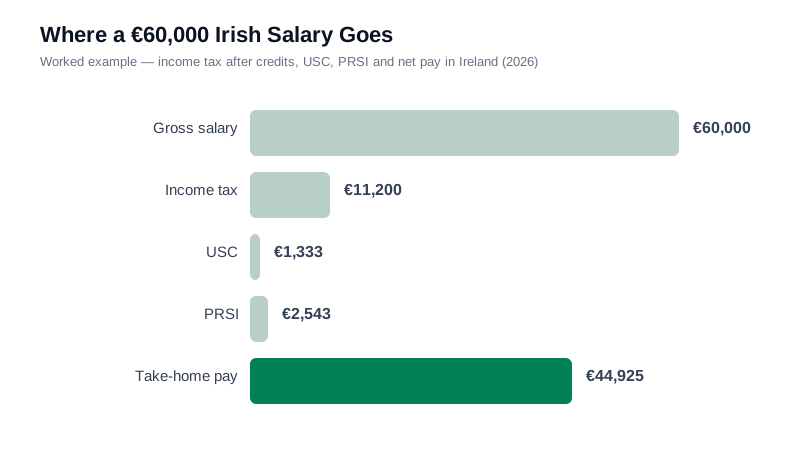
Irish income tax bands and rates (2026)
Income tax works on a cut-off system: for a single person, the first €44,000 of taxable pay is taxed at 20% (the standard rate band), and everything above it at 40%. Everyone also gets €4,000 in annual tax credits (€2,000 personal + €2,000 PAYE employee credit), which reduce the tax bill directly.
USC bands (2026)
| Band | Rate |
|---|---|
| First €12,012 | 0.5% |
| €12,012 to €28,700 | 2% |
| €28,700 to €70,044 | 3% |
| Income above €70,044 | 8% |
PRSI (2026)
Employees pay 4.2% PRSI on all earnings (rising to 4.35% from 1 October 2026) in 2026 (the rate rose from 4% in October 2025). PRSI funds State benefits including the contributory pension, and unlike income tax it has no credits or bands.
Worked example: €60,000 salary
A single person on €60,000 pays income tax of €11,200 (after credits), USC of €1,333 and PRSI of €2,543 — keeping €44,925 a year. Run your own salary through the Ireland salary calculator or see the ready-made breakdowns from €30,000 up to €80,000, including the pivotal €44,000 band-edge salary.
Rates checked October 2026. Sources: Revenue.ie, Budget 2026 measures. Estimates only — always confirm with a qualified professional for financial decisions.
Credits vs bands: which lever actually moves your bill
The two halves of the Irish income tax system get conflated constantly. Bands decide the rate: 20% up to the €44,000 cut-off, 40% above it. Credits decide the discount: €4,000 off the finished bill, whoever you are. A higher band never touches the first €44,000 — only the slice above it pays 40% — while every euro of credit is a euro not paid at all. Reading a payslip correctly means checking both: gross tax (bands at work) then tax after credits (the number that reaches your pocket).
The practical asymmetry: bands are set by income and mostly outside your control, while credits stack — rent, home carer, and other claims all add to the base. Claiming every credit is the one lever that reduces the final bill without needing a raise.
The 8% USC slice and high earners
USC is the silent third charge, and above €70,044 of income it runs at 8% on the top slice — higher than the 40% income tax band’s effective pull once credits are counted in relative terms at the margin. For high earners the three-charge stack means the top euro is taxed at 40% income tax plus 8% USC plus 4.2% PRSI, which is why the take-home tables on the salary pages fall faster above €70,000 than below it. The lesson for comparing offers at the top of the scale: quote net, not gross — the charges are not flat.
Frequently asked questions
What is the standard rate cut-off in Ireland for 2026?
€44,000 for a single or widowed person. Income below the cut-off is taxed at 20%, above it at 40%.
How many tax credits does a single person get?
€2,000 personal tax credit plus €2,000 employee (PAYE) credit — €4,000 total, which reduces income tax but not USC or PRSI.
Why is my take-home lower than a UK colleague on the same salary?
Ireland combines three charges: income tax, USC and PRSI. The combined burden at average salaries is comparable to the UK, but USC bands make the middle of the income range feel heavier.
Is USC reduced by tax credits?
No — USC runs on its own band structure (0.5%, 2%, 3%, 8% for 2026) and tax credits apply only to income tax, not to USC or PRSI.
What is the difference between the cut-off point and a tax credit?
The cut-off point (€44,000 for a single person) is a band: it decides the rate applied to each slice of income. A tax credit reduces the finished tax bill euro for euro — the €4,000 stack directly off the total.
Popular Ireland salary breakdowns
Exact 2026 take-home pay for every common salary:
- €30,000 after tax in Ireland
- €35,000 after tax in Ireland
- €36,000 after tax in Ireland
- €37,000 after tax in Ireland
- €38,000 after tax in Ireland
- €39,000 after tax in Ireland
- €40,000 after tax in Ireland
- €41,000 after tax in Ireland
- €42,000 after tax in Ireland
- €43,000 after tax in Ireland
- €44,000 after tax in Ireland
- €45,000 after tax in Ireland
- €50,000 after tax in Ireland
- €60,000 after tax in Ireland
- €70,000 after tax in Ireland
- €80,000 after tax in Ireland
Related pages
Ireland Salary Calculator
Full take-home model with USC and PRSI
Average Salary in Ireland (2026)
CSO data by sector and region
€70,000 After Tax Ireland
Take-home pay on a €70k salary
€40,000 After Tax Ireland
Take-home pay on a €40k salary
€44,000 After Tax Ireland
Take-home pay on a €44kk salary
€45,000 After Tax Ireland
Take-home pay on a €45kk salary
€50,000 After Tax Ireland
Take-home pay on a €50k salary
€60,000 After Tax Ireland
Take-home pay on a €60k salary
Sources: Irish Revenue. Rates last verified October 2026. Estimates only — see our editorial policy.