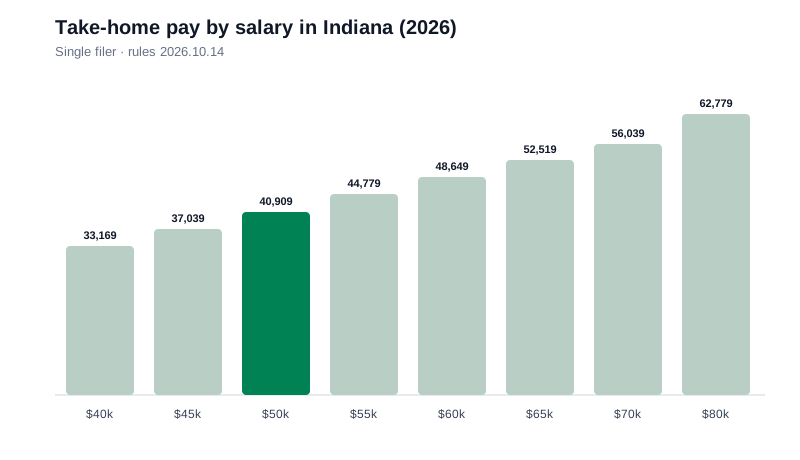
$50,000 after taxes in Indiana at a glance
| Pay period | Take-home pay |
|---|---|
| Per year | 40,909 |
| Per month | 3,409 |
| Per biweekly paycheck | 1,573 |
| Per week | 786.73 |
| Per hour (2,080-hour year) | 19.67 |
Where your $50,000 goes: the 2026 deductions
| Deduction | Amount per year |
|---|---|
| Gross salary | $50,000 |
| Federal income tax (after standard deduction) | −3,820 |
| Social Security (6.2%) | −3,100 |
| Medicare (1.45%) | −725 |
| Indiana state income tax | −1,446 |
| Take-home pay | 40,909 |
How Indiana income tax works in 2026
The versioned 2026 model uses the state’s flat 2.95% rate before any county add-on. Most Indiana counties levy their own income tax on top of the state rate, so your real withholding may run modestly higher than this estimate. At $50,000, modeled state deductions are about 1,446 (2.9% of gross).
The county-tax footnote every Indiana earner should know
The headline Indiana tax is a flat 2.95% — among the lowest state rates in the country. The footnote that changes your real payslip: most Indiana counties levy their own income tax on top, commonly around one to two percentage points, and this standard estimate excludes that layer. Budget $40,909 as the state-only floor; your actual deposit may run $50–$80 a month lighter depending on the county that appears on your pay stub.
Why a flat rate helps at $50,000
Flat-rate states never punish a raise — every dollar above the threshold costs the same 2.95% (plus the county slice), so overtime and promotions behave identically from your first hour to your last. That predictability is worth real money in a state whose wages are rising with the logistics and manufacturing build-out around Indianapolis and Fort Wayne.
The Chicago comparison, priced honestly
Northwestern Indiana commuters weigh Chicago salaries against Indiana taxes. A $50,000 job taken inside Indiana keeps $40,909 of state-model take-home; the same salary earned in Illinois — flat 4.95% — returns noticeably less, and Cook County adds layers of its own. The wage premium across the border often covers the difference, but the tax line alone favours the Indiana side by several hundred dollars a year.
One payroll election to check
Indiana taxes 401(k) deferrals the same way the federal system does, so a traditional contribution cuts both bills at once. At $50,000, a $150-a-month deferral typically lowers the combined withholding by about $25 a month — the single easiest optimization on an Indiana payslip.
More salaries after tax in Indiana
- $40,000 after tax in Indiana
- $45,000 after tax in Indiana
- $55,000 after tax in Indiana
- $60,000 after tax in Indiana
- $65,000 after tax in Indiana
- $70,000 after tax in Indiana
- $80,000 after tax in Indiana
- See the full Indiana paycheck calculator
$50,000 after tax in other states
- $50,000 after tax in California
- $50,000 after tax in Illinois
- $50,000 after tax in Michigan
- $50,000 after tax in Texas
- $50,000 after tax in Florida
- $50,000 after tax in New York
- $50,000 after tax in Pennsylvania
- $50,000 after tax in North Carolina
Frequently asked questions
What is $50,000 after taxes in Indiana?
About 40,909 a year or 3,409 a month for this standard single-filer 2026 estimate.
How much is that per month?
Approximately 3,409 per month, based on annual take-home divided by 12.
How much is that biweekly?
Approximately 1,573 across 26 pay periods.
What is the after-tax hourly rate?
About $19.67 per hour on a 2,080-hour work year.
Do Indiana counties add income tax?
Yes — most Indiana counties add their own rate on top of the state’s flat 2.95%. This standard estimate excludes the county layer, so expect slightly lower take-home on a real Indianapolis-area payslip.
How does Indiana compare to other states at $50,000?
The state tax of 1,446 is the only difference versus most of the country — a zero-tax state such as Texas keeps about 1,446 more of the same salary.