$60,000 after taxes in Indiana at a glance
| Pay period | Take-home pay |
|---|---|
| Per year | 48,649 |
| Per month | 4,054 |
| Per biweekly paycheck | 1,871 |
| Per week | 935.58 |
| Per hour (2,080-hour year) | 23.39 |
Where your $60,000 goes: the 2026 deductions
| Deduction | Amount per year |
|---|---|
| Gross salary | $60,000 |
| Federal income tax (after standard deduction) | −5,020 |
| Social Security (6.2%) | −3,720 |
| Medicare (1.45%) | −870 |
| Indiana state income tax | −1,741 |
| Take-home pay | 48,649 |
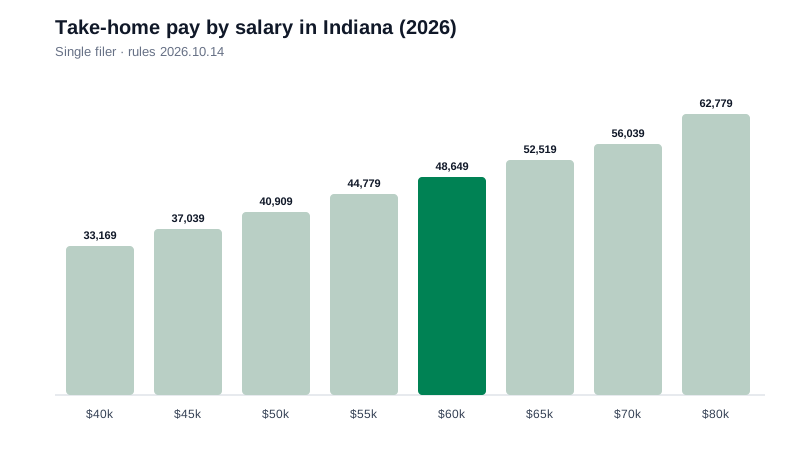
How Indiana income tax works in 2026
The versioned 2026 model uses the state’s flat 2.95% rate before any county add-on. Most Indiana counties levy their own income tax on top of the state rate, so your real withholding may run modestly higher than this estimate. At $60,000, modeled state deductions are about 1,741 (2.9% of gross).
$60,000 in Indiana: the take-home reality
Sixty thousand dollars gross converts to $48,649 in the state-only model above — roughly $4,054 a month, $1,871 biweekly, $23.39 an hour on a full working year. Indiana’s share of that is just $1,741: the flat 2.95% state rate makes the deduction table one of the shortest in this series, and the county line is the only thing between the estimate and your real payslip.
Where $4,054 a month goes in Indiana
Indiana’s cost of living does the heavy lifting at this income: median rents in Indianapolis, Fort Wayne and Evansville leave a genuinely balanced budget — roughly half for needs, a third for wants and the rest for savings, without the stretch the same salary demands on the coasts. A $60,000 earner in Marion County who avoids high county-tax suburbs can effectively live like a $70,000 earner elsewhere.
The county decision, in dollars
County income taxes vary meaningfully across Indiana’s 92 counties. A worker whose employer sits in a higher-rate county but who lives in a lower-rate one generally pays the residential county’s rate — a detail worth thirty minutes of research before choosing where to sign a lease, because at $60,000 the spread between counties can approach $40 a month.
Overtime at the flat rate
Because Indiana’s state rate never climbs, overtime hours are taxed at the same combined marginal rate as regular hours — roughly 22 cents to the state-plus-federal stack plus FICA. For shift workers in logistics and manufacturing, that flat arithmetic makes extra hours unusually easy to price.
More salaries after tax in Indiana
- $40,000 after tax in Indiana
- $45,000 after tax in Indiana
- $50,000 after tax in Indiana
- $55,000 after tax in Indiana
- $65,000 after tax in Indiana
- $70,000 after tax in Indiana
- $80,000 after tax in Indiana
- See the full Indiana paycheck calculator
$60,000 after tax in other states
- $60,000 after tax in California
- $60,000 after tax in Illinois
- $60,000 after tax in Michigan
- $60,000 after tax in Texas
- $60,000 after tax in Florida
- $60,000 after tax in New York
- $60,000 after tax in Pennsylvania
- $60,000 after tax in North Carolina
Frequently asked questions
What is $60,000 after taxes in Indiana?
About 48,649 a year or 4,054 a month for this standard single-filer 2026 estimate.
How much is that per month?
Approximately 4,054 per month, based on annual take-home divided by 12.
How much is that biweekly?
Approximately 1,871 across 26 pay periods.
What is the after-tax hourly rate?
About $23.39 per hour on a 2,080-hour work year.
Do Indiana counties add income tax?
Yes — most Indiana counties add their own rate on top of the state’s flat 2.95%. This standard estimate excludes the county layer, so expect slightly lower take-home on a real Indianapolis-area payslip.
How does Indiana compare to other states at $60,000?
The state tax of 1,741 is the only difference versus most of the country — a zero-tax state such as Texas keeps about 1,741 more of the same salary.