$70,000 after taxes in Indiana at a glance
| Pay period | Take-home pay |
|---|---|
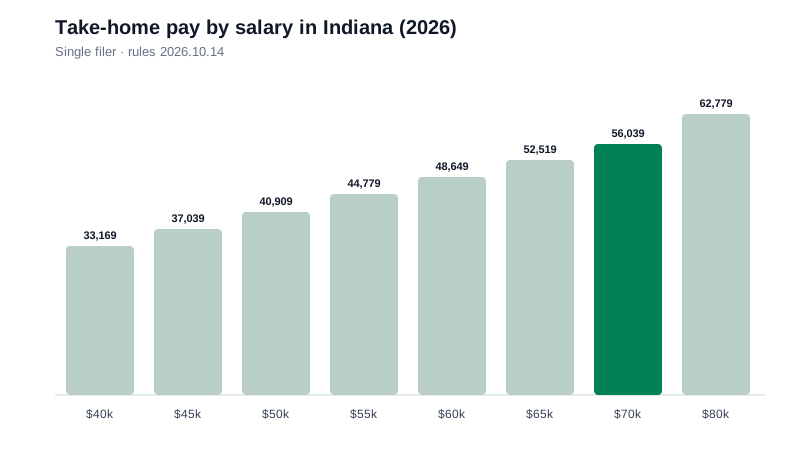
| Per year | 56,039 |
| Per month | 4,670 |
| Per biweekly paycheck | 2,155 |
| Per week | 1,077.69 |
| Per hour (2,080-hour year) | 26.94 |
Where your $70,000 goes: the 2026 deductions
| Deduction | Amount per year |
|---|---|
| Gross salary | $70,000 |
| Federal income tax (after standard deduction) | −6,570 |
| Social Security (6.2%) | −4,340 |
| Medicare (1.45%) | −1,015 |
| Indiana state income tax | −2,036 |
| Take-home pay | 56,039 |
How Indiana income tax works in 2026
The versioned 2026 model uses the state’s flat 2.95% rate before any county add-on. Most Indiana counties levy their own income tax on top of the state rate, so your real withholding may run modestly higher than this estimate. At $70,000, modeled state deductions are about 2,036 (2.9% of gross).
Saving on a $70,000 Indiana salary
At $70,000, Indiana’s flat tax produces the smallest state line in this money-page series — $2,036, about 2.9% of gross, against $56,039 of annual take-home. What separates good outcomes from great ones at this income is not the tax rate; it is what the surplus is routed into.
The 401(k) trade at the flat rate
Indiana taxes traditional deferrals the same way the federal system does, so every pre-tax dollar escapes both the 12% federal bracket and the 2.95% state rate (plus the county slice). A $400-a-month deferral at $70,000 lowers combined withholding by roughly $65 a month while adding the employer match on top — in a flat-tax state there is no bracket-cliff reason to skip it.
The Indianapolis housing arithmetic
Lenders typically offer around 4.5× gross salary, putting a $70,000 earner near $315,000 of borrowing — enough for a genuinely good single-family home in most of the Indianapolis metro, Fort Wayne or the South Bend suburbs. The practical comparison most Indiana earners run at this level is house-in-the-city versus house-in-the-county: county income-tax rates, school districts and commute costs move the total more than the mortgage rate does.
Comparing offers across state lines
Against Illinois’s 4.95% flat rate or Michigan’s 4.25% plus city taxes, Indiana’s 2.95% state rate plus county add-ons usually nets out the lightest of the three at $70,000. Against a zero-tax state such as Tennessee, the difference at this salary is roughly $2,000 a year — real money, but small enough that the job itself should decide the move.
More salaries after tax in Indiana
- $40,000 after tax in Indiana
- $45,000 after tax in Indiana
- $50,000 after tax in Indiana
- $55,000 after tax in Indiana
- $60,000 after tax in Indiana
- $65,000 after tax in Indiana
- $80,000 after tax in Indiana
- See the full Indiana paycheck calculator
$70,000 after tax in other states
- $70,000 after tax in California
- $70,000 after tax in Illinois
- $70,000 after tax in Michigan
- $70,000 after tax in Texas
- $70,000 after tax in Florida
- $70,000 after tax in New York
- $70,000 after tax in Pennsylvania
- $70,000 after tax in North Carolina
Frequently asked questions
What is $70,000 after taxes in Indiana?
About 56,039 a year or 4,670 a month for this standard single-filer 2026 estimate.
How much is that per month?
Approximately 4,670 per month, based on annual take-home divided by 12.
How much is that biweekly?
Approximately 2,155 across 26 pay periods.
What is the after-tax hourly rate?
About $26.94 per hour on a 2,080-hour work year.
Do Indiana counties add income tax?
Yes — most Indiana counties add their own rate on top of the state’s flat 2.95%. This standard estimate excludes the county layer, so expect slightly lower take-home on a real Indianapolis-area payslip.
How does Indiana compare to other states at $70,000?
The state tax of 2,036 is the only difference versus most of the country — a zero-tax state such as Texas keeps about 2,036 more of the same salary.