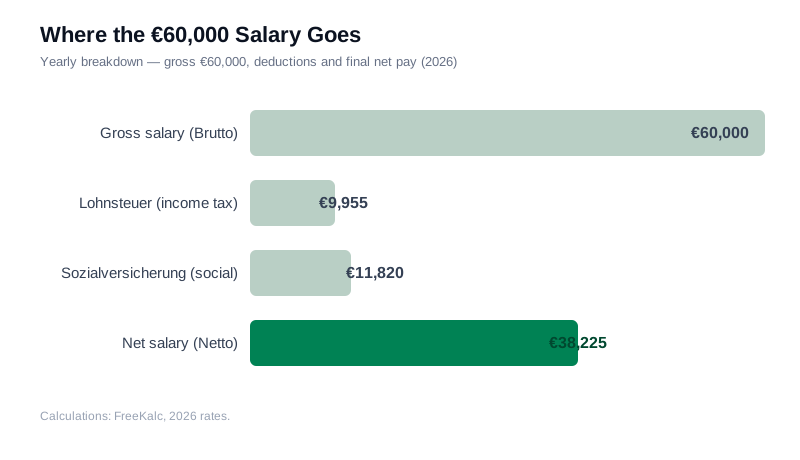
From a €60,000 brutto salary, roughly €38,447 a year is netto after tax and social contributions.
Total deductions are about 33.0% of gross — typical for a single employee in tax class I without church tax.
Understanding the German deductions
Germany combines a progressive income tax (with a €12,348 tax-free Grundfreibetrag) with high flat-rate social contributions. Health and care insurance run on a cap-free basis for most salaries, while pension contributions cap at €96,600 of gross (2026) — at €60,000 you are comfortably under it.
Your Steuerklasse matters: married couples can split income using classes IV/V or the factor method, and members of a church pay 8–9% of income tax as Kirchensteuer. Model all of these in the brutto-netto calculator, or compare with gross vs net salaries across Europe.
€60,000 brutto in netto — the month, the week, the hour
The Zeitraum view German workers actually plan around: €3,203.92 per month netto, €739.37 per week, €18.48 per hour on a standard 40-hour week. The annual figure contracts quote is €38,447 netto — remember the gross number in the contract is always the bigger Brutto figure above.
€60,000 brutto: the steepening zone
€60,000 brutto loses €21,553 to the combined stack — a 35.92166666666667% share — leaving €38,447 netto, €3,203.92 a month. The structure behind that share has changed character: Lohnsteuer is now running through the steep part of the progressive curve, and each further raise keeps less than the last.
For planning, this is the level where marginal thinking starts to matter more than average thinking. A raise from €60,000 to €65,000 adds roughly €raise_v netto — visibly less than five thousand — and the shortfall grows as the top marginal zone approaches. The deferral levers (bAV, commuting allowances, the full employee deduction set) are priced against that marginal, which is exactly why German tax-advice conversations concentrate at this level and above.
Frequently asked questions
Was bleibt von 60.000 € Brutto netto?
Etwa €38,447 netto pro Jahr (rund €3,204 pro Monat) in Steuerklasse I.
Is €60,000 a good salary in Germany?
Yes — clearly above the German full-time median of about €43,000. Comfortable in most large cities.
How much is €60,000 brutto per hour in Germany?
About €28.85 gross per hour on a 40-hour week, roughly €18.48 net.
Which deductions come off a German salary?
Lohnsteuer plus health (7.3%), care (1.8%) and pension/unemployment (10.6%) contributions. Church tax only for church members.
Which deductions come off my German salary?
Income tax (Lohnsteuer) after the €12,348 tax-free allowance, plus employee social security: 7.3% statutory health insurance, 1.8% care insurance and 10.6% pension and unemployment insurance. Church tax (8–9% of income tax) applies only to church members.
Is church tax (Kirchensteuer) included in this estimate?
No. Church tax of 8–9% of the Lohnsteuer amount is excluded, as the note above states. Members of a recognised church pay it on top — at this salary that means roughly a two-figure-to-low-three-figure euro amount per month depending on the federal state.
How much is €60,000 brutto in netto per month?
About €3,203.92 per month netto in tax class I, based on €38,447 per year after income tax and social contributions.
Estimates are for guidance only and are based on published 2026 rates for a single employee with no pension or other deductions. Always confirm with a qualified professional for financial decisions.