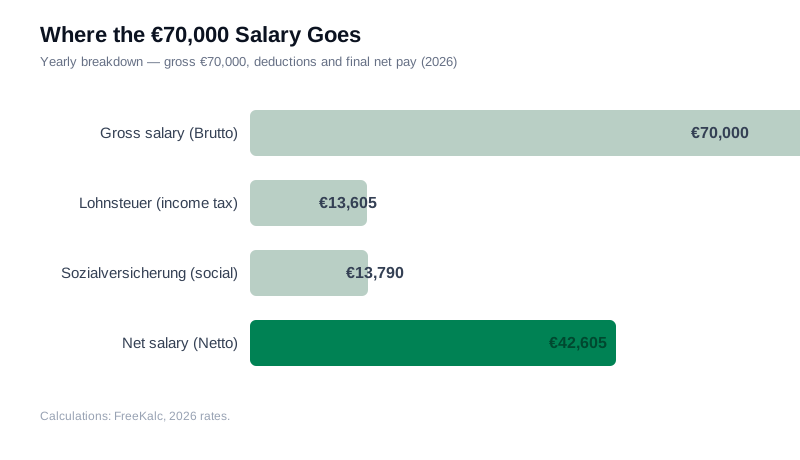
From a €70,000 brutto salary, roughly €42,943 a year is netto after tax and social contributions.
Total deductions are about 33.0% of gross — typical for a single employee in tax class I without church tax.
Understanding the German deductions
Germany combines a progressive income tax (with a €12,348 tax-free Grundfreibetrag) with high flat-rate social contributions. Health and care insurance run on a cap-free basis for most salaries, while pension contributions cap at €96,600 of gross (2026) — at €70,000 you are comfortably under it.
Your Steuerklasse matters: married couples can split income using classes IV/V or the factor method, and members of a church pay 8–9% of income tax as Kirchensteuer. Model all of these in the brutto-netto calculator, or compare with gross vs net salaries across Europe.
€70,000 brutto in netto — the month, the week, the hour
Brutto-netto conversions usually arrive as questions about the month: €3,578.58 net is what the calendar budget is built on. The year behind it is €42,943 — the figure job contracts quote, gross of everything. Per week that averages €825.83, and on a 40-hour schedule the net hourly equivalent is €20.65.
€70,000 brutto: the top of the series
€70,000 brutto closes the series with the full German stack engaged: €27,057 of deductions, a 38.652857142857144% share, €42,943 netto, €3,578.58 a month. The Lohnsteuer marginal is in the top zone of the progressive schedule; the social contributions are at or near their assessment ceilings; the remaining variables — church tax (Kirchensteuer), which this estimate excludes, and the annual reconciliation’s deduction set — are the only movers left.
The view from the top is one of legibility: every euro of gross is now priced by a rule the table above can quote. The planning moves are structural rather than scheduling — bAV deferrals against the top marginal, the equity-versus-salary mix for senior roles, and the city decision, which at €3,578 netto a month is worth more than any single raise left below this level.
Frequently asked questions
Was bleibt von 70.000 € Brutto netto?
Etwa €42,943 netto pro Jahr (rund €3,579 pro Monat) in Steuerklasse I.
Is €70,000 a good salary in Germany?
Yes — well above the German full-time median of about €43,000. Comfortable in any German city, including Munich and Frankfurt.
How much is €70,000 brutto per hour in Germany?
About €33.65 gross per hour on a 40-hour week, roughly €20.65 net.
Which deductions come off a German salary?
Lohnsteuer plus health (7.3%), care (1.8%) and pension/unemployment (10.6%) contributions. Church tax only for church members.
Which deductions come off my German salary?
Income tax (Lohnsteuer) after the €12,348 tax-free allowance, plus employee social security: 7.3% statutory health insurance, 1.8% care insurance and 10.6% pension and unemployment insurance. Church tax (8–9% of income tax) applies only to church members.
Is church tax (Kirchensteuer) included in this estimate?
No. Church tax of 8–9% of the Lohnsteuer amount is excluded, as the note above states. Members of a recognised church pay it on top — at this salary that means roughly a two-figure-to-low-three-figure euro amount per month depending on the federal state.
How much is €70,000 brutto in netto per month?
About €3,578.58 per month netto in tax class I, based on €42,943 per year after income tax and social contributions.
Estimates are for guidance only and are based on published 2026 rates for a single employee with no pension or other deductions. Always confirm with a qualified professional for financial decisions.