$27 an hour after taxes at a glance
| Pay period | Gross pay | Take-home pay |
|---|---|---|
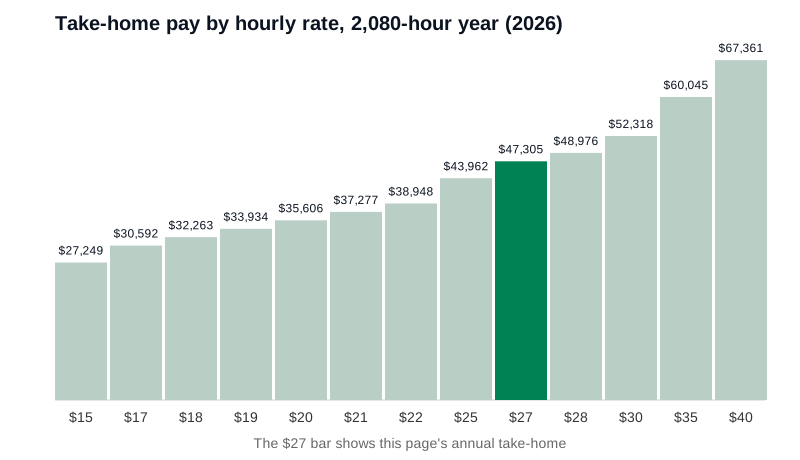
| Per year (2,080 hours) | $56,160 | $47,305 |
| Per month | $4,680 | $3,942 |
| Per biweekly paycheck | $2,160 | $1,819 |
| Per week | $1,080 | $910 |
| Per hour | $27 | $23 |
Where your $56,160 goes: the 2026 deductions
| Deduction | Amount per year |
|---|---|
| Gross annual pay ($27 × 2,080 hours) | $56,160 |
| Federal income tax (after standard deduction) | −$4,559 |
| Social Security (6.2%) | −$3,482 |
| Medicare (1.45%) | −$814 |
| Take-home pay | $47,305 |
The week, the month and the year at $27 an hour
$3,942 a month is the number to budget from: rent or mortgage, then utilities, then everything else. Across a full year that is $47,305, and it lands in the account as roughly $1,819 on each of 26 paychecks. A weekly-paid worker sees $910; a biweekly worker plans around the two months each year that carry three checks.
Overtime at $27 an hour, priced
Time-and-a-half hours at $27 pay $40.50 gross — about $32.54 after the marginal stack of federal tax, Social Security and Medicare. That is roughly eighty cents kept per overtime dollar.
Twenty-seven an hour: the support-tier ceiling
$27 an hour is where the tech-adjacent support tiers — operations, implementation, senior support — run into their ceiling before the management track begins. Full-time hours produce $56,160, of which $47,305 survives federal tax and FICA.
The planning reality at this rate: the next raise likely comes as a title change, and the federal schedule is still gentle — every additional dollar keeps about 80 cents, with the 22% bracket waiting nearly five dollars an hour above. That makes this the accumulation band: $3,942 a month with the marginal still flat is where aggressive 401(k) funding and index-saving habits get built.
More hourly rates after tax
- $15 an hour after tax
- $16 an hour after tax
- $17 an hour after tax
- $18 an hour after tax
- $19 an hour after tax
- $20 an hour after tax
- $21 an hour after tax
- $22 an hour after tax
- $23 an hour after tax
- $24 an hour after tax
- $25 an hour after tax
- $26 an hour after tax
- $28 an hour after tax
- $29 an hour after tax
- $30 an hour after tax
- $31 an hour after tax
- $32 an hour after tax
- $33 an hour after tax
- $34 an hour after tax
- $35 an hour after tax
- $36 an hour after tax
- $37 an hour after tax
- $38 an hour after tax
- $39 an hour after tax
- $40 an hour after tax
Related pages
Frequently asked questions
$27 an hour is how much a year after taxes?
At $27 an hour, a full 2,080-hour year is $56,160 gross and about $47,305 after taxes. That is $4,559 of federal income tax and $4,296 of Social Security and Medicare.
How much is $27 an hour a month after tax?
$3,942 per month. $27 an hour works out to $47,305 a year after federal income tax, Social Security and Medicare.
How much is $27 an hour a week after tax?
About $910 per week after tax ($1,819 on a biweekly paycheck). These figures assume a standard 40-hour week and the 2026 standard deduction.
What is $27 an hour per year before taxes?
$56,160 gross per year at $27 an hour, based on 2,080 hours (40 hours a week for 52 weeks). After taxes, take-home is about $47,305.
Is $27 an hour good pay in 2026?
$27 an hour is roughly the equivalent of a $56,160 annual salary — $47,305 take-home. Whether it is good depends on your state and cost of living; compare your take-home across states with the free paycheck calculator.
How much is $27 an hour annually after tax per paycheck?
$1,819 on a biweekly paycheck (26 pay periods), or $1,971 if you are paid twice a month. State income tax is not included — use the paycheck calculator for your state.
Do these figures include state income tax?
No — this is a federal-only estimate covering federal income tax, Social Security and Medicare. Most states levy their own income tax on top, which reduces the figures above; the state paycheck calculators cover the full picture.
How much is $27 an hour overtime after tax?
Time-and-a-half hours at $27 pay $40.50 gross. After the marginal federal tax and FICA stack, roughly $32.54 of that survives — about 80 cents per overtime dollar.