$37 an hour after taxes at a glance
| Pay period | Gross pay | Take-home pay |
|---|---|---|
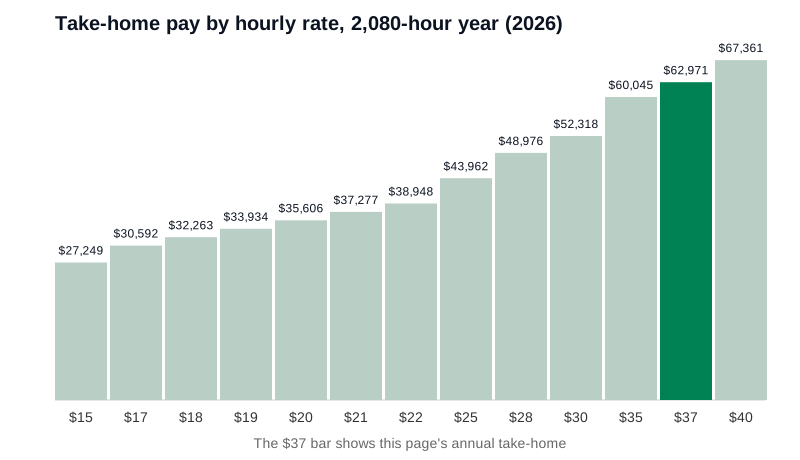
| Per year (2,080 hours) | $76,960 | $62,971 |
| Per month | $6,413 | $5,248 |
| Per biweekly paycheck | $2,960 | $2,422 |
| Per week | $1,480 | $1,211 |
| Per hour | $37 | $30 |
Where your $76,960 goes: the 2026 deductions
| Deduction | Amount per year |
|---|---|
| Gross annual pay ($37 × 2,080 hours) | $76,960 |
| Federal income tax (after standard deduction) | −$8,101 |
| Social Security (6.2%) | −$4,772 |
| Medicare (1.45%) | −$1,116 |
| Take-home pay | $62,971 |
The week, the month and the year at $37 an hour
The budgeting view: $5,247 per month, $2,422 per biweekly check, $1,211 per week. The annual figure behind those is $62,971 — and the weekly-to-monthly conversion hides a detail worth knowing: monthly figures spread the two extra biweekly checks evenly, so real cash-flow months run slightly above and below that average.
Overtime at $37 an hour, priced
Time-and-a-half hours at $37 pay $55.50 gross — about $39.04 after the marginal stack of federal tax, Social Security and Medicare. That is roughly seventy cents kept per overtime dollar.
Thirty-seven an hour: household math
$37 an hour is a $62,971-net single income in this model — or, more commonly at this level, half of a six-figure household. The budgeting figure: $5,247 a month after federal tax and FICA.
Household planning changes the bracket conversation: two earners at this rate stay inside the 22% bracket each on their own paychecks, while a single earner at double the salary would face different filing math. That asymmetry — two moderate incomes taxing gentler than one large one — is one of the few genuinely structural advantages the hourly world holds over the salaried one at this level.
More hourly rates after tax
- $15 an hour after tax
- $16 an hour after tax
- $17 an hour after tax
- $18 an hour after tax
- $19 an hour after tax
- $20 an hour after tax
- $21 an hour after tax
- $22 an hour after tax
- $23 an hour after tax
- $24 an hour after tax
- $25 an hour after tax
- $26 an hour after tax
- $27 an hour after tax
- $28 an hour after tax
- $29 an hour after tax
- $30 an hour after tax
- $31 an hour after tax
- $32 an hour after tax
- $33 an hour after tax
- $34 an hour after tax
- $35 an hour after tax
- $36 an hour after tax
- $38 an hour after tax
- $39 an hour after tax
- $40 an hour after tax
Related pages
Frequently asked questions
$37 an hour is how much a year after taxes?
At $37 an hour, a full 2,080-hour year is $76,960 gross and about $62,971 after taxes. That is $8,101 of federal income tax and $5,888 of Social Security and Medicare.
How much is $37 an hour a month after tax?
$5,248 per month. $37 an hour works out to $62,971 a year after federal income tax, Social Security and Medicare.
How much is $37 an hour a week after tax?
About $1,211 per week after tax ($2,422 on a biweekly paycheck). These figures assume a standard 40-hour week and the 2026 standard deduction.
What is $37 an hour per year before taxes?
$76,960 gross per year at $37 an hour, based on 2,080 hours (40 hours a week for 52 weeks). After taxes, take-home is about $62,971.
Is $37 an hour good pay in 2026?
$37 an hour is roughly the equivalent of a $76,960 annual salary — $62,971 take-home. Whether it is good depends on your state and cost of living; compare your take-home across states with the free paycheck calculator.
How much is $37 an hour annually after tax per paycheck?
$2,422 on a biweekly paycheck (26 pay periods), or $2,624 if you are paid twice a month. State income tax is not included — use the paycheck calculator for your state.
Do these figures include state income tax?
No — this is a federal-only estimate covering federal income tax, Social Security and Medicare. Most states levy their own income tax on top, which reduces the figures above; the state paycheck calculators cover the full picture.
How much is $37 an hour overtime after tax?
Time-and-a-half hours at $37 pay $55.50 gross. After the marginal federal tax and FICA stack, roughly $39.04 of that survives — about 70 cents per overtime dollar.