Adjust the salary, filing status, 401(k) contribution or state below — every figure on this page comes from the same 2026 rate model.
State estimates currently support single filers only.
Where does the money go — tax, FICA and take-home?
Deduction
Amount per year
Gross salary
$47,000.00
Federal income tax (after $16,100 standard deduction)
−$3,460.00
Social Security (6.2%)
−$2,914.00
Medicare (1.45%)
−$681.50
Take-home pay
$39,944.50
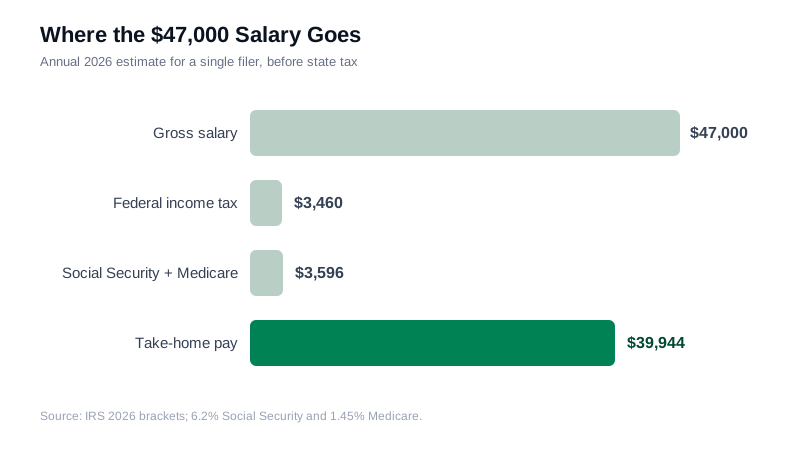
From a $47,000 gross salary, roughly $39,945 a year is take-home pay after tax and contributions.
Total deductions come to about 15.3% of gross. Federal income tax takes $3,460.00 and FICA payroll taxes take $2,914.00 (Social Security) plus $681.50 (Medicare).
Is $47,000 a good salary?
At $47,000 per year, your income is around the US individual median. In no-income-tax states like Texas, Florida or Nevada, you keep $39,944.50 ($3,328.71 per month). In California, state income tax adds roughly $1,350 in deductions, leaving around $38,450 net.
Sources:IRS and state departments of revenue. Rates last verified October 2026. Estimates only — see our editorial policy.
$47,000 after tax in every state
Where you live changes the answer more than any other factor. A $47,000 salary is taxed under the same federal rules everywhere, but state income tax ranges from $3,539 in Oregon to nothing at all in the no-income-tax states. That is a $3,539-a-year difference — $295 a month — on exactly the same gross pay. The table below runs this salary through the same 2026 model as the calculator on this page (single filer, standard deduction, state rules only — local taxes excluded).
Figures are 2026 estimates for a single filer taking the standard deduction, before any 401(k) or other pre-tax deductions. Open your state’s paycheck calculator from the table for state-specific detail, including pay-period breakdowns.
State income tax: what it does to these figures
The take-home figures on this page are federal only — Social Security, Medicare and federal income tax. State income tax comes on top, and it ranges from zero to over 10%:
Nine states charge no income tax on wages: Florida, Texas, Washington, Nevada, Tennessee, South Dakota, Wyoming, Alaska and New Hampshire — your federal figures are your real figures there.
Flat-tax states (Illinois, Pennsylvania, Indiana, Michigan and others) take a simple 2-5% of your taxable income.
High-tax states — California, New York, Hawaii, Oregon and New Jersey — can take another 6-11% at this income level, cutting your monthly net by roughly $265 (California example).
City taxes can apply too — New York City, Philadelphia, Detroit and St Louis all levy local income taxes of 1-4%.
For exact state-by-state numbers at this salary, see our take-home pay by state breakdown covering all 50 states.
What a pay rise actually pays you
At $47,000 your marginal rate is about 19.7% (federal bracket plus 7.65% FICA, before state tax), so this is what common raises actually add to your bank account:
Pay rise
Federal tax + FICA on the rise
Extra take-home
+$1,000 (to $48,000)
−$196
+$804 net
+$2,500 (to $49,500)
−$491
+$2,009 net
+$5,000 (to $52,000)
−$982
+$4,018 net
+$10,000 (to $57,000)
−$1,965
+$8,035 net
From a $2,500 raise you keep about 2,009 net, before state income tax takes its share.
Monthly budget on $47,000: the 50/30/20 rule
A common budgeting split for a federal take-home of $3,328.71 a month:
Emergency fund, 401(k) beyond the match, debt overpayments
Frequently asked questions
Is $47,000 a good salary in the US?
Yes — $47,000 is around the US individual median income and close to the national median household income. It supports comfortable living in most metros, especially in states without income tax.
How much is $47,000 a month after taxes?
A $47,000 salary yields $3,328.71 per month after federal income tax ($3,460.00), Social Security ($2,914.00) and Medicare ($681.50) for a single filer with the standard deduction and no state income tax.
How much is $47,000 an hour?
$47,000 a year works out to $22.60 gross per hour on a full-time 2,080-hour year, or roughly $19.20 an hour after federal tax and FICA (no state income tax).
What is $47,000 after taxes per week?
After federal income tax, Social Security and Medicare, $47,000 gives you $768.16 per week in take-home pay (single filer, no state income tax).
How much is $47,000 a year biweekly after taxes?
$1,536.33 every two weeks, across 26 biweekly pay periods, from a take-home of $39,944.50 per year.
$47,000 a year is how much a month after taxes?
About $3,328.71 per month take-home for a single filer with the standard deduction in 2026, before state income tax.
What is 47000 after tax?
$39,944.50 a year net — roughly $3,328.71 a month — for a single filer with the standard deduction, before state income tax.
How much tax do I pay on a $47,000 salary?
About $7,197 in federal income tax plus FICA (Social Security and Medicare) of about $3,595, leaving $39,945 take-home before state tax.