$45,000 after taxes in New Hampshire at a glance
| Pay period | Take-home pay |
|---|---|
| Per year | 38,337 |
| Per month | 3,195 |
| Per biweekly paycheck | 1,474 |
| Per week | 737.25 |
| Per hour (2,080-hour year) | 18.43 |
Where your $45,000 goes: the 2026 deductions
| Deduction | Amount per year |
|---|---|
| Gross salary | $45,000 |
| Federal income tax (after standard deduction) | −3,220 |
| Social Security (6.2%) | −2,790 |
| Medicare (1.45%) | −653 |
| New Hampshire state income tax | −0 |
| Take-home pay | 38,337 |
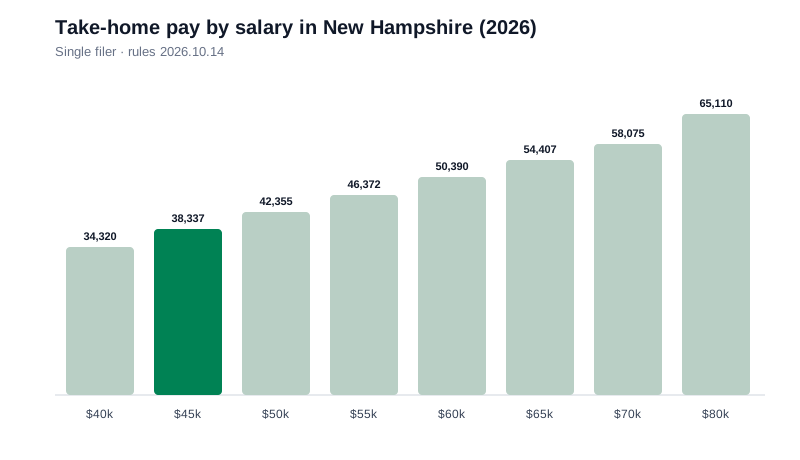
How New Hampshire income tax works in 2026
The versioned 2026 model carries a $0 state line: New Hampshire imposes no broad income tax on wages, and the state’s tax on interest and dividends was phased out entirely from 2025. Property taxes, not wage withholding, fund local services. At $45,000, modeled state deductions are about 0 (0.0% of gross).
The raise to $45,000, with no state waiting
$45,000 in New Hampshire keeps $38,337 — $3,195 a month. Arriving from $40,000, the raise was worth roughly $4,020 net, or about 80 cents per additional dollar: the only hands in the raise were federal brackets and FICA, because the state took none of it.
What a raise keeps, precisely
Below roughly $66,500 of gross salary, additional dollars cost 12% federal plus 7.65% FICA — nothing else. That fixed, legible marginal rate is New Hampshire’s quiet gift to its earners: raises, overtime and side income all price identically, and the planning question reduces entirely to federal levers.
Where the raise lands
An extra $335 a month is the difference between sharing and living alone in Manchester or Concord, or the beginnings of a serious savings rate in the Seacoast towns. In the Boston commuter belt it mostly buys proximity; two towns south it buys lifestyle. The no-sales-tax structure stretches whichever choice you make — there is no several-percent markup waiting on the first big purchase the raise funds.
More salaries after tax in New Hampshire
- $40,000 after tax in New Hampshire
- $50,000 after tax in New Hampshire
- $55,000 after tax in New Hampshire
- $60,000 after tax in New Hampshire
- $65,000 after tax in New Hampshire
- $70,000 after tax in New Hampshire
- $80,000 after tax in New Hampshire
- See the full New Hampshire paycheck calculator
$45,000 after tax in other states
- $45,000 after tax in California
- $45,000 after tax in Illinois
- $45,000 after tax in Michigan
- $45,000 after tax in Texas
- $45,000 after tax in Florida
- $45,000 after tax in New York
- $45,000 after tax in Pennsylvania
- $45,000 after tax in North Carolina
Frequently asked questions
What is $45,000 after taxes in New Hampshire?
About 38,337 a year or 3,195 a month for this standard single-filer 2026 estimate.
How much is that per month?
Approximately 3,195 per month, based on annual take-home divided by 12.
How much is that biweekly?
Approximately 1,474 across 26 pay periods.
What is the after-tax hourly rate?
About $18.43 per hour on a 2,080-hour work year.
How much federal tax is taken from $45,000?
About $3,220 for a single filer in 2026 — computed after the $16,100 standard deduction, with the 10% and 12% brackets doing the work.
How does New Hampshire compare to other states at $45,000?
New Hampshire keeps more of a paycheck than almost any state: the same $45,000 salary in Alabama, Idaho or Delaware surrenders between roughly $1,500 and $4,000 to the state that New Hampshire never collects.