$50,000 after taxes in New Hampshire at a glance
| Pay period | Take-home pay |
|---|---|
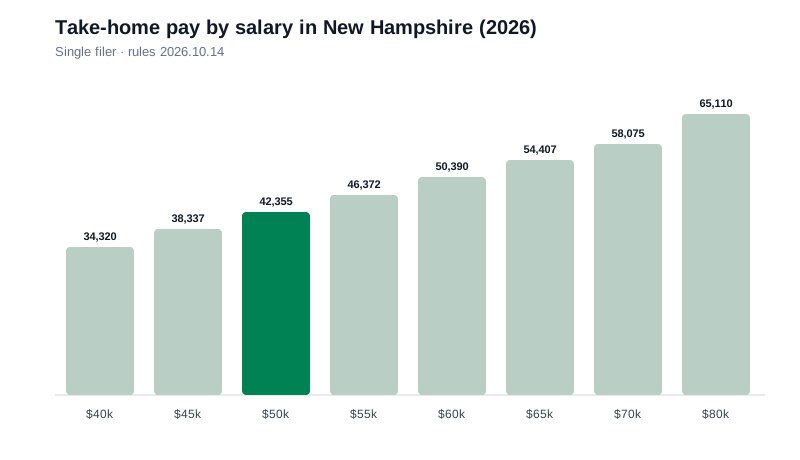
| Per year | 42,355 |
| Per month | 3,530 |
| Per biweekly paycheck | 1,629 |
| Per week | 814.52 |
| Per hour (2,080-hour year) | 20.36 |
Where your $50,000 goes: the 2026 deductions
| Deduction | Amount per year |
|---|---|
| Gross salary | $50,000 |
| Federal income tax (after standard deduction) | −3,820 |
| Social Security (6.2%) | −3,100 |
| Medicare (1.45%) | −725 |
| New Hampshire state income tax | −0 |
| Take-home pay | 42,355 |
How New Hampshire income tax works in 2026
The versioned 2026 model carries a $0 state line: New Hampshire imposes no broad income tax on wages, and the state’s tax on interest and dividends was phased out entirely from 2025. Property taxes, not wage withholding, fund local services. At $50,000, modeled state deductions are about 0 (0.0% of gross).
The $0 line: what fifty thousand keeps in New Hampshire
Every money page in this series has a state tax column; New Hampshire’s is the one that reads zero. A $50,000 salary keeps $42,355 — $3,530 a month, $20.36 an hour — with federal tax and FICA the only deductions in the table above. Against a typical taxed state, that is roughly $150 a month of extra take-home arriving before housing costs are even discussed.
Where the salary stretches
$3,530 a month behaves differently across the Granite State: it funds a genuine one-bedroom in Manchester or Concord, a shared place within commuting distance of Boston-priced jobs, or a substantially larger home than the same money buys in neighbouring Massachusetts. The absence of a state sales tax stretches it further — every purchase, from groceries to a used car, arrives without the several-percent markup most states attach.
The property-tax trade, stated plainly
New Hampshire funds its towns through some of the highest property taxes in the country — the explicit trade for having no income and no sales tax. Renters feel it indirectly through rents; homeowners see it directly on the annual bill. For a $50,000 earner the arithmetic usually still favours the New Hampshire side of the equation, but the honest comparison always includes that line.
More salaries after tax in New Hampshire
- $40,000 after tax in New Hampshire
- $45,000 after tax in New Hampshire
- $55,000 after tax in New Hampshire
- $60,000 after tax in New Hampshire
- $65,000 after tax in New Hampshire
- $70,000 after tax in New Hampshire
- $80,000 after tax in New Hampshire
- See the full New Hampshire paycheck calculator
$50,000 after tax in other states
- $50,000 after tax in California
- $50,000 after tax in Illinois
- $50,000 after tax in Michigan
- $50,000 after tax in Texas
- $50,000 after tax in Florida
- $50,000 after tax in New York
- $50,000 after tax in Pennsylvania
- $50,000 after tax in North Carolina
Frequently asked questions
What is $50,000 after taxes in New Hampshire?
About 42,355 a year or 3,530 a month for this standard single-filer 2026 estimate.
How much is that per month?
Approximately 3,530 per month, based on annual take-home divided by 12.
How much is that biweekly?
Approximately 1,629 across 26 pay periods.
What is the after-tax hourly rate?
About $20.36 per hour on a 2,080-hour work year.
Does New Hampshire tax paychecks?
No — New Hampshire levies no broad income tax on wages, and its former tax on interest and dividends was fully phased out in 2025. High property taxes are the trade-off residents accept in exchange.
How does New Hampshire compare to other states at $50,000?
New Hampshire keeps more of a paycheck than almost any state: the same $50,000 salary in Alabama, Idaho or Delaware surrenders between roughly $1,700 and $3,400 to the state that New Hampshire never collects.