$80,000 after taxes in New Hampshire at a glance
| Pay period | Take-home pay |
|---|---|
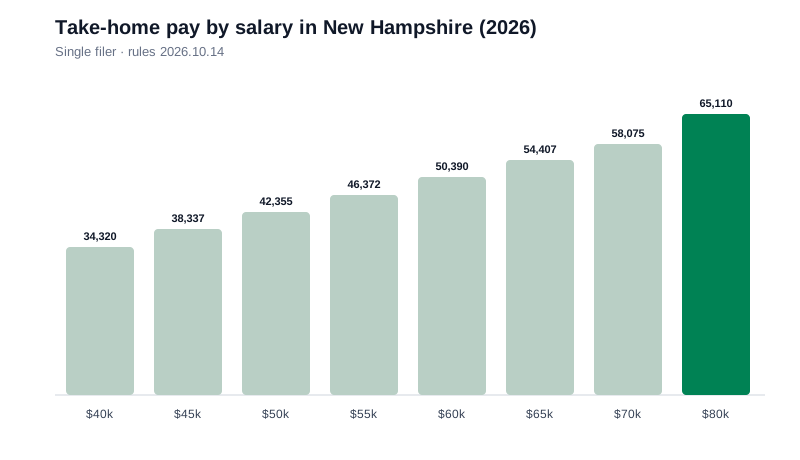
| Per year | 65,110 |
| Per month | 5,426 |
| Per biweekly paycheck | 2,504 |
| Per week | 1,252.12 |
| Per hour (2,080-hour year) | 31.30 |
Where your $80,000 goes: the 2026 deductions
| Deduction | Amount per year |
|---|---|
| Gross salary | $80,000 |
| Federal income tax (after standard deduction) | −8,770 |
| Social Security (6.2%) | −4,960 |
| Medicare (1.45%) | −1,160 |
| New Hampshire state income tax | −0 |
| Take-home pay | 65,110 |
How New Hampshire income tax works in 2026
The versioned 2026 model carries a $0 state line: New Hampshire imposes no broad income tax on wages, and the state’s tax on interest and dividends was phased out entirely from 2025. Property taxes, not wage withholding, fund local services. At $80,000, modeled state deductions are about 0 (0.0% of gross).
At $80,000: the federal bracket changes, the state still doesn’t
$80,000 in New Hampshire keeps $65,110 — $5,426 a month — after $8,770 federal and $6,120 FICA. The state line remains $0, exactly as it was at $40,000. The quiet change is federal: this is the first salary in the series whose top dollars enter the 22% bracket.
The marginal rate, in one sentence
Below roughly $66,500 of gross, additional dollars kept about 80 cents; above it, they keep about 70 — 22% federal plus 7.65% FICA, and still nothing from the state. Raises and bonuses from here on arrive at the higher federal rate, which makes the deferral levers stronger at exactly the moment the state offers no help.
Why high earners lean Roth here
In a taxed state, a traditional 401(k) deferral at $80,000 would cut a 22% federal slice plus a 5–6% state slice. Here it cuts only the federal one, so the Roth case — pay the known federal tax now, never pay any state tax on the withdrawal ever — is as strong as it gets anywhere in the country. Add the state’s no-sales-tax structure and New Hampshire’s pitch to high earners reduces to two numbers: the property tax bill, and everything else.
More salaries after tax in New Hampshire
- $40,000 after tax in New Hampshire
- $45,000 after tax in New Hampshire
- $50,000 after tax in New Hampshire
- $55,000 after tax in New Hampshire
- $60,000 after tax in New Hampshire
- $65,000 after tax in New Hampshire
- $70,000 after tax in New Hampshire
- See the full New Hampshire paycheck calculator
$80,000 after tax in other states
- $80,000 after tax in California
- $80,000 after tax in Illinois
- $80,000 after tax in Michigan
- $80,000 after tax in Texas
- $80,000 after tax in Florida
- $80,000 after tax in New York
- $80,000 after tax in Pennsylvania
- $80,000 after tax in North Carolina
Frequently asked questions
What is $80,000 after taxes in New Hampshire?
About 65,110 a year or 5,426 a month for this standard single-filer 2026 estimate.
How much is that per month?
Approximately 5,426 per month, based on annual take-home divided by 12.
How much is that biweekly?
Approximately 2,504 across 26 pay periods.
What is the after-tax hourly rate?
About $31.30 per hour on a 2,080-hour work year.
Does $80,000 push me into a higher tax bracket?
Federally, yes: the top dollars of an $80,000 salary enter the 22% federal bracket (roughly $8,770 total federal tax). The New Hampshire state treatment is described above and applies at every salary level.
How does New Hampshire compare to other states at $80,000?
New Hampshire keeps more of a paycheck than almost any state: the same $80,000 salary in Alabama, Idaho or Delaware surrenders between roughly $1,500 and $4,000 to the state that New Hampshire never collects.