$55,000 after taxes in New Hampshire at a glance
| Pay period | Take-home pay |
|---|---|
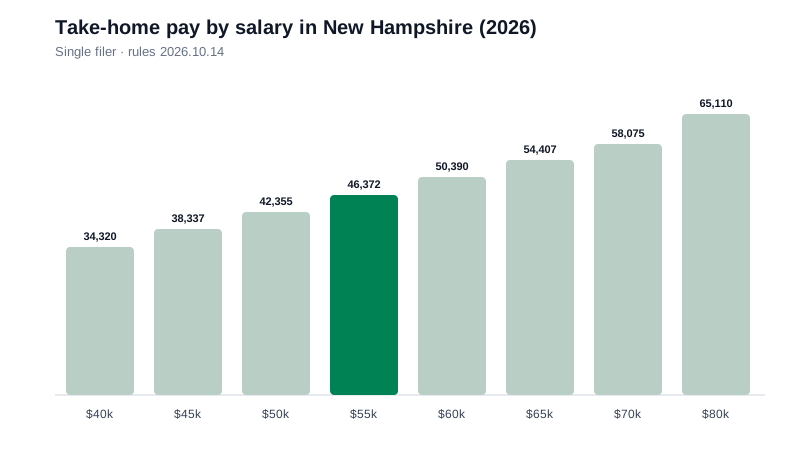
| Per year | 46,372 |
| Per month | 3,864 |
| Per biweekly paycheck | 1,784 |
| Per week | 891.77 |
| Per hour (2,080-hour year) | 22.29 |
Where your $55,000 goes: the 2026 deductions
| Deduction | Amount per year |
|---|---|
| Gross salary | $55,000 |
| Federal income tax (after standard deduction) | −4,420 |
| Social Security (6.2%) | −3,410 |
| Medicare (1.45%) | −798 |
| New Hampshire state income tax | −0 |
| Take-home pay | 46,372 |
How New Hampshire income tax works in 2026
The versioned 2026 model carries a $0 state line: New Hampshire imposes no broad income tax on wages, and the state’s tax on interest and dividends was phased out entirely from 2025. Property taxes, not wage withholding, fund local services. At $55,000, modeled state deductions are about 0 (0.0% of gross).
$55,000: mid-career with the whole state column empty
At $55,000 — $46,372 net, $3,864 a month — New Hampshire earners are making the first genuinely long-horizon decisions: household formation, a first serious investment account, a mortgage runway. The state’s contribution to those decisions is total silence: no wage tax, no dividend tax since 2025, no sales tax.
The Roth question, flipped by geography
In taxed states the standard advice leans traditional 401(k): defer now, deduct against both federal and state. In New Hampshire the deferral only reduces the federal bill — the state cannot discount a tax it never charges — so the Roth comparison genuinely shifts. Many earners here fund Roth accounts with the reasoning that no state will ever tax the withdrawal, because no state tax on this income exists to plan around.
What the missing state line funds
Against a typical taxed state, the $0 column is worth $150–$250 a month at this salary — a full Roth IRA contribution, or the gap between renting and buying in most of the state. The property-tax line remains the honest trade, and at mid-career it is the one number worth reading against any neighbouring-state offer.
More salaries after tax in New Hampshire
- $40,000 after tax in New Hampshire
- $45,000 after tax in New Hampshire
- $50,000 after tax in New Hampshire
- $60,000 after tax in New Hampshire
- $65,000 after tax in New Hampshire
- $70,000 after tax in New Hampshire
- $80,000 after tax in New Hampshire
- See the full New Hampshire paycheck calculator
$55,000 after tax in other states
- $55,000 after tax in California
- $55,000 after tax in Illinois
- $55,000 after tax in Michigan
- $55,000 after tax in Texas
- $55,000 after tax in Florida
- $55,000 after tax in New York
- $55,000 after tax in Pennsylvania
- $55,000 after tax in North Carolina
Frequently asked questions
What is $55,000 after taxes in New Hampshire?
About 46,372 a year or 3,864 a month for this standard single-filer 2026 estimate.
How much is that per month?
Approximately 3,864 per month, based on annual take-home divided by 12.
How much is that biweekly?
Approximately 1,784 across 26 pay periods.
What is the after-tax hourly rate?
About $22.29 per hour on a 2,080-hour work year.
What is $55,000 a year per hour?
About $26.44 gross per hour on a 2,080-hour work year — roughly $22.29 per hour after the deductions in this model.
How does New Hampshire compare to other states at $55,000?
New Hampshire keeps more of a paycheck than almost any state: the same $55,000 salary in Alabama, Idaho or Delaware surrenders between roughly $1,500 and $4,000 to the state that New Hampshire never collects.