£12 an hour after tax at a glance
| Pay period | Gross pay | Take-home pay |
|---|---|---|
| Per year (2,080 hours) | £24,960 | £21,491 |
| Per month | £2,080 | £1,791 |
| Per biweekly paycheck | £960 | £827 |
| Per week | £480 | £413 |
| Per hour | £12 | £10 |
Where your £24,960 goes: the 2026/27 deductions
| Deduction | Amount per year |
|---|---|
| Gross annual pay (£12 × 2,080 hours) | £24,960 |
| Income tax (after £12,570 personal allowance) | −£2,478 |
| National Insurance (8% / 2%) | −£991 |
| Take-home pay | £21,491 |
Scotland has its own income tax bands with lower thresholds — the Scottish income tax calculator shows the exact difference on the same salary.
Living on £10 an hour net: how far £21,491 stretches
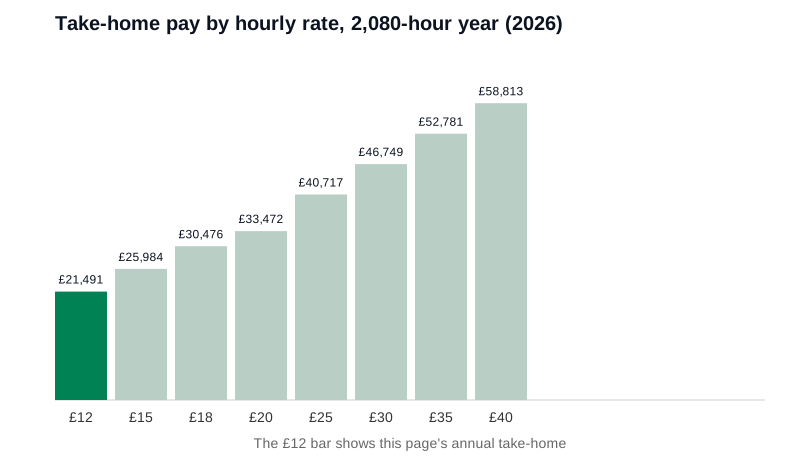
At £12 an hour your real hourly rate after deductions is close to £10 — the table above shows £10.33 once tax and National Insurance come off. That means a full-time year of 2,080 paid hours leaves you with £21,491, which sits just under half a typical UK full-time salary. It is a realistic rate for hospitality, retail supervision, entry-level care work and many driving roles, so it helps to know exactly how the money lands and what levers exist.
The 50/30/20 budget on £1,791 a month
Take-home of £1,791 a month fits the classic 50/30/20 split like this: roughly £896 for needs (rent, food, bills, transport), £537 for wants, and £358 for savings or debt repayment. Shared housing is almost essential at this level in most of southern England — a one-bedroom flat alone would swallow the entire needs budget in London, Manchester or Edinburgh. In cheaper towns and cities in the North, Wales, parts of the Midlands and Northern Ireland, the split becomes genuinely workable, which is why many people on this rate find that location matters more than any pay rise.
Why your deductions are only 28p per extra pound
Your gross £24,960 is comfortably inside the basic-rate band. Income above the £12,570 personal allowance is taxed at 20%, and employee National Insurance takes 8% between the thresholds — so each additional pound you earn is worth 72p. That 28% marginal rate is worth remembering when a zero-hours contract offers more shifts: an extra 5 hours a week at £12 adds about £60 gross and £43 net a week, roughly £2,240 a year in your pocket.
Your tax code, decoded
Most people on this wage are on tax code 1257L. The numbers mean your employer spreads the £12,570 tax-free personal allowance across the year before applying 20% to the rest. If you have a second job or changed employers mid-year, check your code on your payslip — a wrong code is the most common reason take-home differs between two people on identical hourly rates.
One quiet advantage: pension matching from day one
Auto-enrolment puts 5% of your pay into a workplace pension (about £78 a month) and forces your employer to add at least 3%. You can opt out for cash flow reasons, but at this income the government tops up every £1 you contribute with 25p in tax relief, plus the employer money — few savings accounts compete with an instant 60% boost before growth.
Rent reality check by region
Where the same £1,791 lands differently: in Belfast, Hull or Middlesbrough a room in a shared flat costs £350–£450, leaving close to £1,300 fully discretionary after bills. In Nottingham or Sheffield the same room is £450–£550. Cross into the South East or Greater London and a room alone runs £800–£1,100 — at which point the 50/30/20 rule bends into something closer to 60/30/10. If your work allows it, this arithmetic is the strongest argument for negotiating remote days rather than a higher headline rate.
One habit that compounds quietly at this income: banking the annual uprating. The minimum wage rises most Aprils, and people on £12 an hour in April 2025 sat just under the National Living Wage of £12.21. When your employer passes on the increase, move the difference into a standing order before the payslip even arrives — a raise you never see is a raise you never miss.
More UK hourly rates after tax
- £15 an hour after tax
- £18 an hour after tax
- £20 an hour after tax
- £25 an hour after tax
- £30 an hour after tax
- £35 an hour after tax
- £40 an hour after tax
Related pages
Frequently asked questions
£12 an hour is how much a year after tax UK?
At £12 an hour, a full 2,080-hour year is £24,960 gross and about £21,491 after tax. That is £2,478 of income tax and £991 of National Insurance.
How much is £12 an hour a month after tax UK?
£1,791 per month. £12 an hour works out to £21,491 a year after income tax and National Insurance.
How much is £12 an hour a week after tax?
About £413 per week after tax (£827 on a biweekly paycheck). These figures assume a standard 40-hour week and 2026/27 rates.
What is £12 an hour per year before taxes?
£24,960 gross per year at £12 an hour, based on 2,080 hours (40 hours a week for 52 weeks). After tax, take-home is about £21,491.
Is £12 an hour good pay in 2026?
£12 an hour is roughly the equivalent of a £24,960 annual salary — £21,491 take-home. Judge it against the UK average salary and your own rent and commuting costs.
Does £12 an hour take-home differ in Scotland?
Yes. Scottish income tax bands kick in earlier — the 42% rate starts at £43,663 compared with 40% at £50,271 elsewhere. Use the Scottish income tax calculator for exact Scottish figures on the same pay.