£30 an hour after tax at a glance
| Pay period | Gross pay | Take-home pay |
|---|---|---|
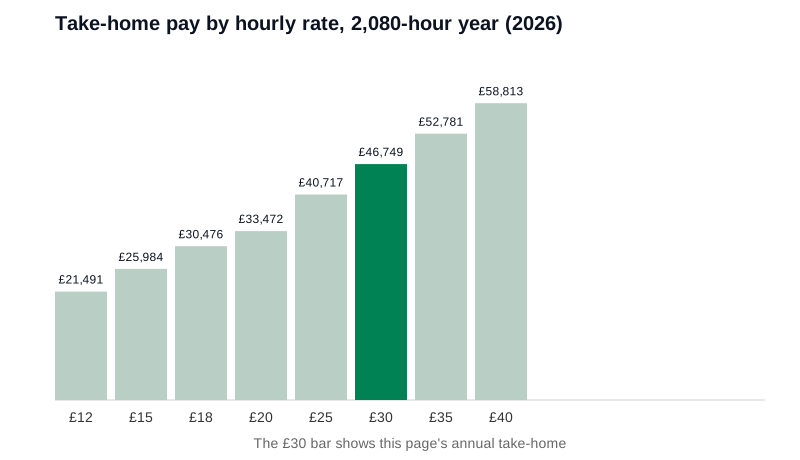
| Per year (2,080 hours) | £62,400 | £46,749 |
| Per month | £5,200 | £3,896 |
| Per biweekly paycheck | £2,400 | £1,798 |
| Per week | £1,200 | £899 |
| Per hour | £30 | £22 |
Where your £62,400 goes: the 2026/27 deductions
| Deduction | Amount per year |
|---|---|
| Gross annual pay (£30 × 2,080 hours) | £62,400 |
| Income tax (after £12,570 personal allowance) | −£12,392 |
| National Insurance (8% / 2%) | −£3,259 |
| Take-home pay | £46,749 |
Scotland has its own income tax bands with lower thresholds — the Scottish income tax calculator shows the exact difference on the same salary.
£62,400: higher-rate by default, with one family trap
Thirty pounds an hour puts your full-time gross at £62,400 and your take-home at £46,749 — £15,651 of deductions, an effective 25%. You are now £12,130 deep into the 40% band, which changes both your planning and, if you have children, your family's tax position.
The 2% surprise in your marginal rate
Because all your income above £50,270 has already passed the National Insurance upper earnings limit, HMRC takes 40% income tax but only 2% NI from each additional pound — a 42% marginal rate. Bonuses are hit identically, which is why higher earners routinely route part of any bonus into pension in the same month it is paid.
The child benefit trap between £60,000 and £80,000
If you or your partner claim child benefit, a net adjusted income of £62,400 sits inside the High Income Child Benefit Charge taper that started at £60,000. The charge claws back a slice of the benefit for every £200 of income above the threshold, pushing your true marginal rate above 50% on that portion of earnings. Two clean fixes exist: claim the benefit and pay the charge, or sacrifice enough salary into pension to fall below £60,000 — at this income roughly £200 a month does it, and it is one of the best trades in UK tax planning.
Pension relief at 40% is now automatic
Contributions through your workplace scheme receive 20% relief at source, and the further 20% comes through self-assessment. If you have not registered for self-assessment despite owing tax at 40%, you are likely leaving money with HMRC. One annual return, filled in after your pension provider issues the relief-at-source statement, restores it.
Living on £3,896 a month
With rent or a mortgage paid, this income supports genuine wealth-building: maxing a workplace pension match, funding an ISA and still affording international holidays. Financial advisers typically start being worth their fee at exactly this level, because the order you use the allowances in now outperforms the effort of saving an extra pound.
Retirement arithmetic that changes decisions
Route the £200-a-month pension contribution that fixes the child benefit taper, and after 25 years the pot holds roughly £150,000 from those contributions alone — before compounding growth, and before the 40% relief that made each pound cost you 58p. People at this income who skip pension contributions for a decade typically need a doubling of savings rate in their forties to catch up, which is a far harder habit than £200 a month today.
The second number worth pinning to the fridge: your take-home of £3,896 is roughly £46,750 a year. If your household can live on one salary at this level while the second income funds pensions and ISAs, the tax system quietly rewards that arrangement more than any savings account ever will.
More UK hourly rates after tax
- £12 an hour after tax
- £15 an hour after tax
- £18 an hour after tax
- £20 an hour after tax
- £25 an hour after tax
- £35 an hour after tax
- £40 an hour after tax
Related pages
Frequently asked questions
£30 an hour is how much a year after tax UK?
At £30 an hour, a full 2,080-hour year is £62,400 gross and about £46,749 after tax. That is £12,392 of income tax and £3,259 of National Insurance.
How much is £30 an hour a month after tax UK?
£3,896 per month. £30 an hour works out to £46,749 a year after income tax and National Insurance.
How much is £30 an hour a week after tax?
About £899 per week after tax (£1,798 on a biweekly paycheck). These figures assume a standard 40-hour week and 2026/27 rates.
What is £30 an hour per year before taxes?
£62,400 gross per year at £30 an hour, based on 2,080 hours (40 hours a week for 52 weeks). After tax, take-home is about £46,749.
Is £30 an hour good pay in 2026?
£30 an hour is roughly the equivalent of a £62,400 annual salary — £46,749 take-home. Judge it against the UK average salary and your own rent and commuting costs.
Does £30 an hour take-home differ in Scotland?
Yes. Scottish income tax bands kick in earlier — the 42% rate starts at £43,663 compared with 40% at £50,271 elsewhere. Use the Scottish income tax calculator for exact Scottish figures on the same pay.