£40 an hour after tax at a glance
| Pay period | Gross pay | Take-home pay |
|---|---|---|
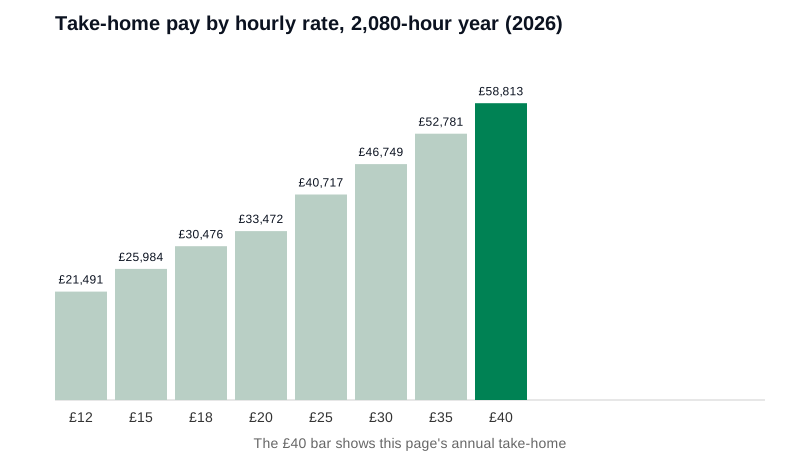
| Per year (2,080 hours) | £83,200 | £58,813 |
| Per month | £6,933 | £4,901 |
| Per biweekly paycheck | £3,200 | £2,262 |
| Per week | £1,600 | £1,131 |
| Per hour | £40 | £28 |
Where your £83,200 goes: the 2026/27 deductions
| Deduction | Amount per year |
|---|---|
| Gross annual pay (£40 × 2,080 hours) | £83,200 |
| Income tax (after £12,570 personal allowance) | −£20,712 |
| National Insurance (8% / 2%) | −£3,675 |
| Take-home pay | £58,813 |
Scotland has its own income tax bands with lower thresholds — the Scottish income tax calculator shows the exact difference on the same salary.
£83,200: strong money — and a preview of the £100,000 cliff
Forty pounds an hour across 2,080 hours is £83,200 gross, £58,813 after £24,387 of deductions — an effective rate of 29% and a marginal rate of 42% on everything above £50,270. You are £16,800 below the threshold where UK tax gets famously cruel, and this is the income at which people who plan ahead keep far more of their next promotion than people who don't.
The £100,000 trap, explained before you hit it
Above £100,000 of adjusted net income the personal allowance is withdrawn at £1 for every £2 you earn, which stacks a hidden 20% on top of the 40% and 2% — producing a marginal rate of about 60% across the £100,000–£125,140 range. It is the harshest slope in the UK system, worse than the 45% additional rate above £125,140. The fix is mechanical rather than clever: pension contributions reduce adjusted net income pound for pound, so a £16,800 sacrifice at this salary keeps you clear of the cliff, collects 40% relief, and costs your take-home about £9,700.
Bonuses at 42% — pay them where they work
Any bonus at this level lands on the 42% marginal rate. Deferring a bonus into pension in the same tax year, or spreading it across April, can matter more than the timing of the salary itself. Check with payroll how your employer handles bonus sacrifice — many run it automatically, and it is the single most valuable checkbox on the form.
Where £4,901 a month goes
This income funds a family lifestyle in nearly every UK city, a comfortable one in London, and — if directed deliberately — a mortgage overpayment plan that saves more than any tax trick on this page. The quiet advice most planners give at this level: automate the pension, the ISA and the overpayment on payday, then spend the remainder without guilt.
A note on your payslip codes
Employers often split this salary across a 1257L code and a D0 or D1 code for the upper slice. If you also have rental, dividend or freelance income, the interaction with your self-assessment payments-on-account is worth an accountant's hour in your first January — the fee typically pays for itself several times over.
Three futures from the same salary
- Do nothing: your next £16,800 of raises and bonuses faces the 42% marginal rate, and the promotion past £100,000 faces roughly 60% on the next slice. Fifteen years of drifting upward costs a six-figure sum in avoidable tax.
- Sacrifice £1,400 a month: adjusted income settles at £66,400, clear of nothing in particular yet — but the habit is in place, the pension grows by £23,520 a year with employer money, and every future raise gets absorbed before the £100,000 cliff ever touches you.
- Route bonuses too: same salary, but each annual bonus goes into pension in the month it is paid. This is the version where the £125,140 upper edge of the trap is never crossed even as gross pay passes £110,000.
The pattern to notice: none of these futures requires earning less or working less. They require deciding, before April, where the next pound lands. At £83,200 you have earned the right to make that choice deliberately.
More UK hourly rates after tax
- £12 an hour after tax
- £15 an hour after tax
- £18 an hour after tax
- £20 an hour after tax
- £25 an hour after tax
- £30 an hour after tax
- £35 an hour after tax
Related pages
Frequently asked questions
£40 an hour is how much a year after tax UK?
At £40 an hour, a full 2,080-hour year is £83,200 gross and about £58,813 after tax. That is £20,712 of income tax and £3,675 of National Insurance.
How much is £40 an hour a month after tax UK?
£4,901 per month. £40 an hour works out to £58,813 a year after income tax and National Insurance.
How much is £40 an hour a week after tax?
About £1,131 per week after tax (£2,262 on a biweekly paycheck). These figures assume a standard 40-hour week and 2026/27 rates.
What is £40 an hour per year before taxes?
£83,200 gross per year at £40 an hour, based on 2,080 hours (40 hours a week for 52 weeks). After tax, take-home is about £58,813.
Is £40 an hour good pay in 2026?
£40 an hour is roughly the equivalent of a £83,200 annual salary — £58,813 take-home. Judge it against the UK average salary and your own rent and commuting costs.
Does £40 an hour take-home differ in Scotland?
Yes. Scottish income tax bands kick in earlier — the 42% rate starts at £43,663 compared with 40% at £50,271 elsewhere. Use the Scottish income tax calculator for exact Scottish figures on the same pay.