£20 an hour after tax at a glance
| Pay period | Gross pay | Take-home pay |
|---|---|---|
| Per year (2,080 hours) | £41,600 | £33,472 |
| Per month | £3,467 | £2,789 |
| Per biweekly paycheck | £1,600 | £1,287 |
| Per week | £800 | £644 |
| Per hour | £20 | £16 |
Where your £41,600 goes: the 2026/27 deductions
| Deduction | Amount per year |
|---|---|
| Gross annual pay (£20 × 2,080 hours) | £41,600 |
| Income tax (after £12,570 personal allowance) | −£5,806 |
| National Insurance (8% / 2%) | −£2,322 |
| Take-home pay | £33,472 |
Scotland has its own income tax bands with lower thresholds — the Scottish income tax calculator shows the exact difference on the same salary.
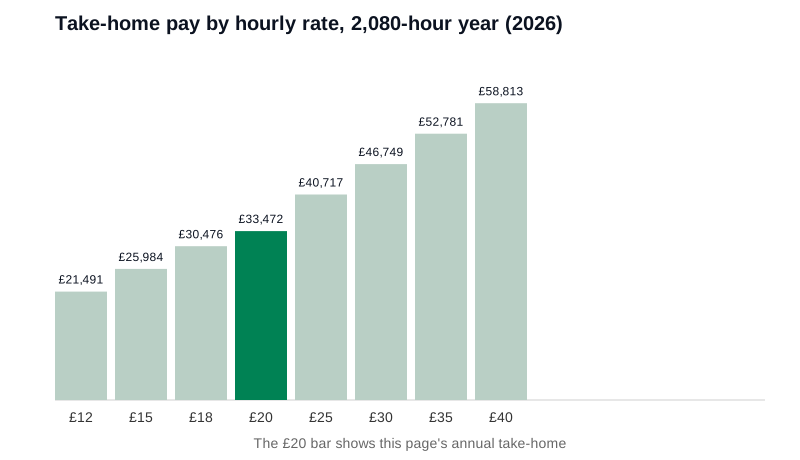
£41,600 a year: the salary where the levers multiply
Twenty pounds an hour across a standard working year is £41,600 gross — £33,472 after £8,128 of income tax and National Insurance, an effective rate near 20%. You are still a basic-rate taxpayer, but at this level the planning options get genuinely interesting.
The 50/30/20 split, funded properly
On £2,789 of monthly take-home, the classic budget allocates about £1,395 to needs, £837 to wants and £558 to savings. Unlike lower hourly rates, this version of the rule can absorb a one-bedroom flat in most regional cities and still fund an emergency fund inside a year — £558 a month is £6,700 annually, enough to reach the oft-quoted three-month cushion by next autumn.
Salary sacrifice beats a pay rise of the same size
Every pound you sacrifice into pension or benefits escapes the 20% tax and 8% National Insurance that a cash pound suffers. A £150 monthly sacrifice into your pension costs your take-home only about £108 — yet £180 lands in the pension including the employer's minimum 3%. For higher-cost benefits like extra annual leave, the same arithmetic applies through your employer's scheme.
Watch the £50,270 line before your next negotiation
Your taxable income sits about £8,600 below the higher-rate threshold. A promotion that pushes you past £50,270 changes the top slice of your salary to a 42% marginal rate (40% tax plus 2% National Insurance above the upper earnings limit). That is still a raise worth taking — but it is also the exact point where pension contributions become the highest-return tax move available to you.
Student loan riders
If a Plan 2 student loan deduction appears on your payslip, it adds 9% on earnings above the repayment threshold — a chunk that quietly changes your real marginal rate to around 37%. Because thresholds are income-tested annually, a pay rise here can partially fund itself in reduced interest accrual if you are targeting early repayment.
What a year of £20 an hour can build
Suppose you bank the full 20% slice — £558 a month. Twelve months later you hold £6,700. Applied to a first-home deposit alongside a partner doing the same, that is the classic 5% deposit on a £260,000 regional flat, roughly the mortgage a lender will offer on your £41,600 salary alone. Applied to a lifetime ISA, the government's 25% bonus adds about £1,300 a year on top.
The alternative use is equally valid: £6,700 clears most car loans, funds a career break, or builds the six-month emergency cushion that financial advisers consider the true mark of adult financial stability. At £20 an hour the income finally generates surplus — and the only real decision is which kind of surplus you want it to be.
Contract framing matters at this level too: £20 an hour and "£41,600 per annum" are the same only at a full 2,080 paid hours. Roles built on 37.5-hour weeks, long unpaid breaks or seasonal shutdowns can quietly deliver less than the headline suggests, while guaranteed-overtime contracts deliver more. Annualise the real pattern before you sign anything.
More UK hourly rates after tax
- £12 an hour after tax
- £15 an hour after tax
- £18 an hour after tax
- £25 an hour after tax
- £30 an hour after tax
- £35 an hour after tax
- £40 an hour after tax
Related pages
Frequently asked questions
£20 an hour is how much a year after tax UK?
At £20 an hour, a full 2,080-hour year is £41,600 gross and about £33,472 after tax. That is £5,806 of income tax and £2,322 of National Insurance.
How much is £20 an hour a month after tax UK?
£2,789 per month. £20 an hour works out to £33,472 a year after income tax and National Insurance.
How much is £20 an hour a week after tax?
About £644 per week after tax (£1,287 on a biweekly paycheck). These figures assume a standard 40-hour week and 2026/27 rates.
What is £20 an hour per year before taxes?
£41,600 gross per year at £20 an hour, based on 2,080 hours (40 hours a week for 52 weeks). After tax, take-home is about £33,472.
Is £20 an hour good pay in 2026?
£20 an hour is roughly the equivalent of a £41,600 annual salary — £33,472 take-home. Judge it against the UK average salary and your own rent and commuting costs.
Does £20 an hour take-home differ in Scotland?
Yes. Scottish income tax bands kick in earlier — the 42% rate starts at £43,663 compared with 40% at £50,271 elsewhere. Use the Scottish income tax calculator for exact Scottish figures on the same pay.