£35 an hour after tax at a glance
| Pay period | Gross pay | Take-home pay |
|---|---|---|
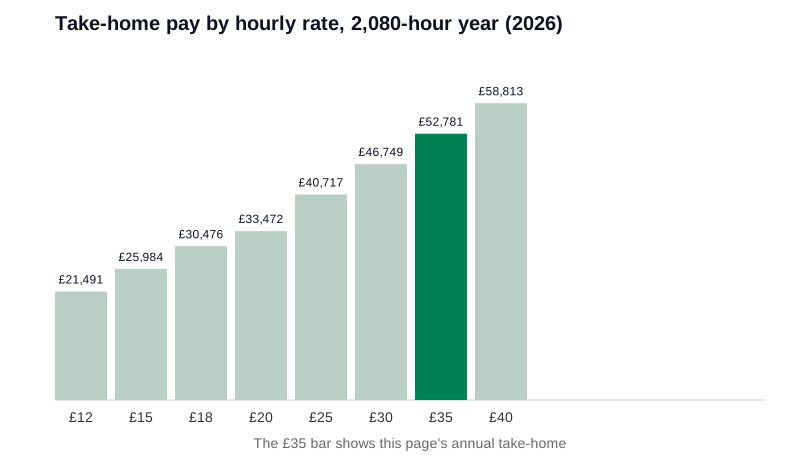
| Per year (2,080 hours) | £72,800 | £52,781 |
| Per month | £6,067 | £4,398 |
| Per biweekly paycheck | £2,800 | £2,030 |
| Per week | £1,400 | £1,015 |
| Per hour | £35 | £25 |
Where your £72,800 goes: the 2026/27 deductions
| Deduction | Amount per year |
|---|---|
| Gross annual pay (£35 × 2,080 hours) | £72,800 |
| Income tax (after £12,570 personal allowance) | −£16,552 |
| National Insurance (8% / 2%) | −£3,467 |
| Take-home pay | £52,781 |
Scotland has its own income tax bands with lower thresholds — the Scottish income tax calculator shows the exact difference on the same salary.
£72,800: deep in the 40% band and inside the child-benefit taper
At £35 an hour your standard working year grosses £72,800 — £52,781 net after £20,019 of deductions, an effective rate just under 28%. The interesting part of this income is not the headline tax but the bands you now straddle, because each planning decision moves thousands rather than hundreds.
Your top £22,530 works at 42%
Everything above £50,270 is taxed at 40% with only 2% National Insurance — so your true marginal rate is 42%, and every overtime hour at £35 puts £20.30 in your pocket. The trap to avoid is letting small pay rises drift in unnoticed: they are real money, but a fifth of each one belongs to HMRC unless it is routed somewhere useful first.
Child benefit is now almost fully reclaimed
For families with children, £72,800 sits well inside the £60,000–£80,000 High Income Child Benefit Charge zone — the taper here reclaims most of the benefit and adds roughly another 10 percentage points to your marginal rate across that span. The charge is the lower-earning partner's problem only in appearance: it is assessed on whoever has the higher adjusted income, so the household remedy is either pension sacrifice by the higher earner or a formal decision to forgo the benefit and stop filing for it.
Two allowances worth the paperwork
At this salary you should be in self-assessment. That opens doors basic-rate taxpayers never see: 40% relief on gift-aided donations, marriage allowance is closed to you but additional-rate pension planning is not, and — most powerfully — carrying forward unused pension allowance from the previous three years. A £16,800 contribution this year both cuts adjusted income below the taper band and uses allowance that would otherwise expire.
What £4,398 a month buys
Take-home at this level absorbs a family mortgage, a car and school-age childcare in most of the UK outside central London, with room left for the pension and ISA habits that make the £100,000 threshold less painful when a future promotion arrives. Speaking of which — the next section is worth reading before that day comes.
Take-home with the sacrifice applied
Contribute £16,800 a year (£1,400 a month) into pension and your adjusted net income falls to £56,000 — below the child benefit taper floor, out of the charge entirely. Your payslip take-home drops to roughly £43,000 a year or £3,580 a month, but the pension receives £23,520 including employer contributions at 3%. The household keeps every pound of child benefit, avoids the self-assessment charge, and converts money taxed at 42% into money taxed at zero until retirement.
The counter-argument is cash flow: £1,400 a month is a serious commitment. A staged version works too — £800 a month drops adjusted income to £63,200, reduces the charge substantially, and can be raised after the next pay review. The taper is calculated on adjusted net income, so every pound sacrificed works immediately, in-year, without waiting for HMRC paperwork.
More UK hourly rates after tax
- £12 an hour after tax
- £15 an hour after tax
- £18 an hour after tax
- £20 an hour after tax
- £25 an hour after tax
- £30 an hour after tax
- £40 an hour after tax
Related pages
Frequently asked questions
£35 an hour is how much a year after tax UK?
At £35 an hour, a full 2,080-hour year is £72,800 gross and about £52,781 after tax. That is £16,552 of income tax and £3,467 of National Insurance.
How much is £35 an hour a month after tax UK?
£4,398 per month. £35 an hour works out to £52,781 a year after income tax and National Insurance.
How much is £35 an hour a week after tax?
About £1,015 per week after tax (£2,030 on a biweekly paycheck). These figures assume a standard 40-hour week and 2026/27 rates.
What is £35 an hour per year before taxes?
£72,800 gross per year at £35 an hour, based on 2,080 hours (40 hours a week for 52 weeks). After tax, take-home is about £52,781.
Is £35 an hour good pay in 2026?
£35 an hour is roughly the equivalent of a £72,800 annual salary — £52,781 take-home. Judge it against the UK average salary and your own rent and commuting costs.
Does £35 an hour take-home differ in Scotland?
Yes. Scottish income tax bands kick in earlier — the 42% rate starts at £43,663 compared with 40% at £50,271 elsewhere. Use the Scottish income tax calculator for exact Scottish figures on the same pay.