$50,000 after taxes in Arizona at a glance
| Pay period | Take-home pay |
|---|---|
| Per year | 41,499 |
| Per month | 3,458 |
| Per biweekly paycheck | 1,596 |
| Per week | 798.06 |
| Per hour (2,080-hour year) | 19.95 |
Where your $50,000 goes: the 2026 deductions
| Deduction | Amount per year |
|---|---|
| Gross salary | $50,000 |
| Federal income tax (after standard deduction) | −3,820 |
| Social Security (6.2%) | −3,100 |
| Medicare (1.45%) | −725 |
| Arizona state income tax | −856 |
| Take-home pay | 41,499 |
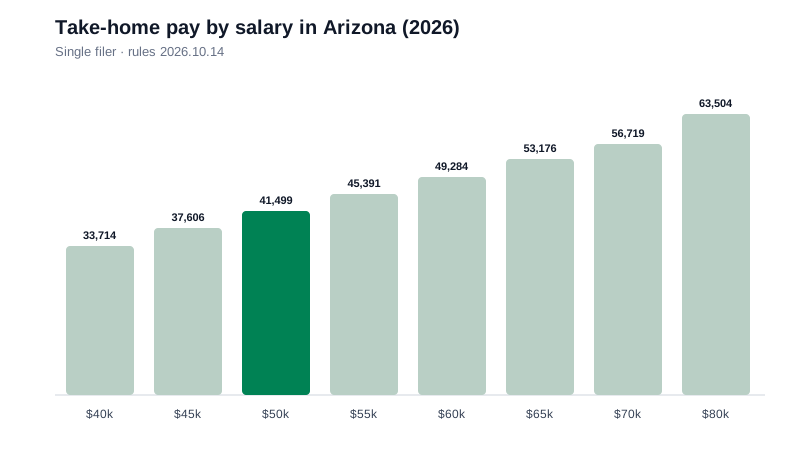
How Arizona income tax works in 2026
The versioned 2026 model uses Arizona’s flat 2.5% rate. Because filers are instructed to use the 2025 single-filer standard deduction ($15,750) until final 2026 figures are published, this estimate is provisional and worth re-checking in the new year. At $50,000, modeled state deductions are about 856 (1.7% of gross).
Flat 2.5%: what it means for a $50,000 salary
Arizona runs one of the lowest income-tax rates in the country — a single flat 2.5% on taxable income — which is why the state line in the deduction table above is just $856. After federal tax and FICA, a $50,000 salary keeps $41,499, and the state of Arizona is the smallest reason anything is missing from it.
Why flat beats progressive at this salary
In a progressive state, the last dollars of a $50,000 salary often face the state’s upper-middle brackets. In Arizona every dollar faces the same 2.5%, so raises, overtime and bonuses all cost exactly the same per dollar — there is no cliff to plan around and no year-end surprise from crossing a threshold mid-year.
The standard-deduction footnote
Arizona’s own standard deduction is unusually large — $15,750 for a single filer in the figure filers are instructed to use for 2026 estimates — which shrinks the taxable base the 2.5% applies to. That combination of a big deduction and a tiny rate is why Arizona’s effective tax on a middle salary lands among the very lightest in the nation, and why the $856 figure behaves predictably in both directions: higher salaries pay the same rate on a modestly larger base, nothing more.
Living on $3,458 a month in Phoenix
Monthly take-home of $3,458 spreads comfortably across the Phoenix metro — rents have climbed with the city’s growth but remain below coastal parity, and no local income tax exists anywhere in Arizona. Tucson and the smaller metros stretch the same money further still. For a $50,000 earner choosing between Phoenix and a zero-tax alternative, the tax line alone is worth about $70 a month before housing costs even enter the comparison.
More salaries after tax in Arizona
- $40,000 after tax in Arizona
- $45,000 after tax in Arizona
- $55,000 after tax in Arizona
- $60,000 after tax in Arizona
- $65,000 after tax in Arizona
- $70,000 after tax in Arizona
- $80,000 after tax in Arizona
- See the full Arizona paycheck calculator
$50,000 after tax in other states
- $50,000 after tax in California
- $50,000 after tax in Illinois
- $50,000 after tax in Michigan
- $50,000 after tax in Texas
- $50,000 after tax in Florida
- $50,000 after tax in New York
- $50,000 after tax in Pennsylvania
- $50,000 after tax in North Carolina
Frequently asked questions
What is $50,000 after taxes in Arizona?
About 41,499 a year or 3,458 a month for this standard single-filer 2026 estimate.
How much is that per month?
Approximately 3,458 per month, based on annual take-home divided by 12.
How much is that biweekly?
Approximately 1,596 across 26 pay periods.
What is the after-tax hourly rate?
About $19.95 per hour on a 2,080-hour work year.
Is Arizona’s flat tax reliable for planning?
The 2.5% flat rate itself is settled law. The only provisional element is the standard deduction amount used for 2026 estimates, which the state instructs filers to base on the 2025 figure ($15,750) until final numbers publish.
How does Arizona compare to other states at $50,000?
The state tax of 856 is the only difference versus most of the country — a zero-tax state such as Texas keeps about 856 more of the same salary.