$80,000 after taxes in Arizona at a glance
| Pay period | Take-home pay |
|---|---|
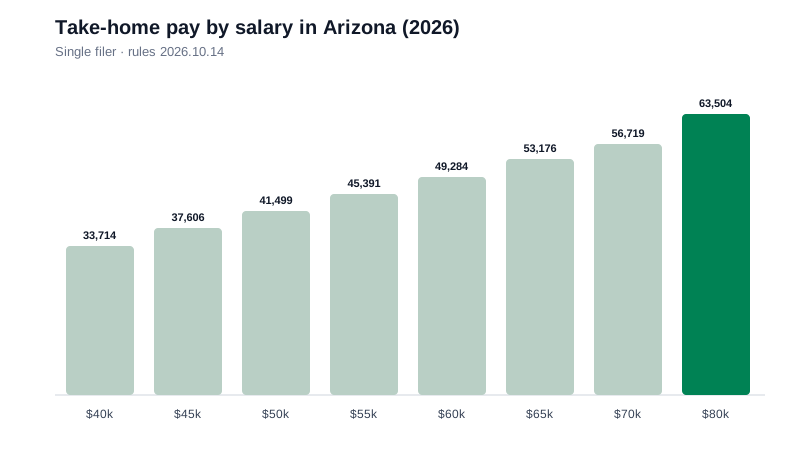
| Per year | 63,504 |
| Per month | 5,292 |
| Per biweekly paycheck | 2,442 |
| Per week | 1,221.23 |
| Per hour (2,080-hour year) | 30.53 |
Where your $80,000 goes: the 2026 deductions
| Deduction | Amount per year |
|---|---|
| Gross salary | $80,000 |
| Federal income tax (after standard deduction) | −8,770 |
| Social Security (6.2%) | −4,960 |
| Medicare (1.45%) | −1,160 |
| Arizona state income tax | −1,606 |
| Take-home pay | 63,504 |
How Arizona income tax works in 2026
The versioned 2026 model uses Arizona’s flat 2.5% rate. Because filers are instructed to use the 2025 single-filer standard deduction ($15,750) until final 2026 figures are published, this estimate is provisional and worth re-checking in the new year. At $80,000, modeled state deductions are about 1,606 (2.0% of gross).
High earning under Arizona’s flat rate
$80,000 in Arizona keeps $63,504 — $5,292 a month — after $8,770 federal, $6,120 FICA and $1,606 of state tax. That state line, 2% of gross and capped by no bracket at all, is the quiet reason Arizona features in so many retirement-planning conversations.
The 22% bracket arrives; the state stays flat
The meaningful change at $80,000 is federal: top dollars above roughly $66,500 of gross enter the 22% bracket, so raises and bonuses keep less than they did at $45,000. Arizona’s response is unchanged and simple — the flat 2.5% applies to every salary identically — so the deferral math is transparent: a traditional 401(k) dollar escapes 22% federal + 2.5% state, roughly 25 cents of immediate relief.
The retirement simplicity, compounded
Arizona does not tax Social Security, and the flat rate means retirement withdrawals are taxed at the same 2.5% as wages — no bracket arbitrage, no planning cliff, no reason to time income across state lines. At $80,000 the whole state-level retirement question reduces to one sentence, which is more than most states can say.
More salaries after tax in Arizona
- $40,000 after tax in Arizona
- $45,000 after tax in Arizona
- $50,000 after tax in Arizona
- $55,000 after tax in Arizona
- $60,000 after tax in Arizona
- $65,000 after tax in Arizona
- $70,000 after tax in Arizona
- See the full Arizona paycheck calculator
$80,000 after tax in other states
- $80,000 after tax in California
- $80,000 after tax in Illinois
- $80,000 after tax in Michigan
- $80,000 after tax in Texas
- $80,000 after tax in Florida
- $80,000 after tax in New York
- $80,000 after tax in Pennsylvania
- $80,000 after tax in North Carolina
Frequently asked questions
What is $80,000 after taxes in Arizona?
About 63,504 a year or 5,292 a month for this standard single-filer 2026 estimate.
How much is that per month?
Approximately 5,292 per month, based on annual take-home divided by 12.
How much is that biweekly?
Approximately 2,442 across 26 pay periods.
What is the after-tax hourly rate?
About $30.53 per hour on a 2,080-hour work year.
Does $80,000 push me into a higher tax bracket?
Federally, yes: the top dollars of an $80,000 salary enter the 22% federal bracket (roughly $8,770 total federal tax). The Arizona state treatment is described above and applies at every salary level.
How does Arizona compare to other states at $80,000?
The state tax of 1,606 is the only difference versus most of the country — a zero-tax state such as Texas keeps about 1,606 more of the same salary.