$70,000 after taxes in Arizona at a glance
| Pay period | Take-home pay |
|---|---|
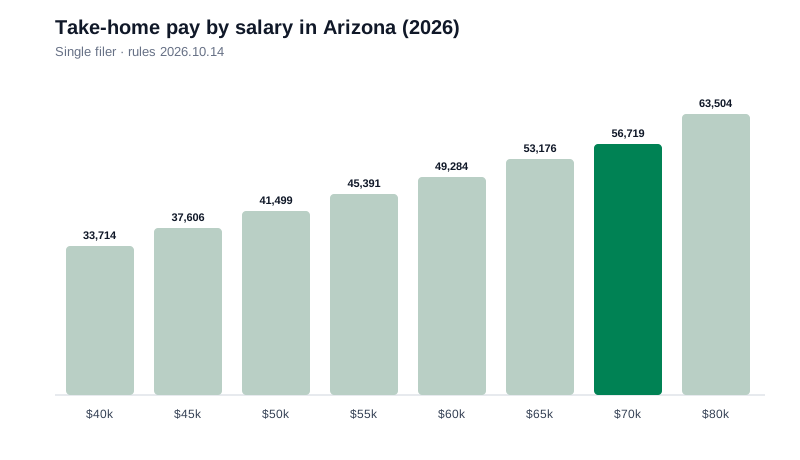
| Per year | 56,719 |
| Per month | 4,727 |
| Per biweekly paycheck | 2,182 |
| Per week | 1,090.75 |
| Per hour (2,080-hour year) | 27.27 |
Where your $70,000 goes: the 2026 deductions
| Deduction | Amount per year |
|---|---|
| Gross salary | $70,000 |
| Federal income tax (after standard deduction) | −6,570 |
| Social Security (6.2%) | −4,340 |
| Medicare (1.45%) | −1,015 |
| Arizona state income tax | −1,356 |
| Take-home pay | 56,719 |
How Arizona income tax works in 2026
The versioned 2026 model uses Arizona’s flat 2.5% rate. Because filers are instructed to use the 2025 single-filer standard deduction ($15,750) until final 2026 figures are published, this estimate is provisional and worth re-checking in the new year. At $70,000, modeled state deductions are about 1,356 (1.9% of gross).
The California comparison: why $70,000 goes further in Phoenix
At $70,000, Arizona’s entire state income-tax line is $1,356 — about $113 a month. The same salary inside California’s schedule surrenders roughly $1,200 more per year to the state. The take-home above, $56,719, is therefore one of the strongest results in this state series, and the reason relocation math from coastal California has become one of the most common calculations in the American job market.
The same salary, two states
Stack the border difference at $70,000 and the California side loses about $1,200 more per year of state-level tax than the Arizona side — money that in Phoenix funds a full year of a starter retirement contribution, or most of a lease on a good car. Employers on the California side often price part of that tax burden into higher wages, but rarely all of it at this salary level.
Your marginal rate on the next dollar
Arizona’s flat 2.5% plus the federal 12% bracket plus 7.65% FICA means each additional dollar keeps about 78 cents — among the friendliest marginal stacks at this income anywhere in the country. Bonuses, overtime and raises all behave identically, and the federal 22% bracket is still comfortably above this salary after the standard deduction.
Retirement planning under a flat rate
Arizona does not tax Social Security benefits, and its flat 2.5% applies equally in retirement — there is no bracket arbitrage between working years and drawing years, so the traditional-versus-Roth decision at $70,000 is purely a federal question. In practice that makes Arizona one of the simplest states in the country to plan a long horizon in: the state variable is small and unchanging, and the federal levers are the only ones worth optimizing.
More salaries after tax in Arizona
- $40,000 after tax in Arizona
- $45,000 after tax in Arizona
- $50,000 after tax in Arizona
- $55,000 after tax in Arizona
- $60,000 after tax in Arizona
- $65,000 after tax in Arizona
- $80,000 after tax in Arizona
- See the full Arizona paycheck calculator
$70,000 after tax in other states
- $70,000 after tax in California
- $70,000 after tax in Illinois
- $70,000 after tax in Michigan
- $70,000 after tax in Texas
- $70,000 after tax in Florida
- $70,000 after tax in New York
- $70,000 after tax in Pennsylvania
- $70,000 after tax in North Carolina
Frequently asked questions
What is $70,000 after taxes in Arizona?
About 56,719 a year or 4,727 a month for this standard single-filer 2026 estimate.
How much is that per month?
Approximately 4,727 per month, based on annual take-home divided by 12.
How much is that biweekly?
Approximately 2,182 across 26 pay periods.
What is the after-tax hourly rate?
About $27.27 per hour on a 2,080-hour work year.
Is Arizona’s flat tax reliable for planning?
The 2.5% flat rate itself is settled law. The only provisional element is the standard deduction amount used for 2026 estimates, which the state instructs filers to base on the 2025 figure ($15,750) until final numbers publish.
How does Arizona compare to other states at $70,000?
The state tax of 1,356 is the only difference versus most of the country — a zero-tax state such as Texas keeps about 1,356 more of the same salary.