$60,000 after taxes in Arizona at a glance
| Pay period | Take-home pay |
|---|---|
| Per year | 49,284 |
| Per month | 4,107 |
| Per biweekly paycheck | 1,896 |
| Per week | 947.77 |
| Per hour (2,080-hour year) | 23.69 |
Where your $60,000 goes: the 2026 deductions
| Deduction | Amount per year |
|---|---|
| Gross salary | $60,000 |
| Federal income tax (after standard deduction) | −5,020 |
| Social Security (6.2%) | −3,720 |
| Medicare (1.45%) | −870 |
| Arizona state income tax | −1,106 |
| Take-home pay | 49,284 |
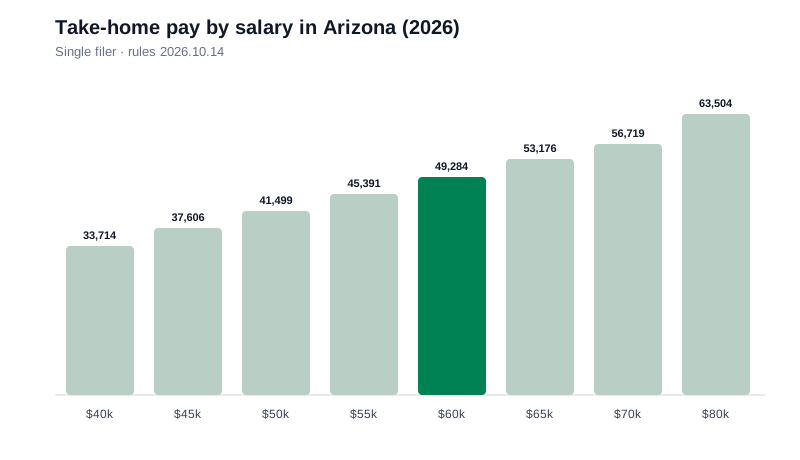
How Arizona income tax works in 2026
The versioned 2026 model uses Arizona’s flat 2.5% rate. Because filers are instructed to use the 2025 single-filer standard deduction ($15,750) until final 2026 figures are published, this estimate is provisional and worth re-checking in the new year. At $60,000, modeled state deductions are about 1,106 (1.8% of gross).
$60,000 in Arizona versus the neighbours
The table above tells the state side plainly: Arizona takes $1,106 of a $60,000 salary, leaving $49,284 — about $4,107 a month. The interesting comparison is geographic, because Arizona sits next to California, and the two states tax the same salary in entirely different universes.
The California border, in dollars
California’s progressive schedule with a small standard deduction takes roughly $700 more per year from the same $60,000 than Arizona’s flat 2.5% does — and the gap widens fast as salaries climb. It is the clearest illustration in this series of why the state column matters as much as the salary line, and why remote workers relocating from California to Phoenix effectively give themselves a quiet raise.
Why overtime is easy to price here
Arizona’s flat rate means every additional dollar earns the same treatment: 12% federal, 7.65% FICA, 2.5% state — roughly 78 cents kept per dollar. Shift workers in Phoenix logistics and health care can price extra hours without bracket math, and raises never trigger a state-rate cliff the way progressive schedules do.
What the surplus funds at $4,107 a month
The Phoenix metro at this income supports a one-bedroom alone or a two-bedroom shared, a funded Roth IRA, and a real car payment without strain. The state’s growth has pushed housing up faster than wages in recent years, so the practical advice at $60,000 is the same everywhere: let the flat tax rate be the one line you never worry about, and spend your planning energy on the housing market instead.
More salaries after tax in Arizona
- $40,000 after tax in Arizona
- $45,000 after tax in Arizona
- $50,000 after tax in Arizona
- $55,000 after tax in Arizona
- $65,000 after tax in Arizona
- $70,000 after tax in Arizona
- $80,000 after tax in Arizona
- See the full Arizona paycheck calculator
$60,000 after tax in other states
- $60,000 after tax in California
- $60,000 after tax in Illinois
- $60,000 after tax in Michigan
- $60,000 after tax in Texas
- $60,000 after tax in Florida
- $60,000 after tax in New York
- $60,000 after tax in Pennsylvania
- $60,000 after tax in North Carolina
Frequently asked questions
What is $60,000 after taxes in Arizona?
About 49,284 a year or 4,107 a month for this standard single-filer 2026 estimate.
How much is that per month?
Approximately 4,107 per month, based on annual take-home divided by 12.
How much is that biweekly?
Approximately 1,896 across 26 pay periods.
What is the after-tax hourly rate?
About $23.69 per hour on a 2,080-hour work year.
Is Arizona’s flat tax reliable for planning?
The 2.5% flat rate itself is settled law. The only provisional element is the standard deduction amount used for 2026 estimates, which the state instructs filers to base on the 2025 figure ($15,750) until final numbers publish.
How does Arizona compare to other states at $60,000?
The state tax of 1,106 is the only difference versus most of the country — a zero-tax state such as Texas keeps about 1,106 more of the same salary.