$50,000 after taxes in Virginia at a glance
| Pay period | Take-home pay |
|---|---|
| Per year | 40,241 |
| Per month | 3,353 |
| Per biweekly paycheck | 1,548 |
| Per week | 773.87 |
| Per hour (2,080-hour year) | 19.35 |
Where your $50,000 goes: the 2026 deductions
| Deduction | Amount per year |
|---|---|
| Gross salary | $50,000 |
| Federal income tax (after standard deduction) | −3,820 |
| Social Security (6.2%) | −3,100 |
| Medicare (1.45%) | −725 |
| Virginia state income tax | −2,114 |
| Take-home pay | 40,241 |
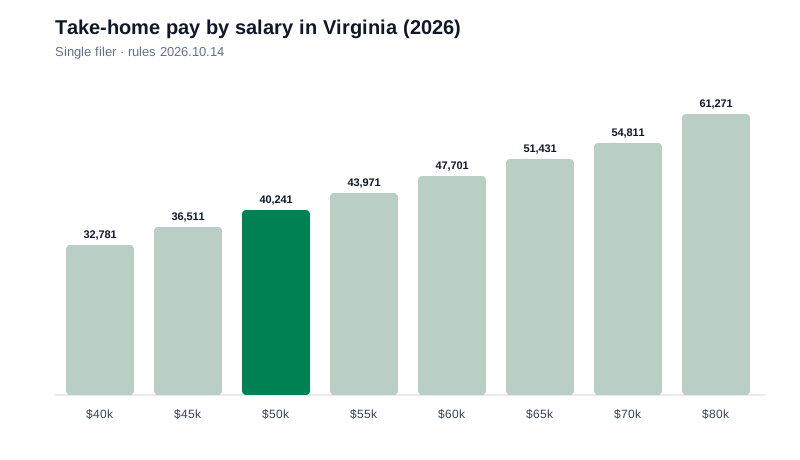
How Virginia income tax works in 2026
The versioned 2026 model uses Virginia’s progressive schedule, with the 5.75% top rate applying to the last dollars earned at this salary. Virginia levies no local income taxes, so the state line on your payslip is the whole state story. At $50,000, modeled state deductions are about 2,114 (4.2% of gross).
A $50,000 salary in Virginia: where it lands
$50,000 is a genuinely mid-career salary in most of Virginia — entry-level in Northern Virginia, comfortable in Richmond or Roanoke. After the deductions in the table above, $40,241 arrives in your account across the year, and the geography you earn it in decides how far that stretches. The same take-home funds a one-bedroom apartment alone in Richmond or a shared place within commuting distance of Arlington; the salary itself never changes, but the housing line under it changes by hundreds of dollars a month from one end of the state to the other.
The 5.75% band is already yours
Virginia’s progressive schedule reaches its 5.75% top rate at a modest taxable income, so by $50,000 your last dollars earned are already taxed at the full state rate. Stack the federal 12% bracket and the 7.65% FICA pair on top and each additional dollar keeps roughly 74 cents. That makes overtime worthwhile but predictable — no bracket cliff is coming, because you are already through it.
One lever works twice in Virginia
Because Virginia taxes the same income the federal system taxes, a traditional 401(k) deferral reduces both bills in the same payroll cycle. At this salary, routing $200 a month pre-tax cuts federal and state withholding immediately and typically softens the year-end reconciliation as well — the efficient move in a state with no local add-ons and no deduction games to play.
More salaries after tax in Virginia
- $40,000 after tax in Virginia
- $45,000 after tax in Virginia
- $55,000 after tax in Virginia
- $60,000 after tax in Virginia
- $65,000 after tax in Virginia
- $70,000 after tax in Virginia
- $80,000 after tax in Virginia
- See the full Virginia paycheck calculator
$50,000 after tax in other states
- $50,000 after tax in California
- $50,000 after tax in Illinois
- $50,000 after tax in Michigan
- $50,000 after tax in Texas
- $50,000 after tax in Florida
- $50,000 after tax in New York
- $50,000 after tax in Pennsylvania
- $50,000 after tax in North Carolina
Frequently asked questions
What is $50,000 after taxes in Virginia?
About 40,241 a year or 3,353 a month for this standard single-filer 2026 estimate.
How much is that per month?
Approximately 3,353 per month, based on annual take-home divided by 12.
How much is that biweekly?
Approximately 1,548 across 26 pay periods.
What is the after-tax hourly rate?
About $19.35 per hour on a 2,080-hour work year.
Does Virginia have local income tax?
No. Virginia state payroll withholding is the only income tax on wages — unlike Pennsylvania or Michigan, no Virginia city or county adds its own layer.
How does Virginia compare to other states at $50,000?
The state tax of 2,114 is the only difference versus most of the country — a zero-tax state such as Texas keeps about 2,114 more of the same salary.