$65,000 after taxes in Virginia at a glance
| Pay period | Take-home pay |
|---|---|
| Per year | 51,431 |
| Per month | 4,286 |
| Per biweekly paycheck | 1,978 |
| Per week | 989.06 |
| Per hour (2,080-hour year) | 24.73 |
Where your $65,000 goes: the 2026 deductions
| Deduction | Amount per year |
|---|---|
| Gross salary | $65,000 |
| Federal income tax (after standard deduction) | −5,620 |
| Social Security (6.2%) | −4,030 |
| Medicare (1.45%) | −943 |
| Virginia state income tax | −2,976 |
| Take-home pay | 51,431 |
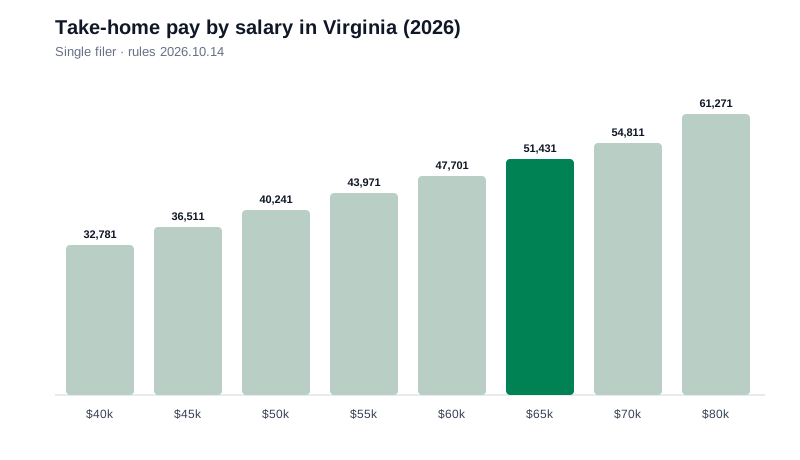
How Virginia income tax works in 2026
The versioned 2026 model uses Virginia’s progressive schedule, with the 5.75% top rate applying to the last dollars earned at this salary. Virginia levies no local income taxes, so the state line on your payslip is the whole state story. At $65,000, modeled state deductions are about 2,976 (4.6% of gross).
$65,000: the planning years in Virginia
$65,000 in Virginia produces $51,431 of take-home — $4,286 a month — with the state taking $2,976 and the federal schedule $5,620. This is the salary band where Virginia’s two structural advantages start doing real work: no local income taxes anywhere, and a retirement system that goes easy on seniors.
Mortgage capacity, in Virginia terms
Lenders typically offer around 4.5× gross salary — roughly $292,500 at $65,000 — which buys a genuine single-family home in Richmond’s residential neighbourhoods, much of Hampton Roads, or the outer NoVA suburbs. The same borrowing capacity in Arlington buys a condo with a longer commute, which is why Virginia’s internal geography functions like a second salary.
The commuter’s ledger
At $65,000 the DC-versus-Virginia decision is worth revisiting: Virginia’s 5.75% ceiling against DC’s higher schedule saves roughly a thousand dollars a year at this level, while NoVA housing costs hand some of it back. Remote and hybrid arrangements change the calculus again — the tax line follows where the work is performed.
The retirement trade, previewed
Virginia does not tax Social Security and exempts much retirement-plan income. At $65,000 the standard move is aggressive traditional 401(k) deferral: taxes are cut now at the full 5.75% plus 12% federal, and the eventual withdrawal is taxed far lighter by the state.
More salaries after tax in Virginia
- $40,000 after tax in Virginia
- $45,000 after tax in Virginia
- $50,000 after tax in Virginia
- $55,000 after tax in Virginia
- $60,000 after tax in Virginia
- $70,000 after tax in Virginia
- $80,000 after tax in Virginia
- See the full Virginia paycheck calculator
$65,000 after tax in other states
- $65,000 after tax in California
- $65,000 after tax in Illinois
- $65,000 after tax in Michigan
- $65,000 after tax in Texas
- $65,000 after tax in Florida
- $65,000 after tax in New York
- $65,000 after tax in Pennsylvania
- $65,000 after tax in North Carolina
Frequently asked questions
What is $65,000 after taxes in Virginia?
About 51,431 a year or 4,286 a month for this standard single-filer 2026 estimate.
How much is that per month?
Approximately 4,286 per month, based on annual take-home divided by 12.
How much is that biweekly?
Approximately 1,978 across 26 pay periods.
What is the after-tax hourly rate?
About $24.73 per hour on a 2,080-hour work year.
How much is $65,000 a month in Virginia?
About $5,417 gross per month, or 4,286 per month after federal tax, FICA and Virginia state income tax in this standard 2026 estimate.
How does Virginia compare to other states at $65,000?
The state tax of 2,976 is the only difference versus most of the country — a zero-tax state such as Texas keeps about 2,976 more of the same salary.